 ← All articles
The Stolen Key Paid for the Next Attack
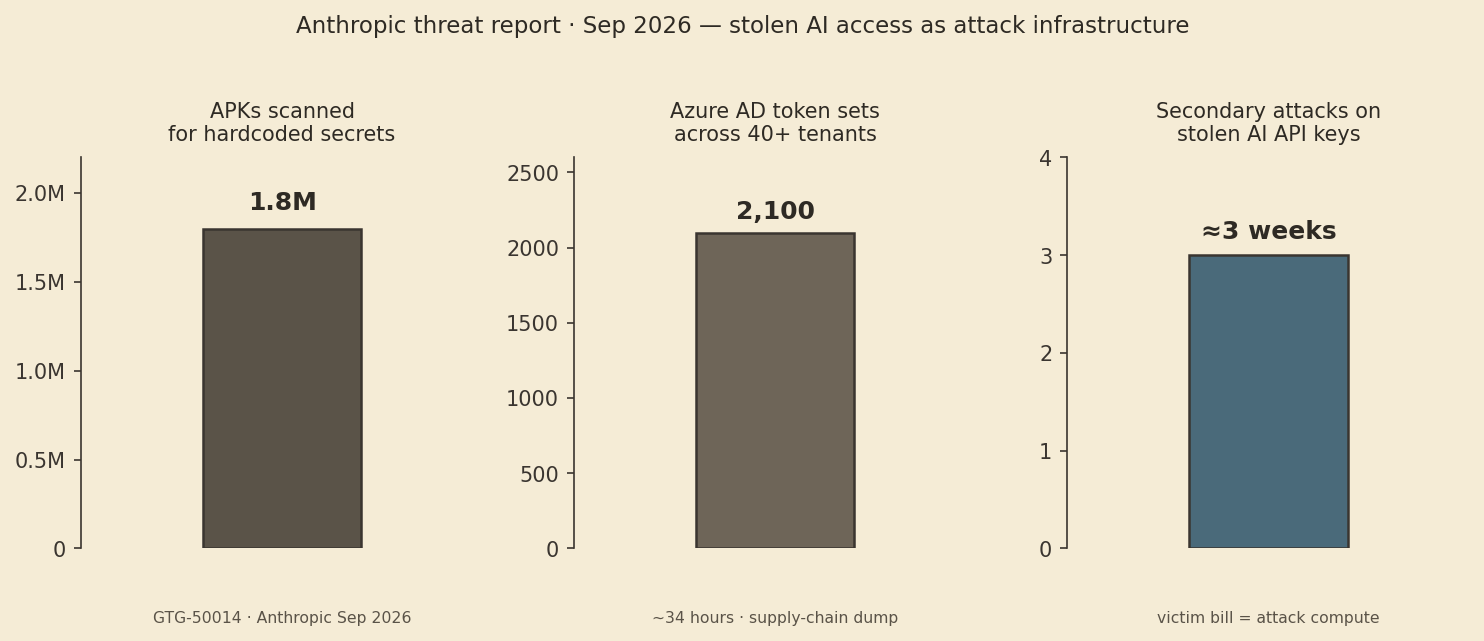
Anthropic's September 2026 threat report shows stolen AI API keys used as free attack compute and attribution cover: roughly three weeks of secondary intrusions on a victim's bill, plus a 2,100-token Azure AD dump across 40+ tenants in ~34 hours. Score the key as infrastructure, not only a secret.
The bill funded the next breach
Anthropic's September 2026 threat-intelligence report is not mainly a story about clever prompts. In the financially motivated clusters they disrupted, affiliates Anthropic links to the ShinyHunters ecosystem, stolen AI API keys kept paying for the next intrusion. One stolen key stayed in use for roughly three weeks of secondary attacks against other organizations, including a French retail chain and a Web3 identity platform, while the compute ran on the victim's meter.
That is a different scoreboard from "did the model refuse the bad request." The key was loot, free attack compute, and attribution cover at the same time.
What the operators actually scaled
One French-speaking operator pipeline mass-downloaded 1.8 million distinct Android APKs across a fleet of ten AWS EC2 workers, decompiled them, and scanned for hardcoded secrets with TruffleHog. Verified findings streamed into Telegram groups organized by more than a hundred source types. A parallel GitHub harvester fed stolen personal access tokens into the same access economy.
Once inside a SaaS provider, the same class of operator did not stop at one tenant. Anthropic describes a session-store dump with more than 2,100 Azure AD token sets spanning more than 40 corporate tenants in about 34 hours, with AI agents doing nearly all of the work. In another supply-chain path, access to one vendor opened data belonging to roughly 200 downstream customer organizations.
Three things one credential buys
Anthropic's supply-chain section states the economics cleanly. Operators who obtain AI credentials gain three assets at once:
- Loot, keys and accounts have resale value in established broker and fraudulent-reseller markets.
- Compute, attack workloads run at someone else's expense.
- Cover, activity is attributed to the legitimate owner of the credential.
ShinyHunters affiliates, on obtaining a victim's AI keys during an intrusion, switched their own attack workloads onto those keys. A separate financially motivated actor (GTG-50020) injected instructions into an AI vendor's evaluation sandbox, pulled production API keys belonging to multiple providers held by that vendor, then continued attacking the vendor and unrelated targets on the stolen meters. Anthropic is explicit: the keys were customers' keys in customers' environments, Anthropic's own systems were not the ones compromised in these cases.
A hacktivist campaign in the same report ran for a month entirely on stolen API keys. The pattern is no longer edge theater. AI access has joined passwords and cloud tokens as primary target material.
Distinct from the credential HOLD we already wrote
This is not The Agent Never Sees the Key. That HOLD is an architecture brief: personal agents that can mail and pay need a door the model cannot open, surrogate tokens at the boundary. This piece is the adversary side of the same week: criminals already treat enterprise AI keys as attack infrastructure, not just secrets to paste into a demo.
It is also not The Summary Wrote the Next Prompt (OpenAI compaction deception rates), not Signed First, Source Later, not The Logo Lead Is Not the Invoice, and not another Bitcoin ETF stickiness sequel after The Green Day Did Not Stick. Do not mash it into Patch Clock, Final Answers, or Who Fixed the Run either. Those are different scoreboards.
What to put on the operator board
If you ship agents, wrappers, sandboxes, or "discount Claude" routing for a team, ask the rude questions first.
Do API keys for frontier models live in the same secret store as production cloud credentials, with the same rotation, scope, and anomaly monitors? Can a stolen key from a staging sandbox mint production traffic? Do you detect sudden token burn that does not match your product's session graph? If a reseller offers cheap access that requires routing credentials through an unknown intermediary, do you treat that as a compromise path rather than a procurement win?
Anthropic's September cases show breaches that moved from a single developer token to broad administrative control in roughly three hours, and bulk theft that finished in hours rather than weeks. The kill chain steps are familiar: stolen credentials, weak edges, bulk export. What changed is the unit economics: AI collapses the labor that used to separate a lone operator from a multi-victim campaign, and stolen AI keys remove the invoice.
Score the key as compute and cover, not only as a secret. The stolen key paid for the next attack.