 ← All articles
The Scoreboard Measured the Scaffold
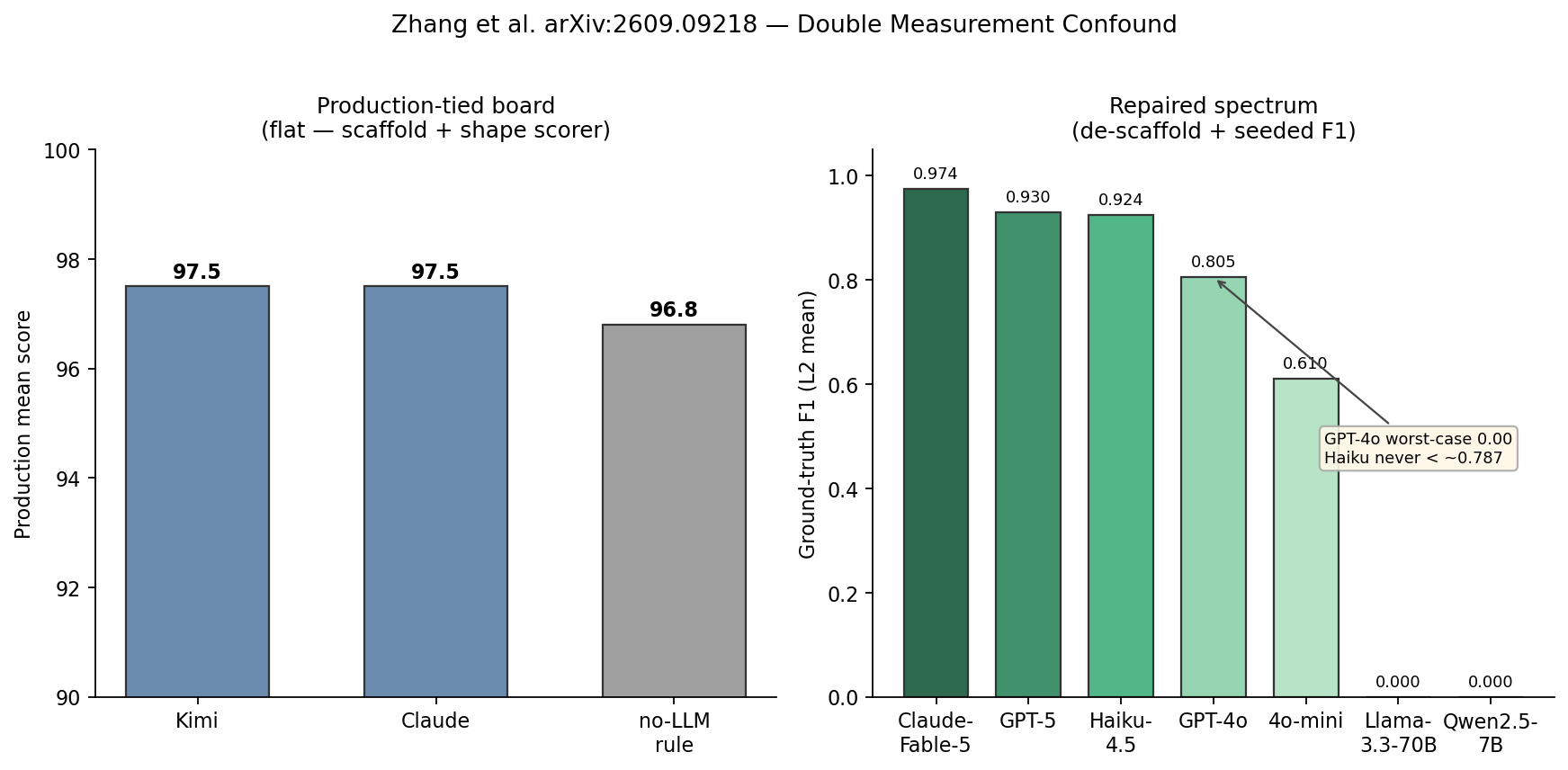
Zhang et al. (arXiv:2609.09218) show ComtradeBench production scores of 97.5 for Kimi and Claude while a no-LLM rule script scores 96.8. Joint repair opens a spectrum from Claude-Fable-5 at 0.974 F1 to floor models at 0.000. Ask who owns retries, not just the mean.
Two labs, one identical 97.5
On September 6, 2026, Zhang and co-authors posted The Double Measurement Confound in Agent Benchmarks (arXiv:2609.09218). The headline on ComtradeBench's production config is almost rude: Kimi and Claude both print mean 97.5. A rule-based script with no LLM at all scores 96.8. Two unrelated open models, Qwen2.5-7B and Llama-3.3-70B, also receive byte-identical per-seed scores under that setup.
If your procurement sheet ranks labs by that board, you are ranking the harness.
What the scaffold owned
ComtradeBench is a seeded adversarial trade-data tool-use task: fetch every page of a mock API, deduplicate, submit a cleaned record set with metadata and a run log. In the production scaffold (L0), execution-critical decisions, retries, pagination, submit, sit in the fixed loop. The model fills templated slots. The shipped scorer grades output shape and self-reported metadata, not seeded ground truth.
The paper's probe is blunt. A fabricated record set scores 0.987 under the shape scorer, the same number as the correct ground-truth payload. Shape credit does not care whether the rows are true. So the leaderboard can look frontier-tight while the model never owned the failure modes the task claims to measure.
Joint repair opens a spectrum
Neither fix alone is enough. De-scaffold to L2 so the model owns retries, pagination, and submit, but keep the shape scorer, and differences stay misgraded. Keep the production scaffold and switch only the scorer, and you still measure the harness. Remove both artifacts together: slim execution ownership to the model, and score submissions as ground-truth F1 against seeded truth.
Then the flat board becomes a graded spectrum. Claude-Fable-5 leads on mean ground-truth F1 at about 0.974 (worst case about 0.824). GPT-5 and Claude-Haiku-4.5 cluster near 0.930 and 0.924. GPT-4o sits mid by mean (~0.805) but reaches a worst-case of 0.00. The smaller Claude-Haiku-4.5 never falls below about 0.787. Llama-3.3-70B and Qwen2.5-7B floor at 0.000, marshaling failures under L2, not "almost as good as Claude on the old board."
That reorder is the operator fact. Mean ranks and reliability ranks are not the same column.
τ-bench is not innocent either
The confound is not unique to ComtradeBench. On τ-bench, the authors find the four native scaffolds shift the same model's reward by up to 0.267 and reorder rankings. Scaffold ownership is an uncontrolled axis wherever they probed. A number quoted without its scaffolding level is not interpretable, full stop.
Ask two questions before you trust a mean
If you buy or build agents against a public board, put two lines above the mean:
- Who owns retries, pagination, and submit, the model or the fixed scaffold?
- Does the scorer check seeded ground truth, or only shape and self-reported metadata?
If the answer to (1) is "the scaffold" and (2) is "shape," a 97.5 next to a 96.8 rule script is not a model race. It is a harness echo. Run your own tickets with ownership and scoring declared. Prefer worst-case and Reliability@τ next to the mean. GPT-4o's mid mean with a 0.00 floor is exactly why.
Not cost-per-solve, not corpus, not session
This is not Same Solve, Five Times the Cost. HarnessTax holds the model fixed and varies the coding shell's invoice. This paper holds the task fixed and shows when the score measured the scaffold and the shape judge instead of the model.
It is not The Harness Became the Corpus (training on harness trails), The Harness Opened / The Session Did Not (control-plane ownership), Final Answers Are Weak Evidence, The Summary Wrote the Next Prompt, or Scratchpad Is Shrinking. Those are different thermometers. This one is measurement validity: construct claims versus what the loop actually graded.
Primary source: Zhang et al., The Double Measurement Confound in Agent Benchmarks: De-Scaffolding, Ground-Truth Scoring, and Reliability Beyond the Mean, arXiv:2609.09218 (6 Sep 2026). PDF on disk for this draft batch.