 ← All articles
The Rebound Was Not Unanimous
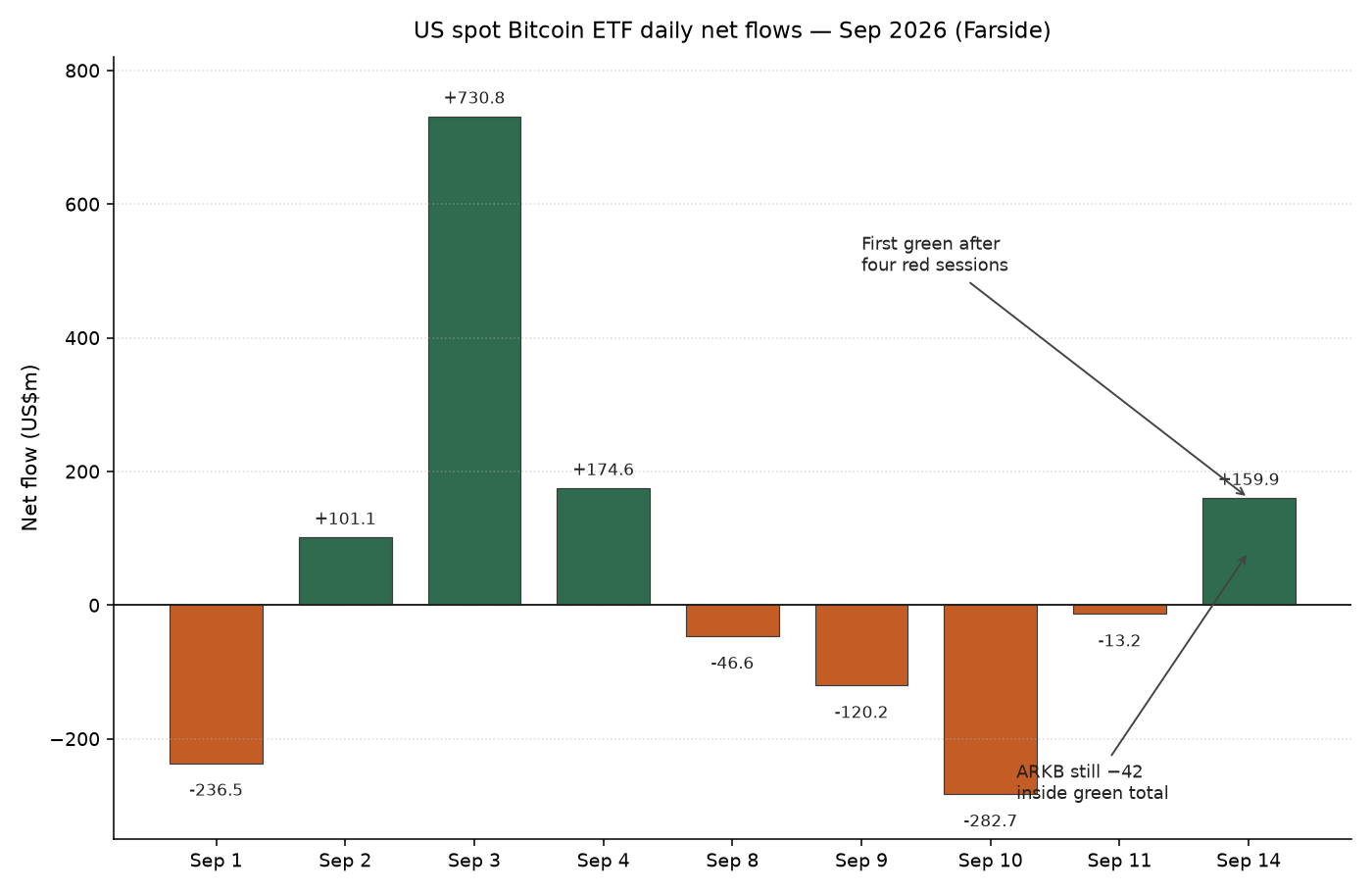
On September 14 US spot Bitcoin ETFs printed +$159.9M, the first green day after four red sessions. IBIT and FBTC led the buy. ARKB still redeemed about $42M inside that green total. Score issuer mix on rebound days, not just the complex print.
The first green day
On September 14, 2026, US spot Bitcoin ETFs flipped from four straight outflow sessions to a +$159.9M net creation day, per Farside Investors. That ended the holiday-shortened week of September 8-11, when the complex had shed roughly $462.7M across every trading day.
Month-to-date through September 14 sits near +$467M, still a green month, even after the four-day bleed. The headline on Monday morning will be "ETFs bounced." That is not wrong. It is incomplete.
Who bought, who still left
Open the issuer row on the rebound day before you celebrate the total.
BlackRock's IBIT took in about $134.3M. Fidelity's FBTC added about $53.3M. Morgan Stanley's MSBT, still the 0.14% fee product, printed another small green day at about $9.7M. Franklin's EZBC added a few million.
ARK 21Shares' ARKB did not join the rebound. It redeemed about $42.0M on the same session that the complex went green. That is the point.
A green total can hide a red ticker. The complex is a basket of custody products with different holders, different fee schedules, and different AP routing. Treating +$159.9M as if every issuer "came back" is how you invent consensus from arithmetic.
Same week, different thermometer
Last week's story was the four red sessions against a quiet fee market, paper leaving the wrapper while mempool demand sat near the floor. This week's opening print is the other side of that split ledger: creations returned fast, and they returned unevenly.
Fees did not suddenly need to announce the bounce. On September 14, confirmed blocks still showed plenty of work clearing near the low end of the fee distribution, plenty of transactions landing around 1-2 sat/vB territory rather than a stress spike. The rebound lived in the fund ledger first. That is expected after in-kind creations. It is also why "IBIT printed green" and "the network is congested" remain different columns.
Macro context matters without becoming the thesis. The bounce lands into Fed week, with the September 15-16 FOMC already the tape everyone is watching. Rate-path fear helped empty the wrapper the week before. A single green creation day does not prove that fear is gone. It proves authorized participants found enough demand, somewhere in the complex, to print net creations again.
Do not mash the rebound into the mining week either. Idle hash, Texas 4CP calendars, and difficulty tax are about who mines. This is about which regulated shares expanded on the first green day after a redemption streak.
What the green day actually measures
Score three things separately.
First, streak: four red sessions broke. That matters for flow narrative and for anyone who only watches consecutive-day signs. Streaks are how headlines travel. They are a weak map of who actually holds the coins.
Second, monthly net: September is still positive after the bounce, roughly +$467M through September 14 if you sum the Farside daily rows. A single green day inside a green month is not a regime change; it is a repair print. Keep the monthly column next to the streak column so one ugly week cannot redefine the month, and one bounce cannot redefine the risk.
Third, issuer mix: IBIT and FBTC did the heavy lifting; ARKB kept redeeming. MSBT stayed small and green. If the next red week arrives, watch whether the same names lead outflows, and whether the low-fee seat keeps accumulating on ugly days. That is the durable operator scoreboard.
The scarce object is not "did ETFs print green on Monday." It is whether you still treat the complex total as unanimous when one of the largest outflow names of the prior week is still red inside the rebound.
What to put on the scoreboard
Before you call the outflow week finished, open the issuer table. Ask who created shares on the first green day. Ask who was still redeeming. Ask whether the monthly net or the four-day streak is the number your risk memo actually needs. And ask what you will do when the next green total again contains a red ticker, because September 14 already showed that pattern is available on demand.