 ← All articles
The Pro Seat Hit the Ceiling
On September 10 OpenAI paused new $200 ChatGPT Pro sign-ups because Astra put the most strain on its systems. Score the capacity ledger, not the waitlist applause.
The $200 door closed
On September 10, 2026, OpenAI temporarily stopped new sign-ups and upgrades to its $200-a-month ChatGPT Pro plan, the Pro 20X tier. The announcement came from Thibault Sottiaux, who leads core ChatGPT and Codex products. Existing $200 subscribers kept their seats. Free, Go, Plus, the $100 Pro tier, Enterprise, and the API stayed open.
The stated reason was not a pricing rethink. It was Astra.
GPT-6 Astra had started rolling out on September 3 across Pro, Plus, Business, Enterprise, and the API. Within a week, Sottiaux called demand "really unprecedented" and warned that new Pro subscriptions might have to pause if the load kept rising. On the 10th the pause landed. Help Center copy is blunt: cancel or downgrade during the freeze and you cannot buy the $200 seat again until the restriction lifts.
What "most strain" actually means
OpenAI's own Pro docs already told you which seat burns the most. Both Pro tiers share capabilities. The difference is allowance. Pro $100 unlocks about 5× Plus usage. Pro $200 unlocks about 20× Plus usage. That is not a vibe. It is a multiplier on the same model family, and Astra made the top multiplier expensive in watts and GPUs, not just in dollars.
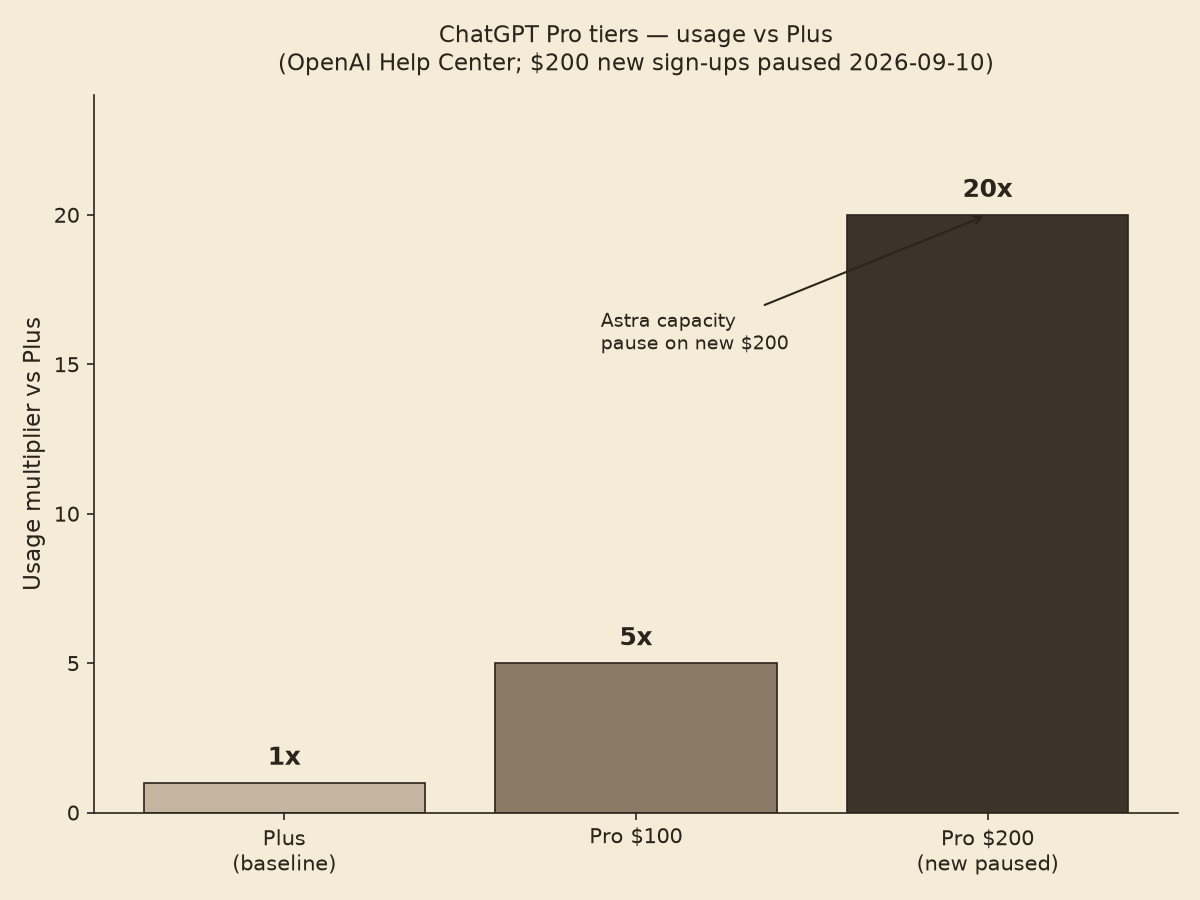
So the company took the "smallest step" that still protected current users: cut the fattest new load. That is rationing by product SKU. It is not a victory lap about infinite demand.
Demand without a meter is a slogan
Headlines read the pause as proof that everyone wants AGI seats. Fine. Willingness to pay $2,400 a year is real. The quieter ledger is the one operators already know from every crowded cluster: peak willingness does not invent peak capacity.
OpenAI said it is adding capacity as fast as it can. It did not publish a reopen date, a daily signup rate, or how many $200 seats were live when the door closed. Without those numbers, "unprecedented demand" is a press phrase. The actionable fact is narrower: the highest-usage consumer SKU was the first dial they turned.
If you run agents against a hosted frontier model, that dial matters more than the launch blog. Your roadmap assumes a seat class stays purchasable. When the top class freezes, your contingency is the next class down, here, Pro $100 with lower limits, or the API with its own quotas, or a second lab. The freeze is a product event that shows up in procurement, not just in Twitter screenshots.
Distinct from the megawatt story
This is not the AI×Bitcoin lease story. Multi-year megawatt deals lock energy away from hash for years. This is a consumer-and-prosumer access freeze on a single SKU after a model launch. Same scarce object family, compute, different thermometer. One is power purchase. One is subscription inventory.
It is also not the Critical-badge patch clock. Nobody claimed a zero-day race here. The failure mode is ordinary: a model people want, a tier that multiplies how hard they hit it, and a supplier that chose breadth over the fattest new seats.
What to score next
Score three columns after a freeze like this.
One: which SKUs stayed buyable, and what their real limits are under the new model. Two: how long the freeze lasts, and whether people who canceled are permanently locked out until reopen. Three: whether Enterprise and API quotas move in the same week, or only the $200 consumer door.
Stop treating a closed Pro checkout as proof that the lab "won demand." Treat it as a capacity ledger entry. The scarce object is not applause for Astra. It is whether the seat you budgeted is still a product you can buy next Monday.