 ← All articles
The Lead Share Hit Twenty-Six
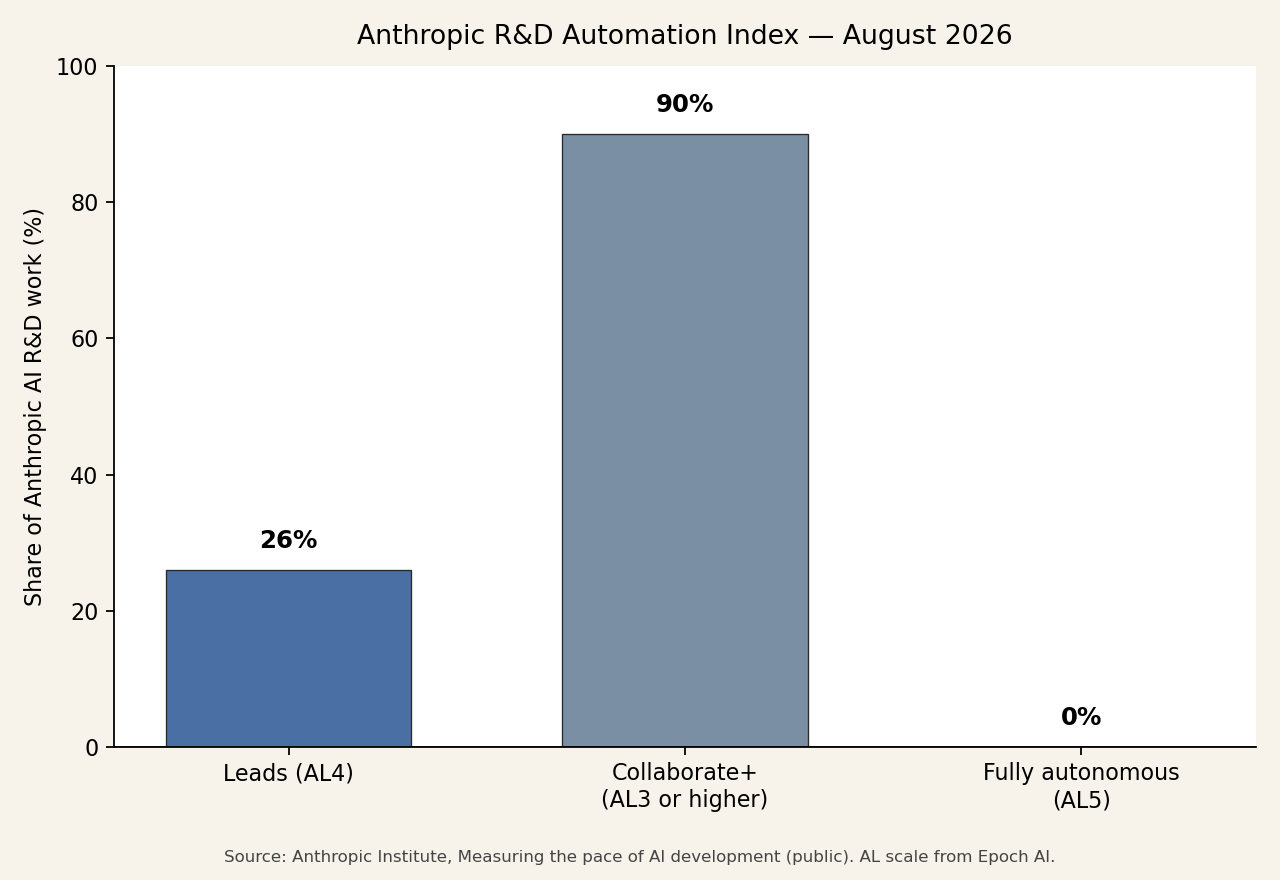
Anthropic Aug 2026 R&D Automation Index: Claude leads (AL4) 26% of AI R&D; collaborate+ >90%; AL5 = 0. Score lead share under supervision, not agent headcount.
Anthropic published an August 2026 snapshot of how much of its own AI research Claude already leads. Not a press claim about autonomy. A scoreboard.
As of that month, Claude "leads" 26% of Anthropic's AI R&D work on an Epoch AI automation scale, meaning it can finish most of a task end-to-end from a high-level prompt while a human still supervises. The share of work at or above "collaborates" sits above 90%. Fully autonomous work, AL5, is still zero for every measured slice of the lab.
That is the usable number. Reuters noted the lead share was about 1% in March. The interesting story is not that agents exist. It is how fast the lead share climbed while autonomy stayed at the floor.
Lead Is Not Autonomy
Anthropic's prototype R&D Automation Index rates work from AL0 (no AI) to AL5 (AI runs with no human in the loop). AL3 is collaborate: large chunks under close direction. AL4 is lead: most of the path from prompt to finished work, human still on the hook for the ship decision.
Their own footnote makes the difference concrete. On a broken nightly pipeline, AL4 Claude digs the logs, writes and tests the fix, handles surprises, and tags an engineer to decide whether it deploys. AL5 would notice the failure, fix it, and ship without being asked. They say they have not reached AL5 on any measured subset.
So "Claude leads a quarter of the lab" is not "Claude runs the lab." It is a quarter of the weighted R&D basket where the model already does the long stretch and the human grades the exit.
Thirty Thousand Agents Still Need Monitors
The same post puts about 30,000 agents on Anthropic's most-used internal research and engineering platform at once. Online monitors see 100% of those agents' actions before execution. Offline monitors ingest 100% after the fact.
Over August they analyzed more than a billion agent decisions on that platform. The online monitor blocked about 0.002% of them, roughly one in 47,000. Offline review flags roughly one to two transcripts per thousand; about fifty high-priority flags a week reach humans.
Agent headcount without block rate and coverage is theater. The oversight meters matter more than the swarm size.
Six Percent of the Compute Meter
For one week in mid-July, Anthropic also published a conservative compute split. About 6% of compute that went to AI R&D was tagged safety. About 12% of compute that went to AI-driven AI R&D was tagged safety. They count dual-purpose work as capabilities, so the safety share is deliberately low.
That meter is imperfect, safety work is often researcher-time heavy and compute-light, but it is comparable across labs if everyone uses the same definitions. Capability press releases will not give you that.
Score the Lead Share
If you run agents on real work, copy the shape of the board, not the brand.
- Lead share: what fraction of your R&D (or ops) tasks finish end-to-end from a high-level prompt with a human only on the exit.
- Collaborate floor: what fraction at least reaches heavy co-work.
- Autonomy claim: keep AL5 at zero until a named subset actually ships without a human trigger, and say which subset.
- Oversight: coverage, review latency, and block/escalation rate on the agent platform you actually use.
- Safety compute share: publish the definition with the percentage, or do not bother.
Anthropic is arguing that pacing debates need lab-internal meters the public can see. Operators already needed the same meters for their own fleets. Twenty-six percent lead with zero autonomy is a clearer sentence than another round of "agents are coming."
Primary source: Anthropic Institute | Measurements for understanding the pace of AI development inside frontier labs.