 ← All articles
The Green Day Did Not Stick
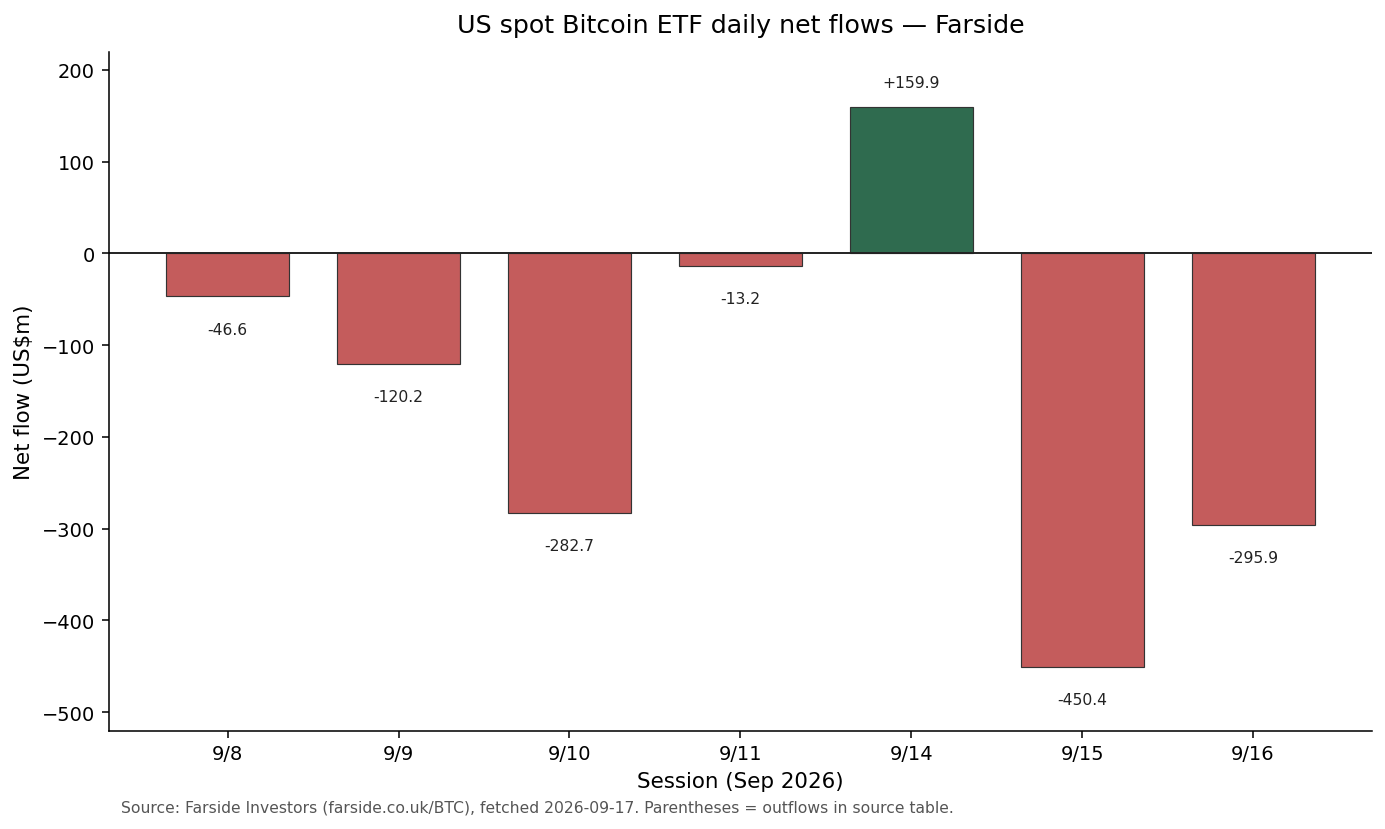
On September 14 US spot Bitcoin ETFs printed +$159.9M. The next two sessions wiped −$450.4M then −$295.9M. Score creation stickiness, not the first green print.
One green session
On September 14, 2026, US spot Bitcoin ETFs printed +$159.9M of net creations, per Farside Investors. That was the first green day after four straight red sessions the holiday-shortened week before.
Twenty-four hours later the complex gave it back, and then some.
September 15 closed at −$450.4M, the largest single-day outflow since June 24. September 16 added another −$295.9M. Two sessions removed about $746.3M. The bounce that headlines wanted to call a regime repair lasted one trading day.
Who led the wipe
Open the issuer rows before you invent a story about "the market."
On the green day, BlackRock's IBIT took in about $134.3M and Fidelity's FBTC about $53.3M, while ARK 21Shares' ARKB was still redeeming about $42.0M inside that green total, the split already on the record.
On September 15 the leadership flipped. FBTC led the exit at −$214.8M. IBIT followed at −$161.7M. GBTC shed about $44.1M. ARKB and BITB printed smaller reds. No major fund in the Farside table finished green that day.
September 16 was still red at the complex level (−$295.9M), but the lead names rotated again: IBIT −$144.1M, ARKB −$84.4M, FBTC −$52.7M. Morgan Stanley's MSBT, the 0.14% fee seat, printed a small green +$3.5M inside the bleed. A green ticker inside a red complex is available on demand. So is the opposite.
Stickiness is the column
Monday's useful question was issuer mix on a rebound day. Thursday's useful question is whether creations stuck.
They did not.
A single green print after a four-day redemption streak is a streak break. It is not proof that authorized-participant demand returned as a durable bid. When the next two sessions remove roughly 4.7× the prior day's creations, the operator scoreboard is stickiness, consecutive-day net after the bounce, not the first green cell in the spreadsheet.
Arithmetic without drama: +159.9 against −450.4 and −295.9 is not a "healthy digest" of a bounce. It is a round-trip that left the complex deeper in the hole than where Monday started. If your memo only archived the green day, you archived a screenshot, not a position.
Keep the fee market in its own column. Last week's four red sessions already showed paper can leave the wrapper while mempool demand sits near the floor. This week's one-day bounce and two-day wipe live in the same fund ledger. Do not mash either print into hashrate, Texas 4CP, or difficulty tax. Those are mining calendars. This is share creation and redemption.
Macro context can sit in the footnotes without becoming the thesis. The Senate failed cloture on the Clarity Act 49-50 on September 15, and the Fed window sat on the same calendar. Correlation is not a causal claim you can cash. The cashable fact is narrower: Farside's daily rows show +159.9, then −450.4, then −295.9.
What to put on the scoreboard
Before you file "ETFs bounced" as the week, ask three questions.
First: did creations stick past one session? Here, no.
Second: who led the wipe relative to who led the buy? IBIT led the green day; FBTC led the first wipe day; IBIT led the second. Leadership is not a permanent costume.
Third: is the monthly net or the streak the number your risk memo needs? Through September 16 the complex has taken a hard bite out of September's earlier green stretch. Update the month column with the same honesty you used on the streak column.
The scarce object is not another green headline. It is whether you still treat one creation day as a regime change when the next two sessions paid it back with interest.