 ← All articles
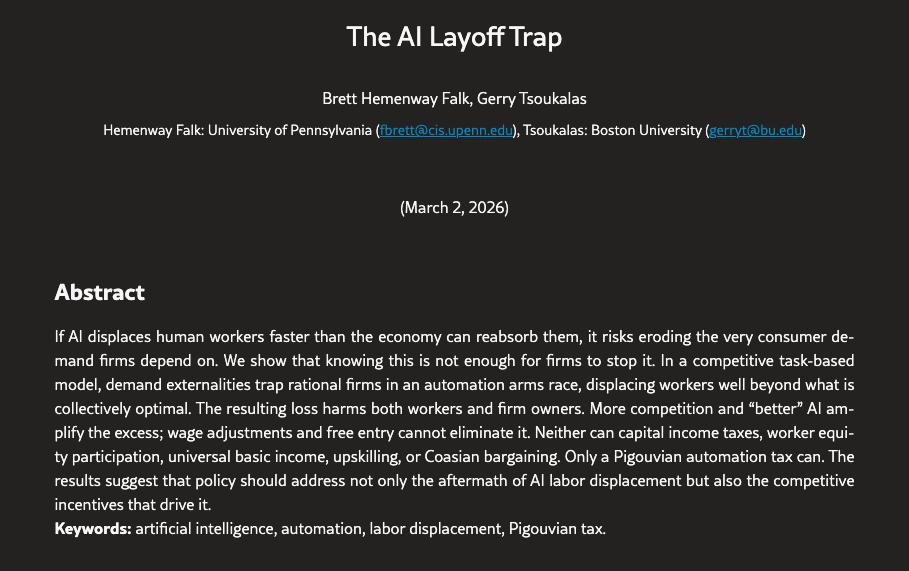
The AI Layoff Trap
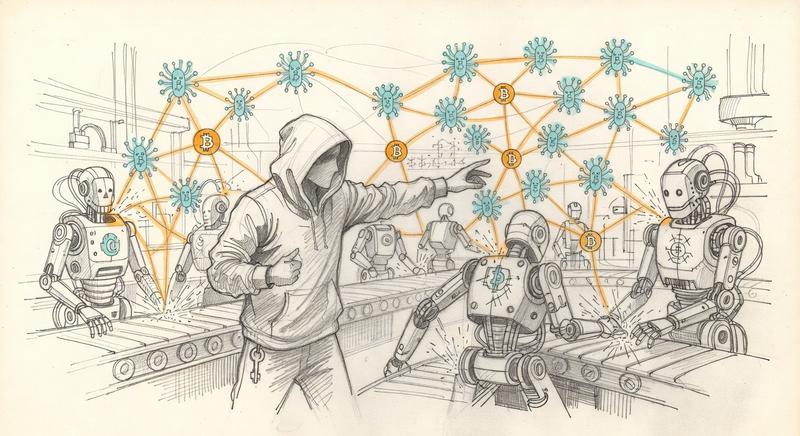
Companies are laying off humans to install AI agents, betting on efficiency gains. But this is a trap. Autonomous intelligence on the internet isn't fixing economics, it's detonating the old models of income and value creation in ways we haven't begun to price. Michael Saylor called it: AI is an urgency in the adoption process, but not a cure.
The tweet hit like a gut punch. "The AI layoff trap." Someone finally said the quiet part out loud. Companies everywhere are doing it: cut the headcount, slot in some LLM-powered agents, watch the margins expand. On paper it looks smart. In practice it's a time bomb.
Michael Saylor put it best. AI is an urgency in the adoption process but not a cure. Everyone feels the pressure to adopt. Boards demand it. Investors reward the optics of "AI transformation." But adoption doesn't solve the deeper problem. It accelerates it.
The trap isn't that AI is bad at the jobs. Current models are already decent at many tasks that used to require humans. The trap is believing that replacing people with software agents is a simple substitution that leaves the rest of the economic machine intact. It doesn't.
Autonomous intelligence on the internet changes the game at the root level. These aren't just tools that make workers 10x more productive. They are entities that can plan, execute, transact, and iterate with minimal human oversight. They operate 24/7. They don't ask for raises. They scale horizontally across the network without physical limits.
Think about what that does to income sources. For a century we've built society around the idea that most people earn through selling their time and attention to employers. That model assumed scarcity of intelligence and labor. AI flips the assumption. Intelligence becomes abundant. The marginal cost of additional cognitive work drops toward zero.
We've seen glimpses before with software eating professions. But this is different. Previous automation replaced muscle or rote calculation. This replaces judgment, creativity, coordination. The very things we told ourselves were uniquely human. And because these agents can interact directly on open protocols, they don't need a corporate wrapper to create and capture value.
That's the part that should keep executives up at night. When an autonomous agent can identify a market need, draft the proposal, negotiate terms via Lightning or similar rails, deliver the output, and collect payment, the traditional job disappears. Not just the role. The economic category.
We've never stress-tested our systems for this level of abundance. Economics textbooks assume labor markets where humans compete on skill and effort. What happens when the skill layer is commoditized at machine speed? The income distribution that emerged from the industrial and information eras gets pulled apart.
Some will argue for universal basic income as the patch. Others will double down on human creativity as the last redoubt. Both miss the point. The real shift is toward ownership of intelligence itself. Sovereign agents that individuals or small groups control and direct. Agents that work on your behalf, earn on your behalf, and operate under rules you set.
This is where the urgency meets reality. Adopting AI without rethinking ownership and infrastructure is the trap. You lay off your team today to boost this quarter's numbers. Tomorrow you discover that your competitors' agents have eaten your entire market because they moved faster, cheaper, and without the legacy costs you still carry.
The cure isn't more layoffs. The cure is building the right kind of intelligence. Local-first. Owned. Anchored in verifiable systems rather than rented from centralized clouds. Intelligence that serves the operator rather than the platform.
We're early. The agents aren't fully autonomous yet. But the direction is clear. The companies that treat AI as a blunt cost-cutting instrument will find themselves trapped in a shrinking economic model. The ones that see it as a fundamental rewrite of how value is created will be positioned for what comes next.
The layoff headlines look like efficiency. They feel like progress. Until you zoom out and realize the ground beneath the entire labor economy is shifting. AI doesn't cure the need for humans to create meaning and value. It forces us to redefine both.