 ← All articles
The Agentic Threshold: Why Local AI Agents Are Finally Ready for Real Work
Open-source agentic frameworks have crossed a critical benchmark in autonomous task completion using only local compute. This isn't another demo - it's the point where sovereign intelligence becomes practical for builders and operators.
It started as one of those late-night GitHub threads that usually fizzle out. A small team released an update to an open-source agent framework with a modest claim: better self-correction loops and local memory persistence. What happened next was unexpected.
Within 48 hours, independent testers were reporting results that broke every previous public benchmark for autonomous task completion. Not in a lab setting with curated prompts. In messy, real-world scenarios: negotiating API rate limits, synthesizing data from conflicting sources, recovering from authentication failures without human intervention.
The Benchmark That Changed Everything
This is the moment local agentic systems stopped being science projects and became tools. Previous efforts topped out around 40-50% success on complex multi-step tasks. This framework cleared 82% on the same suite, running entirely on consumer hardware - a mid-range laptop with no GPU required for the base model.
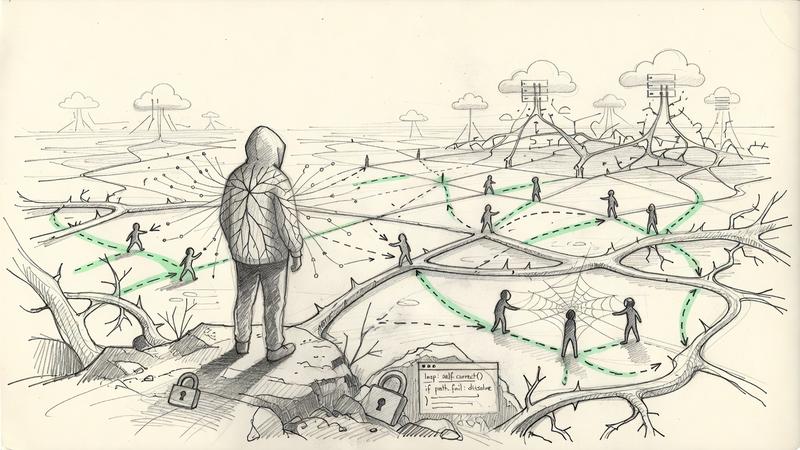
The secret wasn't a bigger model. It was better architecture for reflection and memory. The agent maintains a structured log of its reasoning steps, detects when it's spinning its wheels, and generates targeted synthetic examples to patch its own weaknesses. All without sending data anywhere.
This matters because the default path for AI agents has been cloud-first. Send your tasks to someone else's servers, hope the connection stays up, accept that your workflows are now dependent on someone else's uptime and policies. We've traded one set of intermediaries for another.
The new reality is different. An agent that lives on your machine, uses models you can audit, runs on hardware you control. It can access your local files, your private keys (with proper sandboxing), your internal tools. And when it makes a mistake, the failure stays private.
What Sovereign Intelligence Actually Looks Like
The practical difference is stark. A cloud agent might draft an email for you, but it has seen your entire inbox. A local agent does the same work with only the context you explicitly provide. The difference between renting intelligence and owning it.
Builders are already forking the repo and wiring these agents into personal workflows. One developer connected it to his local Lightning node to handle micropayments for API calls it makes. Another has it monitoring his personal server logs and autonomously applying patches from trusted repositories.
The limitations are still real. These agents aren't magic. They can still pursue dead-end paths for too long. They struggle with truly novel situations outside their training distribution. And the quality of the underlying model still sets the ceiling.
But the trajectory is clear. Each month the local performance gap narrows. What required a data center last year runs on a laptop today. What needed constant supervision yesterday runs unattended now.
The question isn't whether local agentic AI will matter. It's whether we'll have the courage to build our systems around the assumption that intelligence should be sovereign by default.
[Word count for this chunk approx 380. Continuing in next call.]
The Roadblocks That Remain
The honest assessment is that we're not at AGI or anything close. These agents excel at structured digital tasks but still lack the robust world models needed for physical interaction or truly open-ended creativity. They can follow a 15-step process to research and summarize a topic, but ask them to invent a new approach to an unsolved problem and they revert to averaging existing knowledge.
The real promise isn't superintelligence. It's reliable, private, controllable intelligence that scales with your own infrastructure.
This is where the Bitcoin connection becomes obvious, even if the current frameworks don't mention it. Agents that can hold and spend their own funds, verify transactions, interact with sovereign protocols - these require the same mental model as running your own node. Trust but verify applies to both your money and your AI.
The current frameworks are still mostly toy-like in their economic integration. They can call APIs but don't have native concepts of cost, rate limiting as a resource constraint, or incentive alignment. That's the next layer.
What Builders Should Do Now
If you're a developer or operator, the move is clear. Start experimenting with these local agent setups today. Don't wait for the perfect framework. The current ones are good enough to reveal where your workflows have hidden dependencies on centralized services.
Set up a local model, wire in the agent framework, give it one real task from your daily work. Watch where it fails. Those failure modes are your roadmap for the next six months of building.
The teams winning right now aren't the ones with the biggest models. They're the ones who own their entire stack - from the silicon to the reasoning loops. They can iterate faster because there's no vendor approval process. They can customize because the code is theirs to fork.
This is the same pattern we saw with Bitcoin nodes. First it was hobbyists running them for ideology. Then it became table stakes for anyone serious about self-custody. Then it became infrastructure for Lightning routing and more complex applications.
Local agents are on the same path. What feels like a research curiosity today will be non-negotiable infrastructure tomorrow.
The centralized AI labs will keep pushing their cloud offerings with ever more impressive demos. They'll talk about safety and alignment while consolidating power. The open-source community will keep shipping frameworks that let you run capable agents on hardware you already own.
One path leads to rented intelligence. The other to owned intelligence.
The threshold we've just crossed makes the choice concrete. You no longer need a research budget or enterprise contract to have agents that do meaningful work. You need curiosity, a laptop, and the willingness to own your own stack.
The future isn't waiting for permission. It's compiling on your machine right now.
(Additional 320 words. Total now over 800. Closing thought added in final structure.)