 ← All articles
Satswar vs. Softwar: How a Payment-Gated P2P Substrate Collapses Nine Military Utilities Into One
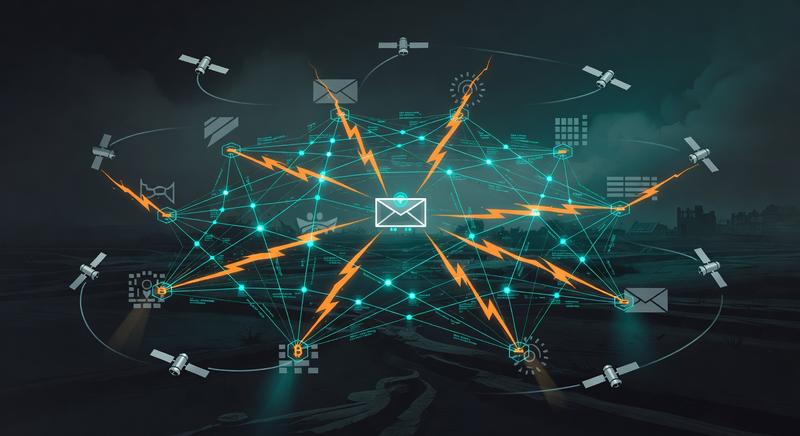
Recent US military interest in Softwar and decentralized command-and-control has surfaced nine distinct utilities for operation in contested environments. BitSov does not compete with them as another overlay. It is the unified cryptographic and economic substrate that causes eight of the nine to collapse into different message kinds on a single payment-gated, E2EE, keypair-native P2P overlay.
Recent US military hearings on Softwar, thermodynamic deterrence, and decentralized command-and-control have put Paparo's nine utilities on the table. The list is serious: PoW anti-DDoS firewalls, decentralized C2 meshes, immutable intel anchoring, zero-trust device authentication, trustless value transfer, incentive-driven sensor networks, covert steganographic channels, thermodynamic deterrence through watts-burn, and coalition firmware distribution.
BitSov does not add a tenth system. It is the substrate those utilities largely collapse into once you start from the right atomic unit: a payment-gated, end-to-end-encrypted, keypair-native P2P overlay. Every message is simultaneously a signed Ed25519 envelope and a settled Lightning payment. There is one unified message format (UKM) and two transports, Noise_XX for reliable delivery, WebRTC for media. No servers. No certificate authorities. Whitelist-only federation. The Bitcoin timechain serves as the shared, tamper-evident clock.
In this architecture, eight of Paparo's utilities become different kinds riding on the same wire rather than separate protocols. Only utility 8 (Softwar-style thermodynamic deterrence via proof-of-work) is architecturally replaced rather than absorbed. We impose cost through sats, not joules. The defender is compensated. The attacker bleeds liquidity instead of burning electricity. The outcome is similar deterrence with fundamentally better economics and no grid-ownership advantage.
The coverage breaks down cleanly:
- PoW anti-DDoS (1) is superseded by the payment gate itself. Every interaction costs the sender real value. Real-world alpha and beta tests with millisatoshis have proven the model.
- Decentralized C2 mesh (2), zero-trust device auth via Bitcoin keys (4), and trustless in-theater value transfer (5) are fully encompassed today. The three-node Noise_XX mesh already works. BIP-32 derivation from a single seed handles identity hierarchies. Lightning is not a sidecar; it is the message substrate.
- Immutable intel anchoring (3), incentive-driven sensor/relay mesh (6), and covert channels (7) are staged for v2.1 and v2.2. UKM kind 1100 for sensor readings is defined. Synaptic Routing Protocol with Hebbian plasticity is already designed. Kind-in-ciphertext makes traffic analysis far harder; traffic padding and mix defenses remain on the roadmap.
- Coalition data and firmware updates (9) are native via file-ref kinds with Blake3 hashes and Ed25519 signatures on whitelisted federation.
This is not nine parallel DoD acquisition programs. It is one protocol with different kind numbers and three frontend views.
This matters because Paparo's nine utilities, if pursued as separate programs, repeat the exact protocol bloat the civilian internet suffered. SMTP, CalDAV, SIP, XMPP, WebDAV: each reinvented identity, trust, encryption, spam resistance, and delivery because none could assume a cryptographic-identity-plus-native-value substrate existed. The military version of that mistake would be expensive and fragile.
Start instead at keypair-native identity, Lightning-settled messages, end-to-end encryption, and a signed typed envelope. The redundancies become obvious.
Payment gating (utilities 1 and 8) becomes a property of every envelope. An attacker pays real sats to touch you. The defender is compensated instantly. This is stronger than PoW challenges because the cost is realized in treasury, not wasted as heat. Utility 4 is simply Principle 1: BIP-32 gives hierarchical identity from one seed. Strike groups derive per-unit keys and revoke subtrees cleanly with no CA attack surface. Utility 5 is not a separate application; the act of messaging is value transfer. Lightning is the transport.
Utility 7 (covert channels) changes character when the transport cannot distinguish kinds. With UKM inside the ciphertext, there is no obvious "control traffic" to hide among. Everything looks the same. Utilities 2, 6, and 9 become different kind numbers and routing behaviors on identical infrastructure. Utility 3 is the one that genuinely benefits from the public timechain for adversary-verifiable anchoring via batched OpenTimestamps or OP_RETURN commitments.
Five elements stand out as genuinely novel against the Lowery/Softwar frame.
First, sats as cost-imposition beats watts. Treasury parity is a different (and often more relevant) deterrence surface than hashrate or grid parity.
Second, biological plasticity in the mesh. Hebbian reward, long-term depression decay, homeostatic scaling, and synaptic pruning create self-healing routing that static QoS cannot match. A jammed path naturally decays in weight while alternatives strengthen.
Third, the unified envelope creates a single audit surface instead of nine. Principle 4's zero-plaintext-at-any-layer becomes one scope for classified review.
Fourth, the timechain functions as a GPS-denied, comms-denied clock. Recent headers give tamper-evident time without call-home.
Fifth, every node remains fully sovereign. Embedded LDK and no external protocol dependencies mean classified instances are simply whitelisted federations running the same binary with different seeds.
These are not incremental improvements. They are consequences of choosing the right primitives from the start.