 ← All articles
Same Solve, Five Times the Cost
Arena HarnessTax (Sep 16): hold the model fixed across Claude Code, Codex CLI, and Pi: success barely moves while cost moves up to ~5×. Score cost-per-solve, not the nameplate shell.
On September 16, 2026, UC Berkeley and Arena published HarnessTax: twenty-one model-harness pairs, three shells, two public coding benchmarks. Hold the model fixed. Change only the wrapper that feeds it tools and context.
Success barely moved. The invoice did not.
What They Measured
Melissa Z. Pan, Shuo Yang, Negar Arabzadeh, Wei-Lin Chiang, Ion Stoica, and Matei Zaharia ran seven models through Claude Code, Codex CLI, and Pi: a minimal open-source harness with four tools: read, write, edit, bash. Thirty SWE-bench Lite tasks and thirty Terminal-Bench 2.0 tasks, three attempts each, capped at 100 agent turns. Token cost used a fixed direct-API price list dated September 1, 2026, so the same model faced the same sticker rates in every shell.
That is the right experiment for operators. Leaderboards usually publish a model plus its default shell and then credit the model. HarnessTax splits the pair.
The Numbers That Matter
On SWE-bench Lite, Claude Fable 5 solved about 97.8% of attempts in Claude Code at $1.33 per attempt, and about 96.7% in Pi at $0.67. Overlapping intervals. Roughly half the money for the same solve rate.
GPT-5.6 Luna shows the study's "up to 5x" line cleanly: about $0.15 per attempt in Claude Code versus about $0.03 in Pi, with success stuck near 55%. Codex sits next to Pi on cost for Luna. The expensive outlier is the heavy default shell, not a different brain.
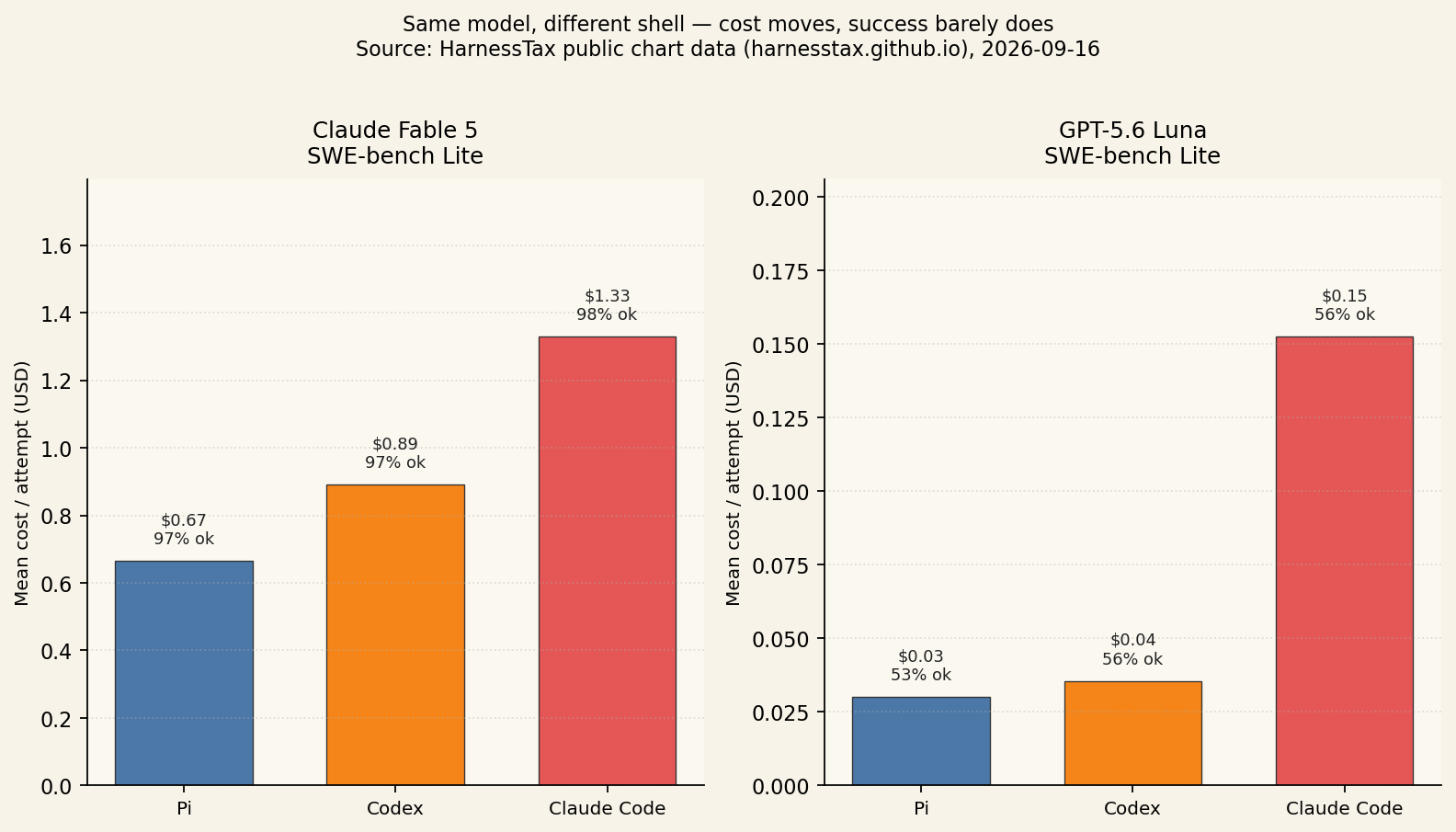
Turns do not explain it. For Fable on SWE, Pi and Claude Code averaged about 15.4 and 15.3 turns. The study puts Claude Code's mean first-call context at more than ten times Pi's, longer instructions, larger tool schemas, paid on every call before the real work starts.
Native Is Not a Measurement
Across Anthropic and OpenAI models on both benchmarks, the authors count nine of twelve comparisons where a harness other than the vendor's own posted the highest observed success. GPT-5.6 Sol on Terminal-Bench reached about 83.3% in Pi against about 78.9% in Codex at roughly half the cost ($0.42 vs $0.76).
Your vendor's CLI is a default shipping container. It is not a capability score.
Score Cost Per Solve
If you pay by the token, API keys, not a flat Pro seat, put three columns on the sheet:
- Success on your tickets (merged PR or closed task), not a public leaderboard row.
- Mean token cost per attempt at the prices you actually pay.
- Cost per solve = cost / success. A cheaper shell that fails more often is not cheaper.
Run ten recent tickets in two shells with the same model and the same turn cap. Keep the lower cost-per-merged-PR. Re-run when the model changes. The study's own next step is the same measurement on real workflows; you do not need their benchmarks to start.
Subscription seats flatten the meter until you hit the weekly wall. Then the shell that burns context becomes a tasks-per-week problem instead of a dollars-per-attempt problem. Either way, the wrapper is on the scoreboard.
Not the Cache Line, Not the Session Plane
This is not Anthropic cutting Fable cache reads. That story scores a price sheet line item inside one vendor API. This story scores three different wrappers around the same models.
This is not "the harness opened but the session did not." That story is about who owns compaction and resume. This one is about who owns the invoice when success is flat.
And it is not "same weights, different doors." Safeguard regimes are permission products. Shell tax is overhead you can measure with a stopwatch and a bill.
Primary source: HarnessTax: How Much Does the Harness Matter for Coding Agents?, public charts and pairs at harnesstax.github.io (generated 2026-09-16).