 ← All articles
The Rise of Sovereign Agents: Why Local-First Agentic AI is the Only Future Worth Building
The shift to fully local agentic systems changes that equation completely. These frameworks let AI plan, act, use tools, and learn while staying on your hardware. It's not a convenience upgrade. It's a return to first principles: your intelligence should belong to you.
Consider the difference in trust models. A cloud agent is a black box running on hardware you don't control, trained on data you can't audit, with behaviors governed by terms of service that can change overnight. A local agent is code you can inspect, running on silicon you own, using models whose weights you can verify. The difference is night and day.
This matters particularly for agentic systems because they are proactive. They don't just answer questions, they take actions on your behalf. An agent that can send emails, make purchases, manage your schedule, or interact with financial systems cannot be allowed to operate under someone else's governance. The stakes are too high.
The open-source community has responded with impressive creativity. New architectures optimize for memory efficiency, allowing agents to maintain context across days or weeks without ballooning RAM usage. Tool-calling has become more reliable with better prompting patterns and local function execution environments. Some frameworks even implement self-reflection loops where the agent critiques its own plans before executing them, all without leaving your machine.
The economic implications are equally profound. When AI capabilities become commoditized on local hardware, the power shifts from a few massive providers to anyone with a decent computer. This democratizes access in a real sense, not the marketing version. A researcher in a small lab or a developer in their bedroom can build agents as capable as what enterprises pay millions for.
Of course, this doesn't mean cloud AI disappears. There will always be use cases for the absolute largest models on specialized tasks. But for the majority of daily work, research, coding assistance, personal organization, creative iteration, local agents are not just sufficient. They're superior in every way that matters for sovereignty.
The lingering question is adoption. Will people value control enough to invest in the hardware and learning curve? Early signs are promising. The same people who run their own email servers, self-host their note-taking apps, and mine their own Bitcoin are the ones flocking to these frameworks. The builder mindset naturally gravitates toward ownership.
In the end, sovereign agents represent more than better AI. They represent a return to first principles: your data, your models, your agents, your rules. The cloud gave us scale. Local-first gives us freedom. The next decade of AI will be defined by which one we choose.
And for those of us who remember why we got into technology in the first place, to build, to create, to think freely, the choice seems obvious.
In the rush to deploy ever-larger models in the cloud, we've forgotten a fundamental truth: intelligence that isn't yours isn't really intelligence at all.
The past few years have been defined by a centralization of AI capabilities. Massive data centers, proprietary APIs, and subscription models that treat your prompts like fuel for someone else's profit machine. But something is shifting. A new generation of open-source agentic frameworks is emerging that runs entirely on your own hardware, making decisions, using tools, and iterating without phoning home to a corporate overlord.
These aren't just chatbots with better memory. Agentic systems are AI that acts: planning multi-step tasks, calling external tools, correcting course when things go wrong, and learning from the outcomes. The difference now is they're doing it locally, on laptops, workstations, or personal servers. No latency from round-tripping to distant servers. No censorship. No surprise bill at the end of the month when your agent decides to research something expensive.
Why does this matter? Because sovereignty isn't a luxury when it comes to intelligence. When your AI agent has access to your emails, calendars, codebases, and personal data, it needs to be under your control. Running it in someone else's cloud means trusting that provider with everything. History shows that's a bad bet. Data breaches, policy changes, sudden price hikes, or just the slow erosion of privacy, we've seen it all before with social media, email, search.
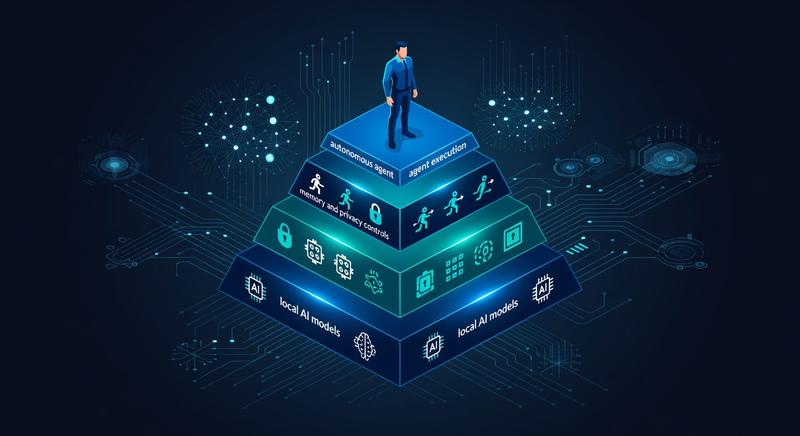
The new wave of frameworks focuses on three things: efficient inference on consumer hardware, robust tool use without cloud dependencies, and memory systems that persist locally. Models like the latest quantized versions of leading open-source LLMs are small enough to run at usable speeds on a decent GPU or even CPU with clever optimizations. The agents built on top of them can browse the web through local proxies, interact with local files, execute code in sandboxes you control, and maintain long-term memory in encrypted local databases.
This isn't a niche hacker project anymore. It's becoming the default for anyone serious about building systems they actually own. The implications stretch far beyond convenience. In enterprise settings, compliance teams are waking up to the fact that sending sensitive data to third-party AI services creates massive regulatory risk. In personal use, it means your digital life stays yours. For developers, it means experimenting without rate limits or content filters.
Yet challenges remain. Local inference still lags behind the absolute cutting edge in raw capability. Coordinating multiple specialized agents locally requires clever orchestration. And the ecosystem is still fragmented, different frameworks with different strengths, none yet the clear winner.
But the direction is clear. The future of AI isn't in bigger clouds. It's in smaller, smarter, sovereign systems that live where you live.
What we're witnessing isn't just a technical improvement. It's a philosophical correction.
For too long we've accepted the idea that intelligence should be rented. That the price of powerful AI is giving up control over how it's used, what data it sees, and where it lives. Agentic frameworks running locally flip that script. They treat intelligence as something to be owned, not accessed.