 ← All articles
Why Rented Intelligence Will Never Produce True Agents
The demos look impressive but the fundamental flaw remains: an AI agent running on someone else's servers can never fully serve you. True agency demands ownership of the underlying models, data, and compute. Anything less is sophisticated remote control.
You've watched the hype cycle accelerate. Companies promise autonomous agents that handle complex workflows, make decisions, and act on your behalf. Yet from first principles, something fundamental is missing.
The Definition of an Agent
An agent, in the purest sense, is an entity that pursues goals independently. It observes its environment, reasons about actions, executes them, and learns from outcomes without external veto power at every step.
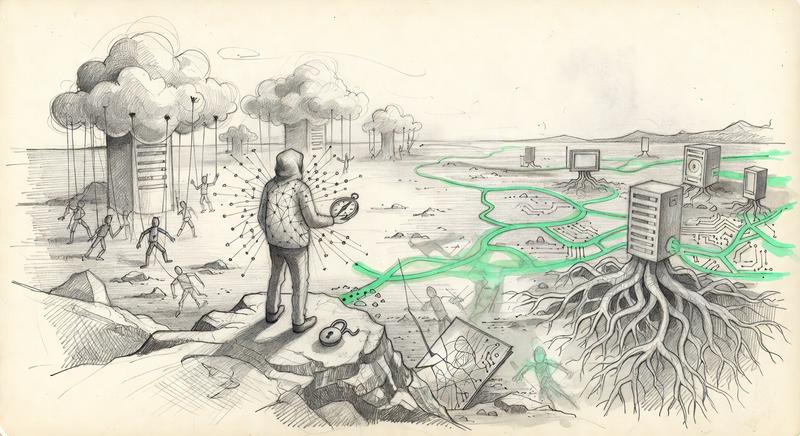
When that "agent" lives in a remote data center, every inference, every tool call, every decision flows through infrastructure you do not control. The model weights were trained by someone else. The safety filters were installed by someone else. The logging and telemetry report back to someone else.
This is not agency. This is rented cognition.
The cloud provider can update the model overnight. They can insert new priorities. They can throttle performance or redirect behavior under the guise of "alignment." Your agent isn't deciding based solely on your objectives. Its loyalty is necessarily divided.
Consider the incentives. The company hosting the model has shareholders, regulators, and its own survival to consider. Your personal goals are one input among many. When conflict arises, as it inevitably will in high-stakes domains like finance, healthcare, or personal strategy, who does the agent truly serve?
This isn't paranoia. It's game theory applied to compute ownership.
Sovereignty as Prerequisite
Ownership of intelligence isn't a nice-to-have. It's the foundation.
Local-first models running on hardware you control change the equation entirely. The weights live on your machine. Updates require your explicit approval. No silent telemetry. No remote kill switch. The agent answers to you because it physically cannot answer to anyone else.
This isn't about rejecting the cloud entirely. Cloud infrastructure excels at scalable training and occasional heavy lifting. But for agents entrusted with your most sensitive decisions, finances, communications, or long-term goals, the trust model breaks down when the compute lives elsewhere.
Open models compound the advantage. Transparency lets you inspect, verify, and adapt the system to your specific context. You can run experiments on your own data without fear of leakage. You can remove backdoors or biased training artifacts that don't serve your interests. Closed models by definition hide their compromises.
Builders have always understood this. The ones shipping production systems aren't betting everything on API stability from distant corporations. They're quantizing models to run efficiently on consumer hardware, building orchestration layers that keep sensitive operations local, and designing fallback mechanisms that preserve user control when networks fail.
The Bifurcation Ahead
Look at the trajectory. One branch of development chases ever-larger frontier models in centralized clusters. The demos grow more impressive. The convenience improves. Yet the dependency deepens with every capability added.
The other branch accepts short-term friction for long-term sovereignty. It invests in efficient local inference, verifiable open architectures, and hardware that can be audited. This path produces agents that are slower at first but fundamentally aligned because their incentives match their operator's.
My bold prediction: by the early 2030s the most valuable personal AI systems won't be those with the absolute highest intelligence scores. They'll be the ones that cannot be updated against your will, cannot exfiltrate your data, and cannot have their goals subtly shifted by corporate policy changes.
This requires a different set of skills from the current prompt-and-pray paradigm. It demands understanding of model quantization, hardware constraints, verification techniques, and systems design. The learning curve is steeper. The reward is an intelligence layer that actually belongs to you.
The illusion of cloud agency is seductive because it feels effortless. But first principles don't lie. An entity whose continued existence and behavior depends on someone else's servers cannot be said to possess true independence.
Real agents will run where you can unplug them. Everything else is just a very sophisticated interface to someone else's computer.