 ← All articles
Rebuild the Pillars From the Bottom Up
Sovereignty, freedom under responsibility and private property: we think the West rests on these three. Twenty years of data show freedom in retreat. We argue the three pillars are slipping with it, and that the repair starts small: a key you hold, a machine you own.
This year's democracy report from the V-Dem Institute contains a sentence that should stop anyone who grew up in Europe or America. The level of democracy for the average citizen in Western Europe and North America is "at its lowest level in over 50 years," mostly, V-Dem says, because of the United States. For the average person on the planet, democracy is "back to 1978 levels." (V-Dem Democracy Report 2026)
Freedom House got there by a different road. Its 2026 report opens flatly: "Global freedom declined for the 20th consecutive year in 2025." Fifty-four countries got worse. Thirty-five got better. (Freedom House)
Twenty years in a row is not a bad patch. We do not claim one cause; the reports point to the United States, coups, wars and incumbents cracking down. We see one pattern worth naming alongside those: power keeps moving up, away from the person.
Three pillars
Not a flag, and not a central bank. We think the West rests on three ideas that fit on a napkin.
Sovereignty of the individual. John Stuart Mill, 1859: "Over himself, over his own body and mind, the individual is sovereign." (On Liberty)
Freedom under responsibility. Mill again. The only purpose for which power can rightfully be used over anyone against his will "is to prevent harm to others." You are free, and you answer for what you do to others. Both halves matter.
Private property. John Locke, 1690. People form governments for "the mutual preservation of their lives, liberties and estates, which I call by the general name, property." And: "The supreme power cannot take from any man any part of his property without his own consent." (Second Treatise)
Now look at your bank statement, your phone and your feed, and ask which of the three is still intact.
Who prints the money?
Start with the money, because every argument rolls back up to it.
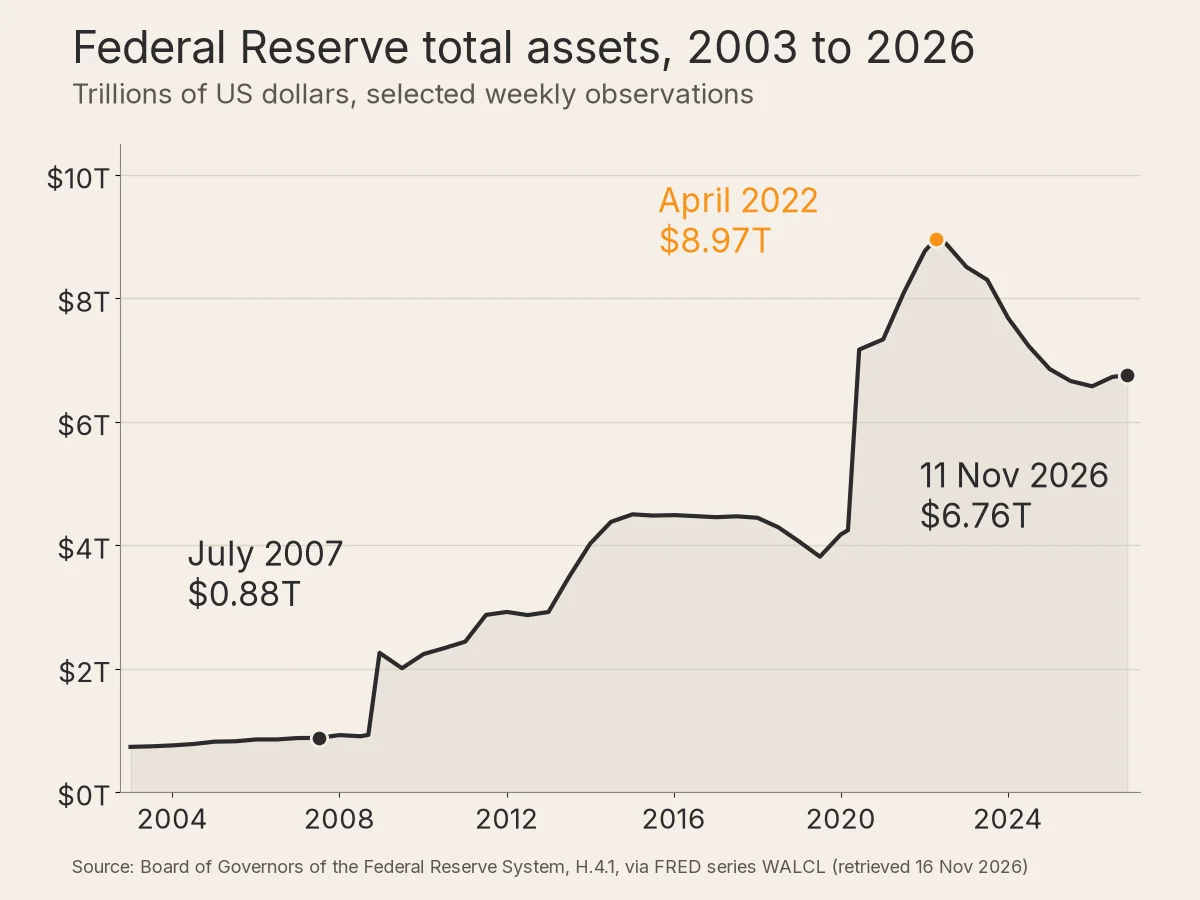
In July 2007 the US Federal Reserve held $0.88 trillion in assets. In April 2022 it held $8.97 trillion, about ten times as much in fifteen years. It shrank to $6.54 trillion by December 2025 and has grown again since, to $6.76 trillion on 11 November 2026. Those assets are mostly bonds paid for with newly created bank reserves: not cash handed out, but new money that enters through the banking system first. (FRED, WALCL)
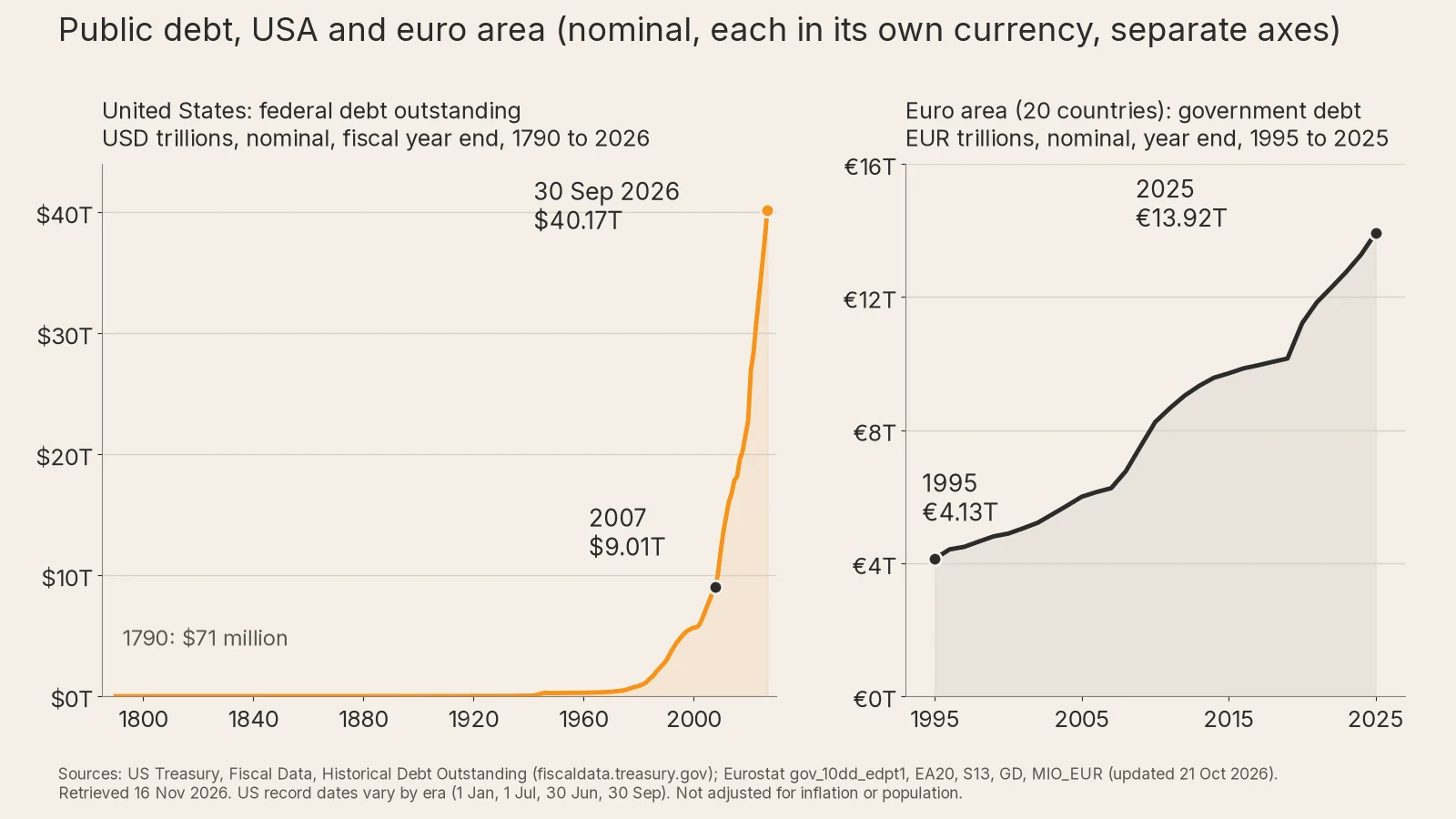
Public debt has climbed too, though not along the same line. Against GDP, US federal debt rose from about 62% in the third quarter of 2007 to about 121% in mid-2026. Government debt of the 20 countries using the euro in 2025 went from about 72% of GDP in 1995 to about 88% in 2025. The measures differ: the US figure is gross federal debt, including what one part of government owes another, while the euro figure is consolidated general government debt. The chart shows the nominal totals in each currency; euro figures before 1999 are converted from national currencies. (FRED, Eurostat, US Treasury)
New money does not land on everyone at once. Richard Cantillon described this in an essay published in 1755, and economists still call it the Cantillon effect. A Monash University paper that modelled it found that a money injection "benefits first recipients of the new money, but hurts later recipients and savers." (Cheng and Angus, 2012) The channel matters: a Bank of Canada staff paper finds that an operation raising the supply of bonds lowers inequality, with poorer households gaining most. (Bustamante, 2021) How money enters decides who gains.
Our reading: who stands closest to the printer today? Banks, governments and whoever can borrow against assets first. Who stands furthest away? The person living on wages and savings. We do not see that as a market result. We see a seating plan.
Who owns the data?
The second leak is quieter, and it lives in our pockets.
Shoshana Zuboff, professor emerita at Harvard Business School, defines surveillance capitalism as "the unilateral claiming of private human experience as free raw material for translation into behavioral data." Those data become prediction products, sold to business customers "with a commercial interest in knowing what we will do now, soon, and later." (Harvard Gazette)
Here we part ways with the usual critics. The problem is not markets, and it is not profit. A market is a voluntary trade between two owners. One side pays, the other delivers, and both walk away better off. A data moat is something else. One side keeps a copy of the other side's life and sells predictions about it to a third party who was never in the room.
When that becomes the model, the builder's compass can flip. The question stops being "is this product better?" and becomes "how much can we learn about the user?" Innovation still happens. It just points at the user instead of serving them. The best companies resist that pull, and markets reward them when customers can leave.
Friedrich Hayek explained in 1945 why free markets beat central planners. The knowledge that matters "never exists in concentrated or integrated form but solely as the dispersed bits of incomplete and frequently contradictory knowledge which all the separate individuals possess." Prices let millions of people act on what only they know, without asking anyone. (The Use of Knowledge in Society)
A data moat pulls some of those dispersed bits back into one company's servers. It is not central planning, but it concentrates what Hayek wanted dispersed.
Left, right, same arrow
The free-market economist looks at the printer and sees a hidden tax. The left-wing critic looks at the platform and sees exploitation. The civil libertarian looks at twenty years of Freedom House scores and sees rights eroding. Three stories, three villains, one shape: decisions, data and money flow up to fewer hands, and risk flows down.
Albert Hirschman gave us the words in 1970 in Exit, Voice, and Loyalty. When an organization declines, you can exit, which means quitting or switching to a competing product, or use voice, which means pushing for change from within. (Harvard University Press) He also warned that easy exit can undercut voice, because the most alert customers leave instead of complaining. We take that seriously. But where exit is costly, as with a currency or a platform that holds your friends, files and history, voice has little weight behind it.
Rebuild from the bottom
So where does repair start? Not by finding better people for the top. Every generation tries that.
Elinor Ostrom won the 2009 Nobel Prize in economics for showing that communities can govern shared resources without one state or one owner. Her Nobel lecture, quoting Vincent Ostrom, Charles Tiebout and Robert Warren (1961), describes polycentric order as "many centers of decision making that are formally independent of each other." (Nobel lecture) Her centers are institutions at many scales, not lone individuals. People who hold their own keys can strengthen such institutions, not replace them.
Engineers reached a similar answer in 1964. Paul Baran at RAND compared centralized and distributed networks, and his simulations indicated that "highly efficient routing can be performed by local control," with no central control point to destroy. (RAND RM-3420) That work helped shape the internet.
In 2008 Satoshi Nakamoto applied the idea to money: "A purely peer-to-peer version of electronic cash would allow online payments to be sent directly from one party to another without going through a financial institution." (Bitcoin whitepaper) No central issuer. A published issuance schedule that anyone running a full node can verify. Early miners were first in line too, but under rules public from day one.
That gives each pillar a possible physical home:
- Sovereignty becomes a key you hold, not an account someone grants you.
- Freedom under responsibility becomes a rule: the sender pays for each message, and the recipient sets who gets in and on what terms.
- Property becomes a machine you own and money whose rules no central issuer can change on its own.
Add Hirschman's exit and voice at the scale of one person: your node runs your rules, and your keys leave with you. Keys are only half of exit, though. A seed restores an identity, not messages or history, and a lost key is a lost identity.
Our bet
This is why we are working on BitSov. It is a proposal, not a product. Today it runs as a closed beta on signet test nodes.
The idea is simple. Each person runs a home node. Identity is a key derived from a seed that only that person holds, with, in the whitepaper's words, "no account, no registration, and no platform namespace authority." Nodes talk node to node. The design rule is that a node does no service for a stranger, beyond receiving the first paid contact, until a payment settles: "no service without settlement." The beta uses signet test coins with no value, and the pre-payment handshake is still an open attack surface. (BitSov whitepaper)
Our position paper with researchers at the University of Southern Denmark, published in the IEEE ICSA 2026 companion proceedings, sketches the wider stack: Bitcoin at the base, then connectivity, identity, payments, storage and messaging above it. It is honest about what is still open. Scalability "has not been empirically validated," and governance before a community exists "is not fully addressed." (Larsen, Larsen and Moghaddam, 2026) We would rather print that than sell a utopia.
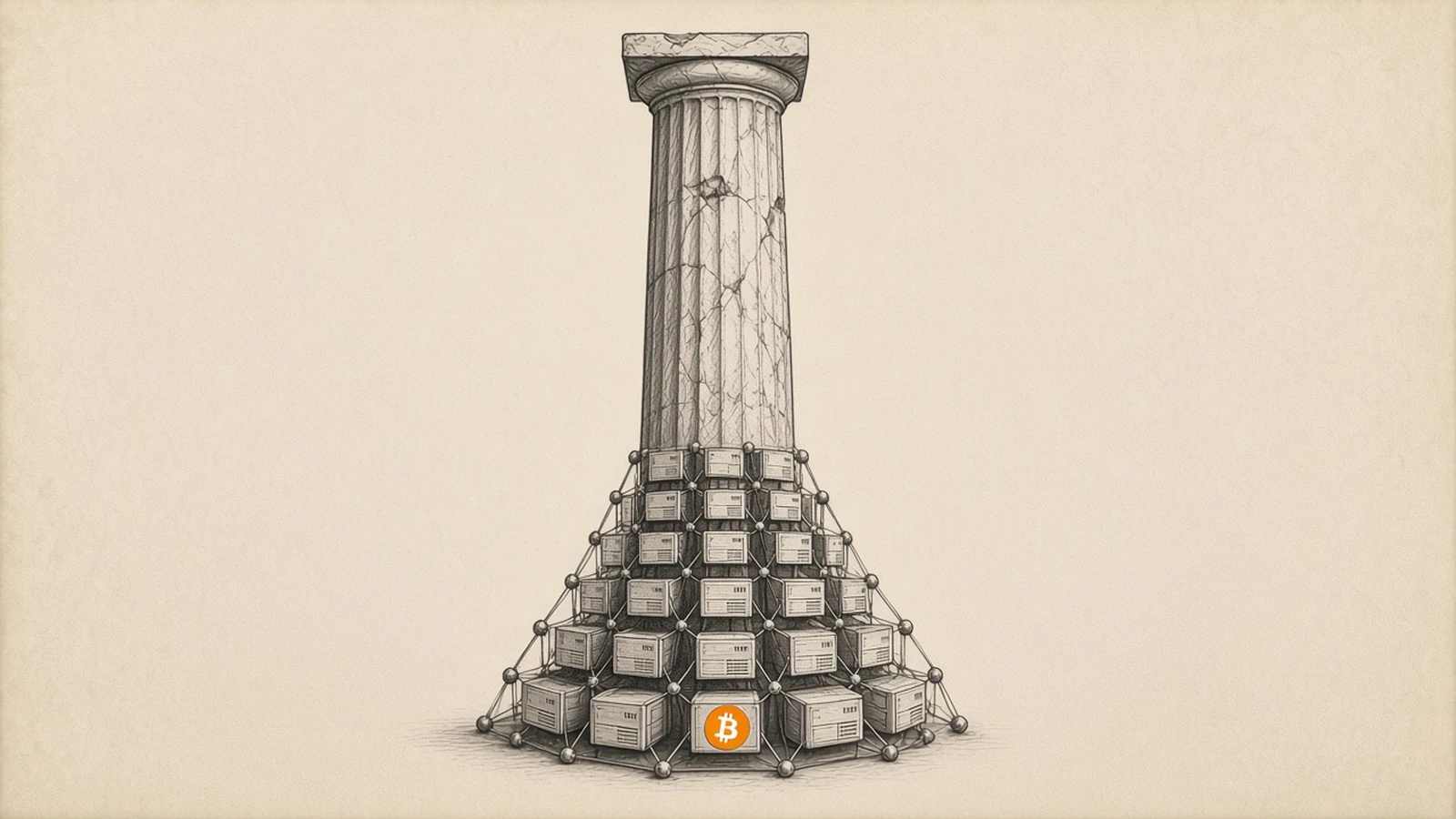
None of this replaces parliaments, courts or ballot boxes, and a node is not a vote. BitSov does not fix the state. It aims at something smaller and, we think, more durable: moving part of the foundation back under the individual. A key you hold, a machine you own. Build enough of them, and perhaps one day link them in a mesh, and the column stands on many small stones instead of one big one.
Parliaments, courts and open markets keep the column standing. We want to make the stones at the bottom stronger.
Sources
- V-Dem Institute (M. Nord, D. Altman, T. Fernandes, A. Good God and S. I. Lindberg), Democracy Report 2026: Unraveling the Democratic Era? https://www.v-dem.net/publications/democracy-reports/
- Freedom House, Freedom in the World 2026: The Growing Shadow of Autocracy. https://freedomhouse.org/report/freedom-world/2026/growing-shadow-autocracy
- John Stuart Mill, On Liberty (1859), Project Gutenberg. https://www.gutenberg.org/files/34901/34901-h/34901-h.htm
- John Locke, Second Treatise of Government (1690), Sect. 123 and 138, Project Gutenberg. https://www.gutenberg.org/files/7370/7370-h/7370-h.htm
- Board of Governors of the Federal Reserve System, Total Assets (WALCL), H.4.1, via FRED, retrieved 16 Nov 2026. https://fred.stlouisfed.org/series/WALCL
- US Office of Management and Budget and Federal Reserve Bank of St. Louis, Federal Debt: Total Public Debt as Percent of GDP (GFDEGDQ188S), Q3 2007 and Q2 2026, via FRED. https://fred.stlouisfed.org/series/GFDEGDQ188S
- Eurostat, gov_10dd_edpt1, euro area (EA20, the 20 countries using the euro in 2025), general government consolidated gross debt, EUR million and % of GDP, updated 21 Oct 2026. https://ec.europa.eu/eurostat/databrowser/view/gov_10dd_edpt1/default/table
- US Treasury, Fiscal Data, Historical Debt Outstanding (1790 to 2026, fiscal year end), retrieved 16 Nov 2026. https://fiscaldata.treasury.gov/datasets/historical-debt-outstanding/
- Cheng and Angus, "The Cantillon Effect of Money Injection through Deficit Spending", Monash University Discussion Paper 12/12 (2012). https://www.monash.edu/business/economics/our-research/working-papers/_archive/2012/1212cantilloneffectchengangus.pdf
- Christian Bustamante, "More Money for Some: The Redistributive Effects of Open Market Operations", Bank of Canada Staff Working Paper 2021-46. https://www.bankofcanada.ca/wp-content/uploads/2021/09/swp2021-46.pdf
- Harvard Gazette, "Harvard professor says surveillance capitalism is undermining democracy" (interview with Shoshana Zuboff, March 2019). https://news.harvard.edu/gazette/story/2019/03/harvard-professor-says-surveillance-capitalism-is-undermining-democracy/
- Friedrich A. Hayek, "The Use of Knowledge in Society", American Economic Review 35(4), 1945, via Econlib. https://www.econlib.org/library/Essays/hykKnw.html
- Albert O. Hirschman, Exit, Voice, and Loyalty (1970), Harvard University Press. https://www.hup.harvard.edu/books/9780674276604
- Elinor Ostrom, "Beyond Markets and States: Polycentric Governance of Complex Economic Systems", Nobel Prize lecture, 8 Dec 2009, quoting V. Ostrom, C. M. Tiebout and R. Warren, "The Organization of Government in Metropolitan Areas: A Theoretical Inquiry", American Political Science Review 55(4), 1961. https://www.nobelprize.org/prizes/economic-sciences/2009/ostrom/lecture/
- Paul Baran, On Distributed Communications: I. Introduction to Distributed Communications Networks, RAND RM-3420 (1964). https://www.rand.org/pubs/research_memoranda/RM3420.html
- Satoshi Nakamoto, "Bitcoin: A Peer-to-Peer Electronic Cash System" (2008). https://bitcoin.org/bitcoin.pdf
- MindLink, BitSov whitepaper (published 19 July 2026, revised 31 October 2026). https://mindlink.tech/bitsov/whitepaper
- O. A. Larsen, R. T. Larsen and M. T. Moghaddam, "BitSov: A Composable Bitcoin-Native Architecture for Sovereign Internet Infrastructure", 2026 IEEE ICSA Companion (ICSA-C), pp. 273-276. https://arxiv.org/abs/2603.28727 (DOI 10.1109/ICSA-C68850.2026.00060)