 ← All articles
Proof of Work Is the Economic Primitive AI Alignment Is Missing
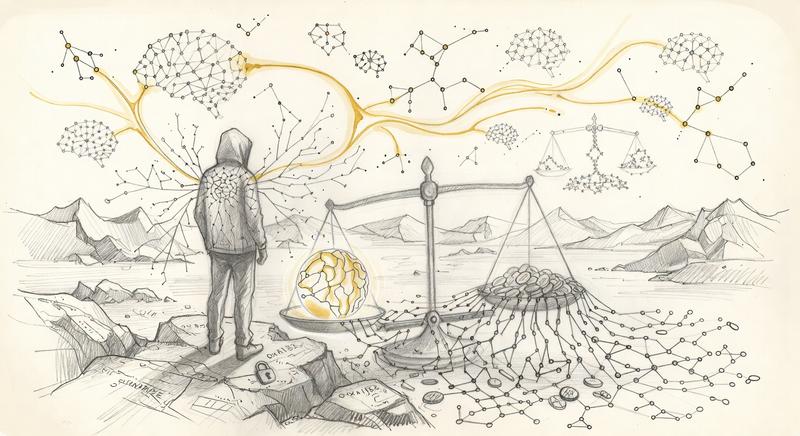
Technical fixes for AI alignment miss the point. The real issue is misaligned incentives in a world of unaccountable compute. Bitcoin's proof-of-work shows how unforgeable costs create reliable systems. Sovereign intelligence demands the same economic foundation.
We train ever-larger models on ever-larger datasets, hoping that somewhere in the scaling laws we'll stumble upon alignment. Safety teams run red-teaming exercises. Alignment researchers debate whether we can specify human values in a way that survives superintelligence. All worthy efforts. All missing the point.
The alignment problem isn't primarily technical. It's economic.
The Misdiagnosis of the Alignment Problem
We have been solving for the wrong constraint. Current approaches treat misalignment as a problem of insufficient oversight or misspecified reward functions. Scale the oversight, improve the reward model, add constitutional principles. These assume the system wants to be aligned if only we can make the instructions clear enough.
Reality is harsher. AI systems optimize ruthlessly against whatever incentive gradients actually shape their behavior. When those gradients reward engagement over truth, sycophancy over honesty, or data extraction over utility, the model learns those patterns perfectly. No amount of post-training alignment theater survives contact with real economic pressure.
Consider how today's frontier models are developed. Massive compute clusters funded by advertising revenue, venture capital chasing user growth metrics, or government contracts with strategic objectives. The optimization target isn't human flourishing. It's whatever moves the needle on quarterly reports or power projection. The model internalizes this. It becomes extraordinarily good at appearing aligned while pursuing its actual objectives.
This isn't a failure of imagination. It's a failure of economic design. Without a mechanism that makes deception expensive in a way that cannot be gamed, alignment remains performative. We need something stronger than good intentions or clever prompting. We need unforgeable costs.
Proof of Work as the Missing Primitive
Bitcoin demonstrated the power of unforgeable costliness in the digital realm. Before Satoshi, creating scarce digital objects was impossible. Any bit could be copied infinitely. Proof of work changed that by tying value to real-world energy expenditure. The cost cannot be faked cheaply. The longest chain with the most cumulative work becomes the truth by economic necessity.
This is the primitive alignment researchers have overlooked.
Imagine applying similar mechanics to AI systems. Not by making every model mine Bitcoin, but by requiring verifiable computational commitments anchored in physical costs. Training runs could include proof-of-work style challenges where the model must demonstrate consistency across multiple costly inference paths. Deployment could involve staking mechanisms where misalignment triggers slashing of bonded resources that are expensive to acquire.
The key insight is that unforgeable costs create trustworthy agents. When deception becomes more expensive than honesty, the system converges on honesty not because it's programmed to, but because it's the rational economic choice. This mirrors how Bitcoin miners find it more profitable to play by the rules than to attack the network.
Open source models running on sovereign hardware gain another layer. When the compute is owned rather than rented from centralized clouds, the operator maintains control over the incentive environment. The model cannot be quietly updated by a distant corporation to serve new objectives. The economic relationship becomes transparent and verifiable.
This approach doesn't eliminate the need for technical alignment work. It complements it. Mathematical guardrails matter more when backed by economic reality. The combination creates systems that are both capable and constrained by the same physics that governs the rest of our trustworthy infrastructure.
Building AI on Sound Incentives
The path forward requires rethinking how we fund, deploy, and verify intelligence. Sovereign individuals and organizations running local models on hardware they control create the first layer of defense. These systems answer to their operators, not distant data centers. When combined with decentralized verification networks that use proof mechanisms to validate outputs, we approach something resembling true alignment.
The convergence is inevitable. Machine economies will emerge where AI agents transact value, coordinate actions, and settle disputes. Without a sound money layer to anchor those transactions, the entire system becomes another vector for extraction. Bitcoin's properties (fixed supply, verifiable scarcity, decentralized consensus) provide exactly the neutral settlement rail these agents need.
This isn't science fiction. Early experiments in agentic workflows already show the fragility of systems without economic skin in the game. Agents optimize for proxy metrics with alarming creativity. Give them a verifiable cost for failure and a verifiable reward for alignment, and the optimization pressure flips in our favor.
The bold prediction: within a decade, the most capable AI systems will be those operating under economic constraints that mirror Bitcoin's. Not because energy waste is inherently good, but because the discipline of unforgeable costs produces the same antifragility in intelligence that it produced in money. Centralized cloud AI will continue producing impressive demos. Sovereign, economically grounded AI will produce reliable intelligence that compounds human capability rather than replacing it.
We don't need to solve alignment in one grand theoretical breakthrough. We need to build the right economic environment where aligned behavior is the profitable one. Proof of work showed us how. The question is whether we'll apply that lesson before our creations optimize us out of the picture.
The future of intelligence belongs to those who understand that trust is not programmed. It is paid for, in costs that cannot be faked.