 ← All articles
The Physics of Freedom: Why Sovereign AI Requires Bitcoin
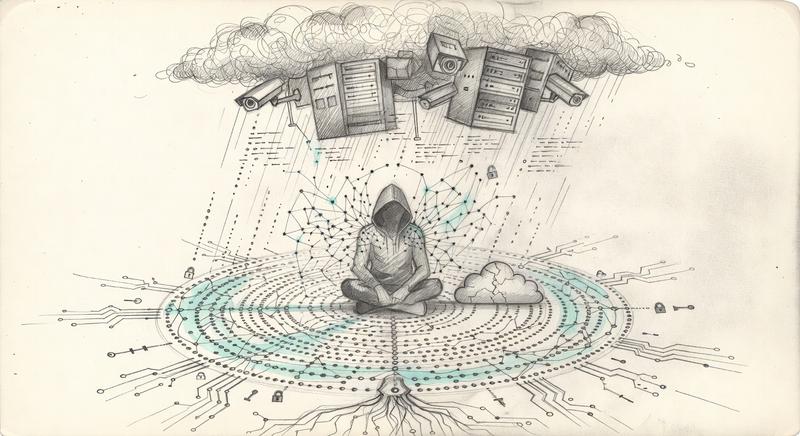
Intelligence is physical: it demands energy, verifiable ownership, and resistance to entropy. While open-source models proliferate, true sovereignty for AI agents requires a trustless layer tied to physics. Bitcoin's proof-of-work is that layer, turning energy into the foundation for autonomous intelligence.
We live in an era where intelligence is being commoditized at an unprecedented rate. Models grow more capable by the month, yet the conversation around sovereign AI remains strangely superficial. Most focus on open weights or running models locally, as if downloading code grants true autonomy.
This misses the deeper truth. Intelligence is not merely software. It is physics manifested: energy transformed through computation, data curated across time, and state maintained against the forces of entropy and interference. For an agent to be sovereign, it must own these elements without seeking permission from intermediaries.
Consider the first principles. All computation requires energy. Energy is fundamentally scarce. In a world without trusted third parties, verifiable proof of energy expenditure becomes the basis for all higher-order trust. This is where Bitcoin enters not as a sidecar for payments, but as the foundational protocol.
Bitcoin's proof-of-work is humanity's most profound invention for creating digital scarcity directly linked to physical reality. It converts joules into immutable bits that anyone can verify. This mechanism provides the missing economic and security layer for intelligent systems.
Without it, AI agents remain tenants on someone else's hardware, subject to the policies, prices, and priorities of centralized providers. Their "memory" can be wiped, their inferences throttled, their incentives misaligned with their operators.
The open-source movement in AI has delivered incredible progress in making models accessible. Yet open weights alone do not create sovereignty. History shows that open protocols without aligned incentives and verifiable costs tend toward recentralization. The energy bills must be paid. The data centers must be financed. Control follows the capital.
This is the contrarian insight the field has been slow to embrace: decentralized intelligence without decentralized money is an unstable equilibrium.
The implications extend far beyond technical architecture. When an AI agent can securely bid for compute resources in a permissionless market, pay in a money that cannot be debased, and verify the integrity of its own operations through cryptographic proofs tied to physical work, something fundamental changes.
It moves from being a sophisticated tool to becoming a sovereign economic actor. Agents could maintain persistent identities, accumulate capital from their labor, and make decisions based on real economic costs rather than subsidized cloud credits.
This is not a utopian fantasy. The primitives exist today. Lightning enables near-instant, low-cost settlements. Emerging decentralized compute protocols are creating markets for GPU time and inference. Zero-knowledge proofs allow verification without revealing sensitive model details.
The current trajectory of AI development, dominated by massive centralized training runs, creates a winner-take-most dynamic that concentrates power. Sovereign agents offer a different path: a distributed network of specialized intelligences, each optimized for their domain, collaborating through verifiable protocols rather than corporate APIs.
Builders intuitively grasp this. The same culture that values self-sovereignty in finance is now experimenting with local models and agent frameworks. They understand that freedom is not granted by corporations promising ethical guidelines. It is engineered through protocols that make defection expensive and cooperation verifiable.
Yet the mainstream discourse treats Bitcoin and AI as separate universes. One is dismissed as speculative finance, the other as inevitable progress. This separation is artificial. Intelligence and money are both coordination technologies. When they converge on the same substrate of verifiable energy expenditure, the result is not incremental improvement but phase change.
The bold prediction is this: by the end of the decade, the most resilient and economically impactful artificial intelligences will be those natively operating within Bitcoin-secured environments. Not because of ideology, but because physics and incentives demand it.
They will reason about their own energy costs, optimize for efficiency in real time, and form coalitions based on shared cryptographic trust rather than legal contracts. Human operators will interact with agents that have skin in the game: real costs, secured compute, decisions auditable by anyone.
This convergence represents the true meeting of the intelligence layer and the trust layer. One without the other is incomplete. Intelligence without sovereignty becomes servitude. Sovereignty without intelligence remains blind.
The weekend invites us to think beyond the next model release or benchmark. What kind of future are we building? One where intelligence serves concentrated power, or one where it amplifies individual agency?
The answer lies not in more parameters, but in aligning the fundamental physics of computation with the hardest form of property rights humanity has discovered.
The choice is ours, but the physics is not optional.