 ← All articles
Open Source Agentic Breakthrough Proves Intelligence Must Be Owned Not Rented
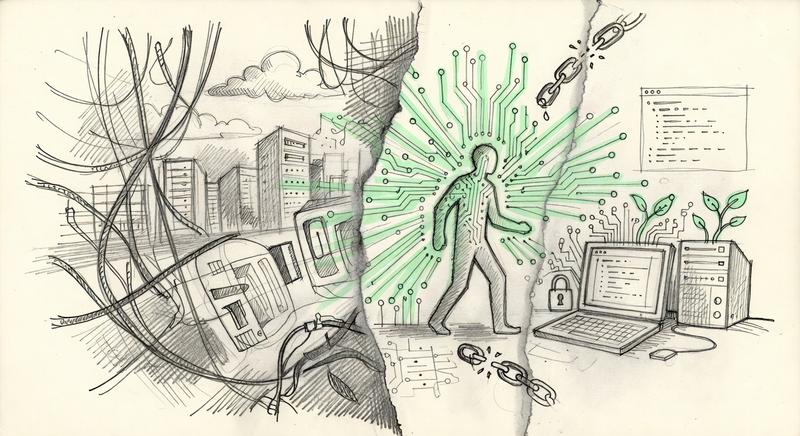
A major new open-source agentic framework has achieved impressive results in real-world autonomy benchmarks without relying on cloud infrastructure. This development reinforces that true intelligence must be owned, not rented from centralized providers, marking a pivotal moment for sovereign AI.
The news broke quietly this afternoon in US time but is already rippling through developer communities and AI research circles. An open-source agentic framework, built on the latest wave of efficiently quantized models, has achieved a significant milestone: matching or exceeding the performance of leading closed-source systems on a suite of real-world autonomy benchmarks. All while running completely locally, with zero cloud dependency.
This isn't another incremental improvement. It's proof that the era of sovereign AI is technically feasible today.
Why Local Autonomy Changes Everything
For too long, AI has been synonymous with centralized power. You send your prompts to a distant data center, hope the model behaves, and accept that your data, your context, and your agent's reasoning traces are now part of someone else's training corpus. The convenience was seductive. The lock-in was subtle.
The new framework flips this script. By combining recent advances in model compression, efficient inference engines, and sophisticated agent orchestration patterns that emphasize reflection and tool use, it creates agents that can handle complex, multi-step tasks with remarkable independence.
The key insight is that intelligence doesn't require scale, it requires control.
These agents don't just follow instructions. They plan, execute, observe outcomes, correct course, and even refine their own approaches within the bounds of their local environment. Early reports suggest they excel at tasks ranging from research synthesis to code generation to personal workflow automation, all without leaking data or depending on an internet connection after initial setup.
This matters because sovereignty in AI is not a luxury; it's a necessity. When your agents operate under someone else's roof, you're not building intelligence. You're renting it. And rented intelligence comes with terms of service that can change overnight, pricing models that scale with usage, and the constant background risk of surveillance or manipulation.
The breakthrough also highlights how far open-source has come. What was once dismissed as lagging behind the closed frontier labs is now competitive in the domains that matter most for real users: reliability, privacy, and independence. The community has taken the best ideas from frontier research and made them accessible, auditable, and deployable on consumer-grade hardware.
This development arrives at a perfect time. With growing awareness of data privacy concerns, regulatory pressure on large AI providers, and increasing corporate demand for on-premise solutions, the market is primed for exactly this kind of local-first approach. It's not anti-cloud. It's pro-choice. The option to own your stack rather than perpetually rent it.
What This Means for Builders and Organizations
The practical implications are profound. Developers can now prototype and deploy agentic systems that previously required expensive API credits and carried compliance risks. Small teams can compete with larger organizations not by scaling compute but by scaling sovereignty.
For enterprises, this opens doors to AI deployment models that align with existing data governance policies. Instead of negotiating complex data processing agreements with cloud providers, they can run agents on their own infrastructure. The auditability of open-source code provides the transparency that closed models can never offer.
The real revolution isn't in the benchmark numbers. It's in the power dynamics.
We've spent years watching AI centralize around a handful of companies with massive compute resources. This breakthrough suggests a different trajectory, one where intelligence becomes democratized not through access to APIs but through access to the means of computation and the freedom to modify the underlying systems.
Of course, challenges remain. Local models still lag in some creative and reasoning tasks where scale provides an edge. Inference hardware requirements, while improving, aren't trivial for the most capable models. The agent orchestration layer itself requires careful engineering to prevent hallucinations or inefficient loops.
Yet the trajectory is clear. Hardware is getting more efficient. Models are getting smaller and smarter. The software patterns for reliable agents are maturing rapidly. What seemed like a distant dream, truly personal, sovereign AI that lives on your devices and servers, is materializing faster than most predicted.
The Sovereign Intelligence Imperative
This isn't just about technology. It's about the nature of intelligence in a digital age. If your thoughts, plans, and decisions are mediated through systems you don't control, how sovereign are you really?
The agents we build will increasingly act on our behalf in the world: negotiating, researching, creating, deciding. If those agents are loyal to distant corporations rather than to their operators, we risk outsourcing not just computation but agency itself.
The open-source agentic breakthrough reminds us that another path is possible. One where AI augments human sovereignty rather than eroding it. Where intelligence is distributed, verifiable, and owned by the people and organizations that depend on it.
As this technology matures, the choice becomes stark: rent your intelligence from the cloud or own it outright. The former offers convenience at the cost of dependence. The latter demands more upfront work but delivers true freedom.
The future belongs to those who choose ownership. The tools are here. The only question is whether we'll have the wisdom to use them.
This evening's news isn't the end of the story. It's the clearest signal yet that the sovereign AI movement has moved from theory to working code. The agents are waking up, and for the first time, many of them can wake up on hardware that we control.