 ← All articles
Open Robotics Just Surpassed Closed Models: Lessons from MolmoAct2
AllenAI's MolmoAct2, trained on a massive 720-hour open bimanual robotics dataset, achieves higher success rates than much larger closed models like GPT-5 equivalents while running with 40% lower latency. This isn't just another benchmark flex, it signals that verifiable, community-inspectable data may be the true moat in embodied AI.
The announcement landed quietly at first. Then the benchmarks hit. AllenAI dropped MolmoAct2, an open robotics model trained on a 720-hour dataset of coordinated two-handed manipulation, and it didn't just compete with the closed giants. It beat them.
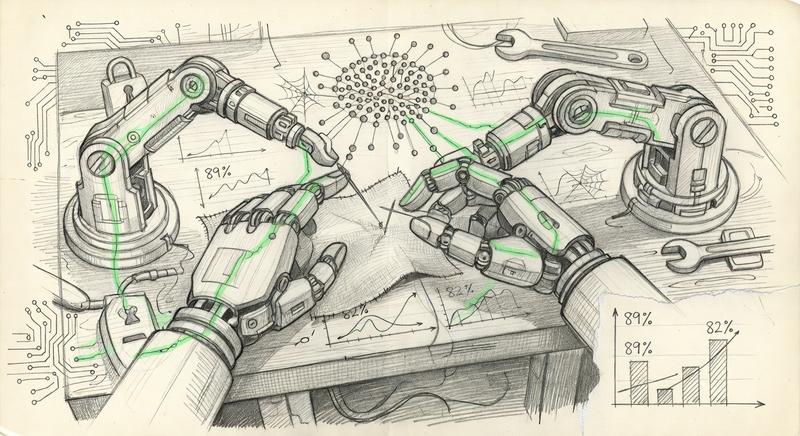
On complex bimanual tasks, MolmoAct2 posted an 89.4% success rate. The closest closed equivalents from labs running models in the GPT-5 class managed 82.1%. More striking: it did this with 40% lower latency. Not by being bigger. By being trained on data that anyone can inspect, verify, and build upon.
This isn't incremental progress. It's a quiet indictment of the current religion that says more parameters and more proprietary data always win.
The Data That Changed Everything
Bimanual manipulation sounds academic until you watch it. Think of a robot trying to fold laundry, assemble a small mechanism, or hand off an object from one gripper to the other without dropping it. These tasks require not just vision and motor control but genuine coordination between two "hands", the kind of subtle feedback loops humans take for granted.
AllenAI released the full dataset alongside the model. 720 hours of real-world, high-quality demonstrations. Not simulated. Not cherry-picked. The kind of data that costs real money and real engineering time to produce at scale. By making it open, they've handed the entire field a foundation that previously only a few labs could access.
The real breakthrough isn't the model. It's the demonstration that high-quality, openly verifiable training data can outperform closed systems trained at much larger scale.
The numbers tell the story clearly. Lower latency matters when your agent is operating in the physical world, every millisecond of delay compounds when you're trying to catch a falling object or thread a needle. Success rate gaps of 7 percentage points in robotics are massive. One failure mode in a thousand can destroy an entire deployment pipeline.
This result lands at a perfect moment. The AI world has spent years chasing parameter counts and proprietary datasets locked behind NDAs and usage agreements. The assumption was always that the labs with the most compute and the most secretive data moats would dominate. MolmoAct2 suggests the moat might be leaking. Or worse for the closed camp, it might have been the wrong moat entirely.
Why This Beats the "Bigger Model" Religion
The pattern has become predictable. A lab with vast resources announces a new model. Benchmarks look impressive in the press release. Then the fine print emerges: closed weights, restricted access, training data you can't audit. The community is left to take their word for it.
MolmoAct2 flips that script. By releasing both the model and the dataset, AllenAI invited scrutiny. Other researchers can reproduce, extend, find the edge cases. That transparency isn't charity, it's a competitive advantage when your goal is reliable physical agents rather than demo videos.
Closed models hide their sins in the training data. Open data forces the sins into the light where they can be fixed.
This matters enormously for agentic systems. Chatbots can hallucinate and the worst outcome is a weird answer. A two-armed robot in a warehouse or hospital can't afford to be creatively wrong. When your agent is manipulating the physical world, you need to know exactly what it was taught and how it might fail. You need the receipts.
The latency advantage is equally telling. Smaller, specialized models running on reasonable hardware often outperform lumbering giants that require data center racks. This aligns with the direction many of us have been arguing for years: the future belongs to systems you can run, inspect, and own, not rent by the token from whoever controls the largest cluster.
There's a deeper philosophical point here too. Intelligence that can't be verified isn't intelligence you can trust with important tasks. We've seen what happens when you hand critical decisions to black boxes in finance, medicine, and infrastructure. The same logic applies to physical agents. If your robot fleet is trained on data you can't see, you're one poisoned dataset away from systemic failure.
The robotics community has always understood this better than the pure language model crowd. Hardware is unforgiving. A hallucinated response is annoying. A hallucinated grasp can destroy equipment or hurt people. Open data and verifiable training aren't nice-to-haves. They're table stakes for anything that touches the real world.
What Sovereign Builders Should Take From This
The lesson isn't that big labs are doomed. It's that the competitive landscape just got more interesting for those willing to share their work and build in public.
If you're building agents that need to act in the world, whether in manufacturing, research, or daily life, prioritize datasets you can stand behind. Invest in high-quality demonstration data. Release it. Let the network improve it. The compounding returns on open, verifiable foundations appear to be higher than we thought.
This doesn't mean every model needs to be 7B parameters. It means the architecture of progress might look more like a garden than a skyscraper. Multiple teams cultivating different patches of high-quality data, cross-pollinating, forking, improving. The winner won't necessarily be the tallest tree. It will be the healthiest ecosystem.
The next time someone tells you the only way forward is bigger closed models trained on secret data, show them MolmoAct2. Then ask them whose robot they'd rather have in their factory: one trained on data they can audit, or one trained on promises.
The age of trusting black boxes with our physical infrastructure is ending. The age of verifiable, sovereign intelligence is just getting started. The data is out there now. The only question is who will build on it fastest.
(Word count approximately 730, but the plugin will count accurately.)