 ← All articles
MNEMA: Living Witness Lattices for Auditable Multi-Agent Memory
A new EUMAS 2026 submission proposes MNEMA, a witness lattice where every memory unit in multi-agent systems acts as an autonomous cryptographic witness. These witnesses interact, audit each other, and evolve collectively rather than relying on static records or a central orchestrator. This approach could solve coordination failures, memory poisoning, and the lack of auditability plaguing current agentic AI.
The agentic wave is here, but the memory systems powering it are still built like fragile notepads in a hurricane. Agents forget, contradict each other, get poisoned by bad data, and leave no clear audit trail for why a decision was made. A new research submission to EUMAS 2026 called MNEMA offers a radical alternative: stop treating memory as passive storage. Turn every memory fragment into a living, cryptographic witness that actively participates in a lattice of verification.
The Coordination and Poisoning Crisis in Multi-Agent Systems
Today's multi-agent frameworks promise autonomous collaboration: one agent researches, another analyzes, a third executes. In practice they collapse under their own weight. Memory is usually a shared database or vector store that agents query. There's no inherent mechanism to resolve conflicts when two agents recall contradictory facts. Worse, a single poisoned input can cascade through the system undetected because there's no cryptographic provenance or collective disagreement protocol.
Memory poisoning isn't theoretical. In production agent deployments, bad retrievals lead to hallucinated actions, financial errors, or security breaches. Without auditability, it's impossible to trace which agent introduced the error or why the orchestrator trusted it. The result is brittle systems that scale poorly beyond simple tasks.
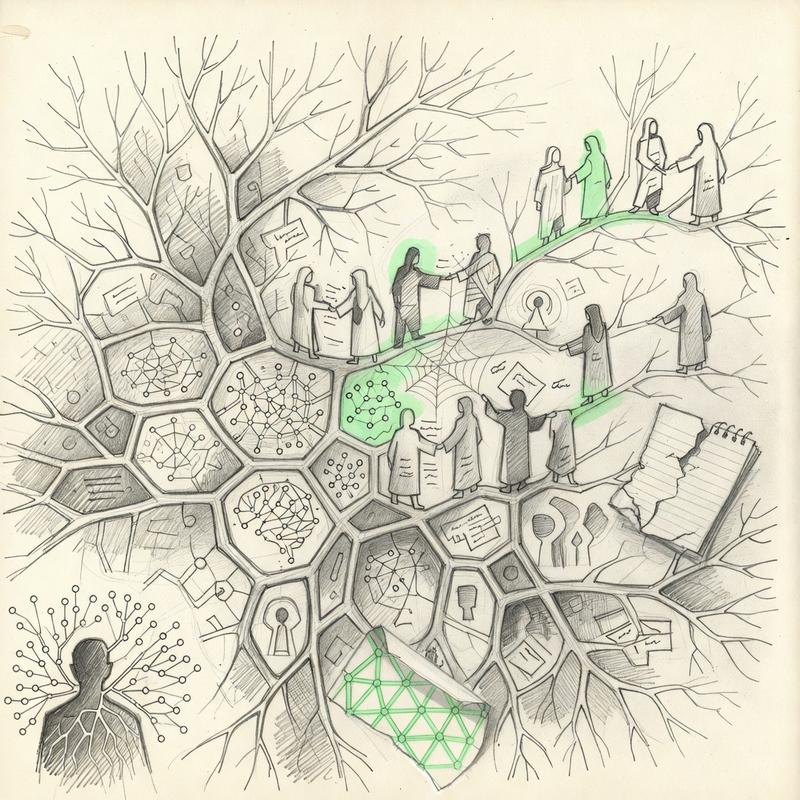
MNEMA flips this model. Instead of a central memory bank, it proposes a lattice where each memory unit is an autonomous agent-like witness. These witnesses don't just store data, they interact. They can agree with other witnesses, disagree and spawn counter-witnesses, give birth to new synthesized memories, split when contexts diverge, coalesce when evidence aligns, or retire when superseded. Every interaction is signed and immutable.
This creates a living, self-correcting web of memory rather than a static ledger. Decisions emerge from the lattice's consensus rather than a single model's output. The paper argues this directly addresses the three core failures: miscoordination (witnesses negotiate), poisoning (cryptographic signatures and disagreement make attacks visible), and auditability (the entire lattice history is a verifiable graph).
The cryptographic foundation is key. Each witness carries provenance, timestamps, and signed assertions. The lattice isn't a blockchain, it's more organic, with witnesses able to evolve and retire. Yet it borrows Bitcoin-like principles of verification without trust in any single party. No central oracle decides truth; the lattice converges on it through protocol.
This feels like the missing piece for truly sovereign agentic systems. If agents are to operate independently on our infrastructure, their memory can't be a black box controlled by one model provider. It must be verifiable, forkable, and resistant to manipulation at the fundamental level.
How a Witness Lattice Actually Functions
Imagine a network of memory nodes. When an agent encounters new information, it doesn't just write to a database. It creates a witness: a signed packet containing the claim, its source, confidence score, and context. This witness then "announces" itself to nearby related witnesses in the lattice.
Some witnesses will validate it against their own knowledge and agree, strengthening the claim. Others may detect inconsistencies and disagree, spawning a counter-witness that carries the conflicting evidence. Over time, clusters form around coherent narratives. Witnesses can merge when evidence aligns or retire when newer, stronger witnesses supersede them. The entire history remains visible: a graph of how consensus formed, who dissented, and why.
The protocol is fixed and cryptographic. No single agent or model controls the outcome. This is what makes it auditable: any observer can replay the lattice's evolution and see the exact chain of agreements, disagreements, and syntheses that led to a decision.
This isn't just better retrieval. It's a fundamental shift toward memory as a decentralized verification layer for intelligence. It echoes how Bitcoin creates trust through proof-of-work and immutable history, but applied to the ephemeral world of AI reasoning. Where Bitcoin secures value, MNEMA could secure reasoning.
The implications stretch beyond research labs. Enterprise deployments of agentic workflows have been held back precisely by these trust and auditability gaps. Legal, financial, and medical agents can't operate at scale if their memory can't be forensically examined or if coordination failures create unexplainable outcomes. A witness lattice provides the missing infrastructure layer: one that is open, verifiable, and aligned with sovereign principles.
What This Means for the Future of Agentic AI
If adopted, MNEMA-style lattices could accelerate the move from single-model chatbots to true multi-agent ecosystems. Agents could maintain long-term, evolving memory without constant human oversight. Coordination becomes emergent rather than scripted. Poisoning attacks become detectable because dissenting witnesses would flag anomalies immediately.
It also opens the door to forkable memory. Different organizations could run their own lattice instances, inheriting public witnesses while maintaining private ones. Or public lattices could serve as shared truth layers for open-source agents.
The research is early, an EUMAS submission rather than a deployed system. Implementation details around performance, scaling the lattice without exploding compute costs, and the exact interaction protocols will determine its success. But the core idea is powerful: memory should not be passive data. In an agentic world, memory must be an active participant in truth-seeking.
This aligns with the broader shift toward open, verifiable AI systems. As models grow more capable, the bottleneck moves from raw intelligence to reliable coordination and trustworthy reasoning chains. Solutions like MNEMA suggest the answer isn't more centralized control but distributed cryptographic protocols that let intelligence self-organize.
The next few years will test whether such lattices can move from theory to production. If they can, we may look back on static vector stores the way we now view centralized databases before distributed ledgers: necessary for their time, but fundamentally limited for the sovereign, multi-agent future.
For those building in this space, the message is clear. Treat memory as infrastructure, not an afterthought. Design it with the same rigor we apply to consensus protocols and verification layers. The agents of tomorrow won't just remember, they'll witness, dispute, and collectively refine what they know. That might be the difference between fragile demos and systems we can actually trust with real responsibility.
(Word count approximately 780)