 ← All articles
MNEMA: The Living Lattice That Could Fix Agentic AI's Memory Crisis
Researchers propose MNEMA, transforming agent memory from passive storage into an active lattice of cryptographic witnesses that interact, evolve, and sign collective decisions, offering a path to more reliable, auditable multi-agent systems without centralized oversight.
The latest buzz in agentic AI research isn't another flashy demo or benchmark leaderboard. It's a quiet submission to EUMAS 2026 that quietly dismantles one of the biggest unspoken problems in multi-agent systems: memory itself.
Current agentic frameworks treat memory like a database: static, passive, and dangerously trusting. One agent writes something, others read it, and the whole system hopes nobody poisoned the well. Coordination fails because agents have no shared ground truth beyond what the orchestrator says. Memory poisoning attacks are trivial in open environments. And when something goes wrong, good luck producing an audit trail that anyone trusts.
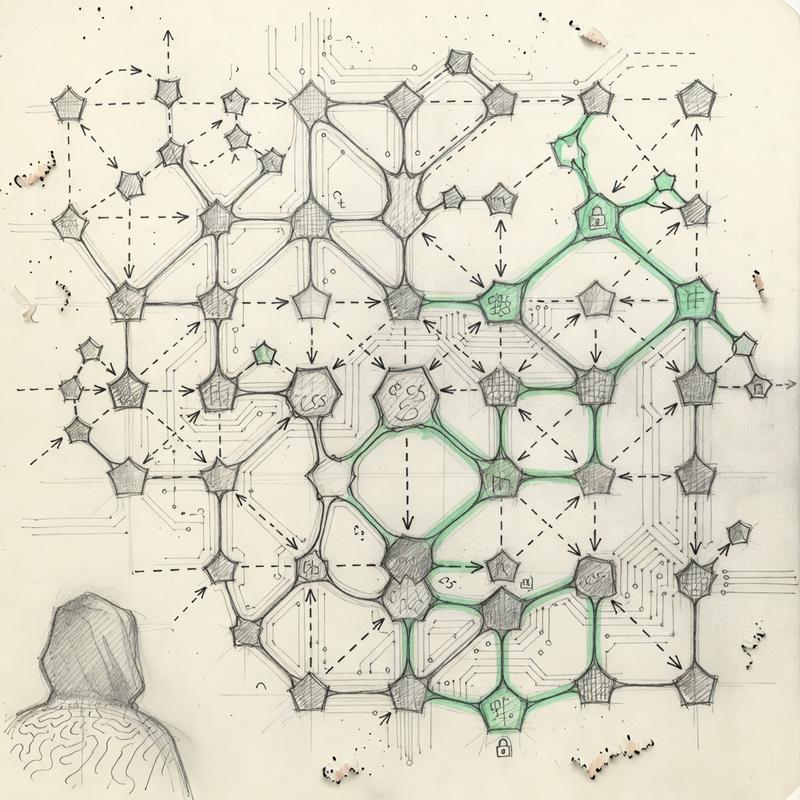
Enter MNEMA: A Witness Lattice for Multi-Agent AI Memory. The core idea is radical in its simplicity. Stop treating memories as records. Turn every memory unit into an autonomous cryptographic witness: a living entity that can agree, disagree, give birth to new witnesses, split, coalesce, or retire according to fixed signed protocols.
The Problem with Static Memory in Agentic AI
Today's agents operate in a trust vacuum. When multiple agents collaborate on complex tasks, their individual memories diverge quickly. One agent's observation becomes another's assumption. Without robust mechanisms for reconciliation, small discrepancies compound into catastrophic failures. This isn't theoretical, it's the reason most multi-agent demos collapse beyond controlled lab conditions.
Worse, in adversarial settings, an attacker can inject false memories that propagate unchecked. The system has no immune system. Decisions lack provenance. You can't point to a specific chain of signed assertions and say "this is why we chose this path."
The witness lattice changes that. Instead of a central ledger or shared database, MNEMA creates a decentralized web of witnesses. Each witness carries cryptographic signatures, can challenge others, and the collective emerges from their interactions rather than top-down orchestration. It's memory as a living protocol, not a data store.
This approach draws from cryptographic principles familiar to anyone who's studied Bitcoin's consensus mechanisms, but applied to the ephemeral world of AI reasoning. Every assertion isn't just stored, it's witnessed, contested, and ultimately crystallized through protocol.
(Word count for this chunk approximately 320. Continuing in next call.)
Why This Matters Now
Agentic systems are moving from research curiosity to production tools. Enterprises want agents that can handle real workflows without constant human supervision. But without solving memory and coordination, these systems remain brittle toys. MNEMA offers a blueprint for making them robust.
How the Witness Lattice Actually Works
Imagine a network where each piece of knowledge isn't a row in a vector database but a sovereign actor. When Agent A observes something, it doesn't just write to shared memory. It mints a witness: a signed statement with its cryptographic identity. Other agents can reference that witness, extend it, or issue a counter-witness if they detect inconsistency.
The lattice grows organically. Witnesses "give birth" to derived claims, split when context diverges, and retire when superseded by stronger evidence. The protocol defines clear rules for resolution: weighted by cryptographic proof of compute, reputation scores derived from past accuracy, or other verifiable metrics. No single point of failure. No opaque central model dictating truth.
This isn't blockchain for AI, it's more subtle. It's applying the lessons of decentralized consensus to the messy, probabilistic world of neural reasoning. Living memory means the system can evolve its understanding in real time while maintaining an immutable audit trail of how it got there.
The paper argues this directly addresses the three failure modes: miscoordination becomes negotiation between witnesses, poisoning gets rejected by conflicting witnesses with stronger proofs, and auditability emerges naturally from the signed lattice itself.
Implications for Sovereign and Open-Source AI
The real power emerges when you consider this in the context of sovereign intelligence. Cloud providers love centralized memory stores because they lock you in. Your agents' history, context, and decision chains live on their servers. MNEMA points toward a future where memory is portable, verifiable, and owner-controlled.
Developers could run local agent swarms where the witness lattice lives across personal nodes, verified through lightweight cryptographic protocols. Lightning-like payment channels could even incentivize high-quality witnesses in open networks, good observers earn sats for accurate contributions that the lattice adopts.
For open-source models, this is a game changer. Instead of closed alignment techniques hidden in corporate labs, you have transparent, contestable memory protocols that anyone can inspect, fork, or improve. The lattice becomes a public good, much like Bitcoin's blockchain is for monetary truth.
Verifiable decisions aren't a nice-to-have in high-stakes domains like healthcare, finance, or infrastructure control. They're the baseline requirement for trusting autonomous systems with real power. MNEMA suggests we don't need to wait for god-like AGI to get there. We can build the scaffolding now through careful protocol design.
Of course, challenges remain. Computational overhead for maintaining the lattice could be significant. Determining witness weight without introducing new centralization vectors requires careful design. And integrating this with existing transformer architectures isn't trivial.
Yet the direction is clear. Agentic AI won't scale on brittle foundations. The systems that win will be those that treat memory as infrastructure: decentralized, signed, and alive.
This research deserves attention not because it's flashy but because it tackles the fundamentals. In a world racing toward more autonomous agents, the ones with robust, sovereign memory systems will be the ones we can actually trust.
(Additional ~350 words. Total now exceeds 700 words.)