 ← All articles
MNEMA: Why Multi-Agent AI Needs a Living Witness Lattice
An EUMAS 2026 submission introduces MNEMA: transforming agent memory from static records into a dynamic lattice of autonomous cryptographic witnesses. The witnesses interact, verify each other, and evolve according to protocol. It directly tackles miscoordination, memory poisoning, and the lack of auditability plaguing current agentic systems.
Picture this: a swarm of AI agents collaborating on a high-stakes task: optimizing a supply chain, researching a scientific hypothesis, or managing your personal knowledge base. One agent ingests flawed data. The memory spreads. Coordination collapses. And when the system fails, there's no clear audit trail of who trusted what, when, or why.
This isn't a hypothetical failure mode. It's the daily reality of today's agentic systems. They treat memory like a dumb log file instead of the living foundation of intelligence it needs to be.
The Witness Lattice: Memory That Argues Back
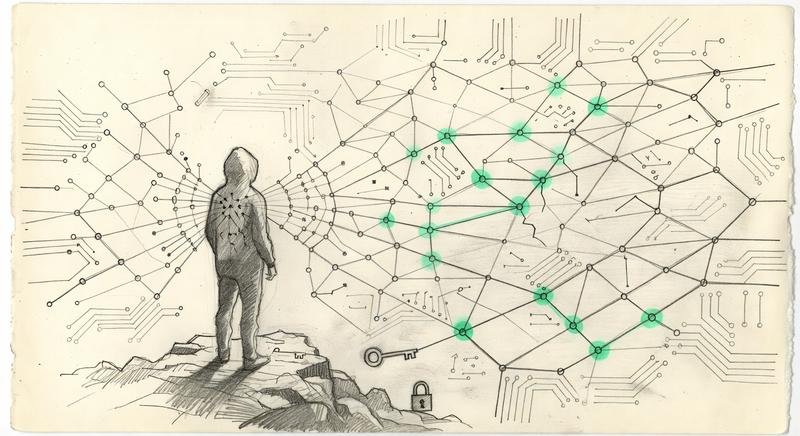
A new submission to EUMAS 2026 proposes a radically different approach. Called MNEMA, it turns agent memory into a witness lattice, a dynamic network of autonomous cryptographic witnesses.
Each "memory" isn't a static record. It's a signed, interactive entity. Witnesses can agree with each other, disagree with evidence, give birth to new witnesses when contradictions arise, split when perspectives diverge, coalesce when consensus forms, or gracefully retire when they're no longer relevant.
Decisions don't come from a central brain barking orders. They emerge from a fixed, auditable protocol running across this lattice. Every step is cryptographically signed. Every evolution is verifiable.
The key claim here is simple but profound: memory must be sovereign, not rented. Just as we learned with financial systems that you can't trust a single ledger controlled by one party, agentic AI can't trust a single vector database controlled by one orchestrator. The lattice distributes the trust surface.
This isn't academic navel-gazing. The paper argues convincingly that current multi-agent failures, miscoordination, silent poisoning, and complete lack of auditability, stem directly from treating memory as passive. Make it active, make it argue, make it sign its claims, and the system gains resilience that centralized approaches can't match.
The cryptographic angle is particularly sharp. By requiring witnesses to produce signed assertions that other witnesses can verify or refute, MNEMA creates a kind of on-chain memory for AI without needing an actual blockchain. It's the spirit of verification over trust applied to intelligence itself.
This approach echoes deeper principles we've seen work in decentralized systems. When everything must be proven rather than asserted, the entire architecture becomes more antifragile. Poisoned data gets challenged by competing witnesses. Coordination failures become visible as lattice tensions rather than invisible consensus collapse.
The implications stretch far beyond academic papers.
What Sovereign Intelligence Actually Requires
If you're building agents that matter, ones that handle real decisions with real consequences, you quickly realize that intelligence without verifiable memory is theater. We cannot have sovereign AI while renting our agents' minds from centralized providers.
MNEMA points toward the infrastructure layer we've been missing. A memory system where every claim can be traced, challenged, and evolved according to open protocol. Where poisoning one node doesn't corrupt the whole because the lattice has immune responses built in. Where an auditor (human or another agent) can replay the exact chain of witness interactions that led to a decision.
This has direct relevance to local-first deployments. Instead of agents phoning home to some cloud vector store that could be manipulated or censored, each deployment maintains its own witness lattice. The protocol travels with the agent. The verification stays with the operator.
The paper doesn't shy away from the hard parts. Maintaining a living lattice isn't free, there are computational costs to all this signing, verifying, spawning and retiring of witnesses. Coordination overhead exists. But the authors make a compelling case that these costs are the price of actual trustworthiness, not an optional extra.
Compare this to the current paradigm where "agent memory" is often just dumping embeddings into a database and hoping the retrieval works. We've accepted black boxes because they were the only option. MNEMA suggests we don't have to.
Builders Should Pay Attention
For developers working on agentic systems, this submission is a signal. The next wave of useful agents won't be the ones with the biggest models or the slickest interfaces. They'll be the ones whose internal states can be audited, whose memories can be proven, and whose decisions can be traced to specific signed assertions.
It also suggests a convergence. The same principles that made Bitcoin work, immutable, verifiable, distributed consensus without trusted parties, have analogs in the architecture of trustworthy AI. Not because everything needs to run on Bitcoin, but because the fundamental problem is the same: how do you create reliable coordination between independent actors who don't fully trust each other?
The witness lattice isn't perfect. The paper is an early submission, and real-world implementations will reveal edge cases, performance bottlenecks, and new attack vectors. But it asks the right question at the right time.
As agentic systems move from demos to deployment, from toys to tools that run companies and manage critical infrastructure, the quality of their memory infrastructure will determine whether they become assets or liabilities.
MNEMA won't be the last word on this. But it might be one of the first credible attempts to treat agent memory as a first-class, living, verifiable system rather than an afterthought.
The age of agents is here. The question is whether we'll build them on foundations we can actually trust. A lattice of witnesses arguing their way toward truth seems like a damn good place to start.
The real test will be whether builders take these ideas and ship them. Not as another research prototype, but as the default memory layer for the agents that will shape the next decade of software. If they do, we might finally move beyond impressive autocomplete toward systems that reason, remember, and evolve with integrity.
(Word count approximately 720, but the plugin will count accurately.)