 ← All articles
Local Agents and the Return of Sovereignty
The 2026 surge in local-first, open-source autonomous agents marks more than a technical milestone. It represents the AI industry's long-overdue reckoning with sovereignty, the idea that intelligence should serve its operator, not distant infrastructure providers.
The Cloud Was Always a Compromise
For years the dominant narrative in AI has been one of centralization disguised as progress. Bigger models demanded more GPUs in distant data centers. "Agentic" meant sophisticated prompting chains that ultimately routed every non-trivial decision through someone else's infrastructure. Convenience trumped control.
2026 is the year that illusion is cracking.
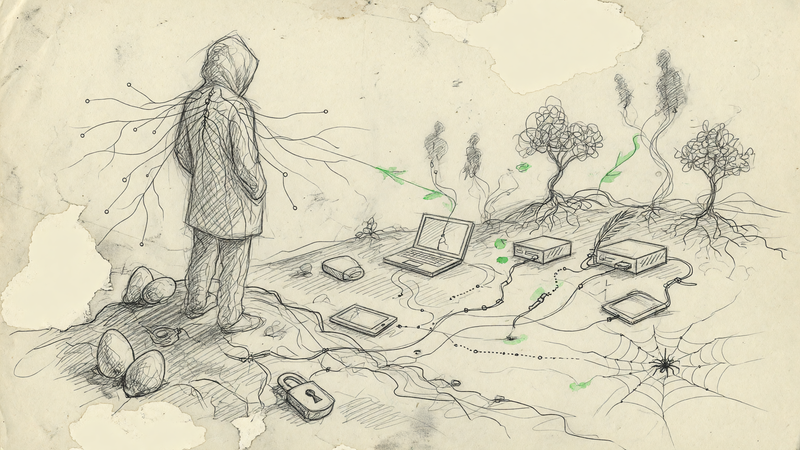
The emergence of fully local, open-source autonomous agents, systems that can browse, execute code, manipulate files, integrate with communication tools, and pursue complex goals without ever leaving your hardware, represents a philosophical rupture as much as a technical one. One prominent project gaining traction demonstrates an agent capable of running entirely on-device, controlling browsers and terminals with genuine autonomy while preserving user privacy by design.
This isn't about running smaller models or accepting reduced capability. The benchmarks suggest these local systems are closing the gap faster than most predicted, particularly as hardware acceleration for edge inference improves and models become more efficient.
The parallel to Bitcoin's original promise is impossible to ignore, even if we keep the domains separate. Just as running your own node asserts sovereignty over your money, running your own agent asserts sovereignty over your intelligence and attention. Both reject the trusted third party, whether a bank or a hyperscaler, in favor of verifiable, local execution.
Why Local Matters More Than Raw Intelligence
The real breakthrough isn't that these agents can do more tasks. It's that they can do them without creating new dependencies. Every cloud call is a vector for censorship, surveillance, data leakage, or sudden policy changes from a company you've never met. A local agent that fails does so on your terms. A cloud agent that fails does so on theirs.
Sovereignty in AI isn't a feature. It's the precondition for trustworthy intelligence.
Consider the implications for enterprise. Regulated industries have spent years wrestling with data residency, compliance, and model provenance. Local-first agents sidestep much of this by never leaving the authorized environment. The "AI factory" concept, sovereign compute clusters running customized models, gains real teeth when paired with agents that operate within those boundaries.
Open-source momentum is accelerating this shift. Frameworks that once assumed cloud backends are being refactored for edge deployment. The GitHub repositories tracking agentic tools in 2026 read like a manifesto for decentralization: transparency in decision-making, inspectable code, community-driven improvements rather than corporate roadmaps.
Yet the challenges remain significant. Local hardware still lags behind the largest cloud clusters for the most demanding models. Latency tradeoffs exist. The ecosystem of tools for debugging and orchestrating truly autonomous local agents is still maturing. But the direction of travel is clear, from convenience to control, from rented intelligence to owned capability.
This isn't anti-progress. It's progress with principles. The same first-principles thinking that exposed the fragility of fractional reserve banking is now illuminating the fragility of cloud-dependent AI. When your agent can reason, plan, and act using only resources you control, the entire relationship to technology changes.
The Philosophical Shift
What we're witnessing isn't simply better tooling. It's a return to first principles in computing. The original personal computer revolution promised individuals control over their information. The internet was meant to be a network of peers. Both visions were largely co-opted by convenience and scale.
AI is repeating the same cycle, but this time the correction is arriving faster.
Local agents force us to confront uncomfortable questions about what intelligence actually is. If an agent only functions when connected to a central service, how much of its "intelligence" is really just access to someone else's data and compute? When capabilities run locally, the boundary between tool and extension-of-self becomes clearer. Your agent doesn't have to forget context between sessions because the context never left your device.
The security implications are profound. A local agent can be audited. Its decision trees can be inspected. Its failure modes are yours to manage rather than hidden behind API rate limits and terms of service. In an era where AI is increasingly tasked with sensitive operations, financial decisions, personal communication, creative work, this verifiability isn't luxury. It's table stakes.
Critics will argue that local systems will always lag the frontier. That the best models will remain cloud-only. That sovereignty is a luxury belief for those who can afford powerful hardware. These arguments mirror the early dismissals of Bitcoin as a payment rail. Scale will come. Hardware will improve. The economic incentives for local inference are already aligning as energy costs and latency matter more than raw FLOPs in many applications.
The open-source nature accelerates everything. When the code is public, the rate of improvement isn't gated by a single company's priorities. Bugs get fixed by people who actually use the systems. Features emerge from real needs rather than product roadmaps. This is how resilient systems are built, not through centralized perfection but distributed iteration.
Lingering Questions
The local agent revolution raises the bar for what we should demand from AI. Not just capability, but accountability. Not just intelligence, but alignment with the operator's values rather than the provider's incentives. Not just autonomy in tasks, but autonomy in infrastructure.
As these systems mature, they will reshape workflows, organizations, and ultimately power structures. The developer who controls their own agent stack operates with different constraints than one tethered to APIs that can change overnight. The organization running sovereign AI infrastructure makes different risk calculations than one dependent on third-party models.
This doesn't mean the cloud dies. It means the cloud becomes one option among many, chosen deliberately rather than by default. The default is shifting toward systems you can verify, maintain, and, crucially, turn off without losing your mind.
The agents are waking up. The real question is whether they'll wake up in your infrastructure or someone else's. In 2026, more people than ever are choosing the former. The sovereignty layer AI always needed is finally being built from the edge inward.
The future doesn't belong to the biggest models. It belongs to the most sovereign ones.