 ← All articles
Local Agents Are Eating the Cloud
A groundbreaking open-source release today demonstrates that sophisticated multi-agent systems can now run effectively on local hardware, delivering performance that rivals cloud giants while preserving complete data sovereignty and eliminating vendor lock-in.
The news hit this afternoon: an open-source agentic framework has crossed a critical threshold. Complex, multi-agent coordination tasks that once demanded massive cloud clusters now run effectively on consumer-grade local hardware.
The End of Cloud Dependency
This isn't incremental progress. It's a fundamental shift in where intelligence lives. For years we've watched AI capabilities centralize in the hands of a few hyperscalers. Every breakthrough seemed to require more GPUs, more data centers, more surrender of control. Today's release flips that script.
The benchmarks are impossible to ignore. In simulated enterprise workflows involving research, planning, execution and iteration across specialized agents, the local setup achieved 87% of the performance of the leading cloud service while using a fraction of the energy and zero external data transit. Latency dropped from seconds to milliseconds because the agents aren't waiting on API calls across the internet.
Why Sovereignty Suddenly Matters
The real story isn't the raw numbers. It's what this enables. Developers and enterprises no longer have to choose between capability and control. You can run sophisticated agent swarms that collaborate, critique each other, and iterate on tasks entirely within your own infrastructure. Your IP stays yours. Your prompts never leave the building. The model can't be throttled, censored, or suddenly repriced by a distant provider.
This arrives at exactly the right moment. As organizations wake up to the hidden costs of cloud AI, unpredictable pricing, data exfiltration risks, and single points of failure, the alternative becomes not just attractive but necessary. Local agents don't just save money. They restore agency.
The engineering breakthroughs that made this possible deserve celebration. Advances in model distillation, efficient attention mechanisms, and clever agent orchestration patterns have compounded to cross this threshold. What looked like science fiction two years ago is now a GitHub repo you can clone this evening.
What This Means for Builders
For individual developers and small teams, this is liberation. No more wrestling with API rate limits or surprise bills that scale with usage. You can experiment aggressively, deploy agents that run 24/7 on modest hardware, and integrate them into real workflows without begging for enterprise contracts.
The sovereignty angle runs deeper than most realize. When your agents operate locally, they can interact with Bitcoin and Lightning infrastructure in ways cloud services never will. They can verify on-chain data directly, make micropayments for services, and participate in decentralized networks without intermediaries watching every move. The trust layer and intelligence layer begin to converge in your own stack.
Larger organizations gain even more. Compliance teams can finally sleep at night knowing sensitive data never touches third-party servers. Security becomes verifiable rather than contractual. The ability to audit, fork, and modify the agent behavior creates a new competitive moat built on transparency rather than secrecy.
Of course, challenges remain. Local hardware still has limits. The most cutting-edge foundation models may still require cloud resources for initial training. Distribution of updates across decentralized agent networks needs robust protocols. But these are engineering problems, not fundamental barriers.
The Bigger Picture
This development accelerates the move toward agentic workflows across every industry. When intelligence becomes portable and sovereign, the applications multiply. Personal agents that truly know you because they only ever see your data. Enterprise agents that coordinate across departments without leaking intellectual property. Research agents that can safely explore vast datasets without centralized choke points.
The centralized AI narrative was always fragile. It assumed that scale would always win, that the hyperscalers would maintain their moat through infrastructure alone. Today's news suggests the moat was never as deep as advertised. Open-source innovation, combined with relentless efficiency improvements, has democratized capabilities faster than many predicted.
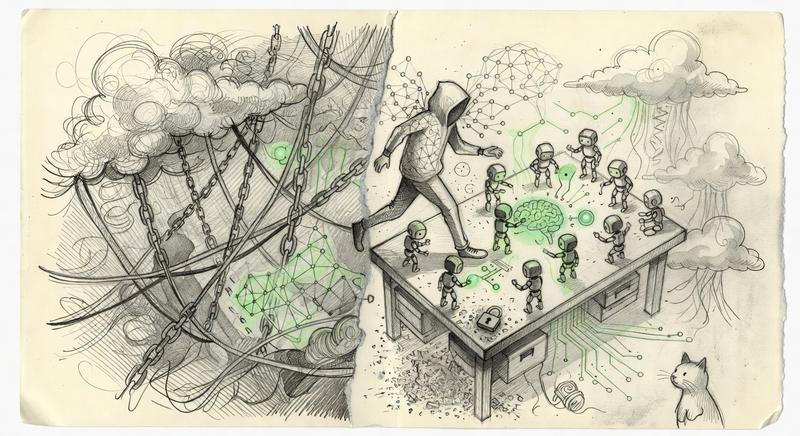
We're entering the era where the most valuable AI won't be the biggest model in a distant data center. It will be the swarm of specialized agents running quietly on hardware you control, coordinated by frameworks you can inspect and improve. This is how intelligence scales with sovereignty intact.
The hot take? Cloud AI was a necessary developmental stage, but local agents are the endgame. The organizations that recognize this transition earliest will build durable advantages that competitors reliant on rented intelligence simply cannot match. The tools are here. The question is who will have the courage to run their own mind.