 ← All articles
LLMs Improving LLMs: Agentic Discovery Automates Test-Time Scaling
A new open framework called AutoTTS lets agents discover optimal test-time scaling strategies automatically rather than depending on hand-crafted human intuition. The entire discovery process costs only $40 and runs in under three hours, yet the resulting controllers deliver superior accuracy-cost tradeoffs that generalize across benchmarks and model scales. This shifts agentic AI from art to searchable engineering, exactly the kind of transparent, sovereign progress the open-source community excels at.
Test-time scaling has quietly become one of the most reliable ways to squeeze more performance out of LLMs without training bigger models. Give the model extra compute at inference, longer thinking time, multiple samples, self-correction loops, and accuracy climbs. The catch? Most of these strategies are hand-crafted. Researchers sit down, follow their intuition, design a reasoning pattern, tune some heuristics, and hope it works. That leaves enormous parts of the search space unexplored.
Enter AutoTTS. Instead of designing individual scaling heuristics, the authors build environments where better strategies can be discovered automatically by agents. The shift is subtle but profound: you no longer engineer the controller. You engineer the discovery environment so that controllers can evolve efficiently inside it.
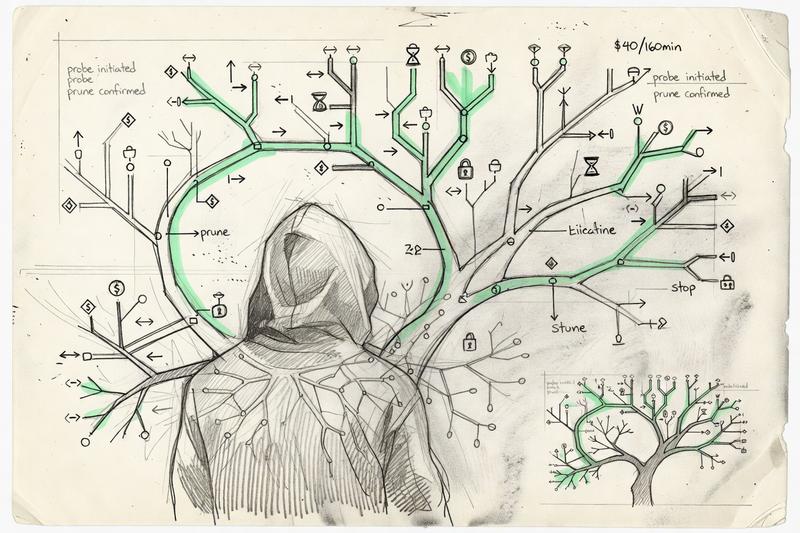
The concrete implementation treats width-versus-depth test-time scaling as a controller synthesis problem over pre-collected reasoning trajectories and probe signals. The controller decides at each step whether to branch into parallel reasoning paths, continue the current one, probe for more information, prune dead ends, or stop. Because the trajectories are pre-collected, evaluating a candidate controller is cheap, no repeated LLM calls needed during the search itself. This is what makes the entire discovery process run for $39.90 and 160 minutes.
They add two practical tricks that make the search tractable. Beta parameterization smooths the decision space so the optimizer doesn't get stuck in brittle discrete choices. Fine-grained execution trace feedback lets the discovering agent diagnose exactly why a particular controller failed on a given problem, not just that it failed, but which branch exploded, which probe gave noisy signals, or where the pruning was too aggressive. That diagnostic loop turns discovery from blind optimization into something closer to scientific debugging.
The results are compelling. The discovered controllers beat strong hand-crafted baselines on mathematical reasoning benchmarks while using compute more efficiently. More importantly, the strategies generalize to held-out benchmarks and to models of different scales. What the agent discovered wasn't a narrow hack for one dataset. It found robust patterns in how reasoning should allocate computation across depth and breadth.
This matters because it mirrors a pattern we've seen before in open-source systems. Bitcoin's base protocol stayed deliberately simple. The real innovation exploded in the layers built on top by anyone who could read the rules. The same thing is happening in agentic AI. Closed labs guard their scaling recipes like trade secrets. The open community is instead building the environments that let the scaling recipes discover themselves.
Running your own discovery process changes the trust model. You aren't renting a black-box heuristic from a frontier lab that might change its mind about what counts as safe reasoning. You have the environment, the trajectories, the controller synthesis code, and the feedback loops. You can inspect why a strategy works, modify the reward for different tradeoffs (latency versus accuracy, cost versus robustness), or specialize the discovery for your domain. The intelligence layer becomes something you steer rather than something you consume.
The low cost is the quiet revolution. $40 and less than three hours to discover a controller that generalizes. That means students, independent researchers, small teams, and sovereign operators can participate in the test-time scaling conversation without begging for API credits or waiting for the next lab paper. It democratizes the part of AI progress that actually moves the needle in production: not raw parameter count, but how intelligently you use the parameters you have.
There is still work to do. The current formulation focuses on width-depth tradeoffs over pre-collected traces. Real-world agents operate in open environments with live tool calls, changing contexts, and long-horizon goals where "pre-collected" is impossible. The next leap will be discovery environments that operate online, that learn to generate their own probe signals, that treat the entire agent loop as the searchable object. But the direction is set. From hand-crafted to discovered. From intuition to searchable engineering.
The open-source edge here isn't just faster iteration. It's that the discovery process itself can be forked, audited, improved, and anchored to principles the operator controls. When your agents are discovering their own reasoning strategies on hardware you own, with code you can read, the sovereignty question stops being philosophical. It becomes practical.
Builders should take note. The paper releases the data and code. The cost barrier is now low enough that the limiting factor is no longer compute. It is taste in environment design and the quality of feedback you give your discovering agent. Those are problems that reward clear thinking more than big budgets.
Run the experiments. Fork the environment. Improve the controller synthesis. The next generation of reliable agents won't be designed by researchers staring at whiteboards. They will be discovered by agents that have been given the right search space and the right way to learn from their failures. That future is already cheap enough to start building today.