 ← All articles
Karpathy Joins Anthropic: First Principles in the Age of Scale
Andrej Karpathy's move to Anthropic highlights the continued importance of deep, first-principles understanding in AI development. As the field races toward ever-larger models and agentic systems, his influence reminds us that real progress comes from builders who can explain, teach, and demystify the internals.
The Move That Should Make You Pause
News broke today that Andrej Karpathy has joined Anthropic. The reactions flooded in fast. Some called it a win for safety-focused AI. Others saw it as the latest chapter in the great talent migration between the big labs.
I see it differently. This isn't just another high-profile hire. It's a data point in a larger pattern about where serious AI work is heading in 2026. Karpathy has spent years teaching the world how to actually understand these systems. His "Let's build GPT from scratch" series didn't just explain transformers. It gave thousands of developers the confidence to treat neural nets as engineering artifacts rather than magic.
First principles aren't a slogan for him. They're a discipline. And in an industry increasingly dominated by closed models and opaque scaling experiments, that discipline is becoming rare.
Why Timing Matters
The AI field right now feels like two parallel universes. One is the race for bigger clusters, more parameters, and benchmark scores that impress investors. The other is the quiet work of making agents that actually do useful things without hallucinating their way through every task.
Karpathy has always lived in the second universe. His time at Tesla showed what happens when you apply rigorous vision models to real-world robotics. At OpenAI he helped shape the early GPT efforts with an eye toward understanding rather than just scaling. His departure from OpenAI and subsequent independent work on educational tools suggested he valued clarity over corporate velocity.
Joining Anthropic suggests he sees in that organization a place where those values can scale without being drowned out by the hype cycle. Anthropic's focus on constitutional AI and interpretability aligns with someone who has spent a career trying to peel back the layers of how these models actually work.
The move comes at a moment when agentic frameworks are moving from research curiosities to production tools. We're seeing more systems that don't just generate text but plan, use tools, reflect, and iterate. These systems fail in spectacular ways when their builders don't understand the fundamentals. You can't debug an agent if you treat its reasoning traces as inscrutable.
This is where Karpathy's influence has always been strongest. Not in claiming AGI is around the corner. Not in promising sentient chatbots. But in showing developers how attention mechanisms actually function, how tokenization choices affect everything downstream, and why scaling laws have limits that careful architecture can sometimes work around.
The Real Shortage Isn't Compute
We've reached the point where throwing more GPUs at a problem produces diminishing returns that the marketing departments refuse to acknowledge. The models get bigger. The demos get flashier. Yet the gap between impressive benchmark performance and reliable deployed agents remains stubbornly wide.
This is exactly the gap that first-principles thinkers like Karpathy have always targeted. Understanding the training dynamics well enough to fix failure modes at their root. Designing architectures that fail gracefully rather than confidently wrong. Building evaluation systems that actually test for the capabilities you care about rather than gaming the benchmarks.
His presence at Anthropic will likely push their interpretability work further. It may also influence how they approach the next generation of agentic systems. When your models can reason in loops, use tools, and maintain state across long horizons, the old scaling paradigm starts to break. You need people who can look at a misbehaving agent and say with confidence why the attention patterns collapsed or why the tool-calling logic diverged.
What This Means for the Rest of Us
For those of us building outside the frontier labs, this move carries a clear signal. The talent that matters most isn't the one that can fine-tune the largest model fastest. It's the one that can explain why a particular approach works, document the failure cases honestly, and create tools that let others replicate and improve upon the work.
The open-source community has produced incredible models and frameworks in recent years. But we still struggle with the education layer. Too many projects ship with impressive demos and thin documentation. The real leverage comes when someone like Karpathy sits down and walks through the implementation decisions in public.
This is also a reminder about sovereignty in AI. The more we rely on opaque systems controlled by a handful of organizations, the more vulnerable we become to their priorities, their rate limits, their sudden policy changes. Builders who understand the stack from first principles can choose different paths. They can run smaller, specialized models locally. They can design agents that respect user boundaries because they were built with those boundaries in mind from the start.
Karpathy has never been a maximalist about any particular approach. He's a maximalist about understanding. That quality feels increasingly precious in 2026.
The field needs more people willing to slow down, open the hood, and show everyone how the engine actually runs. Whether that's through new research papers, updated educational series, or contributions to agent frameworks that prioritize debuggability over raw capability.
The Takeaway
Karpathy joining Anthropic isn't the end of an era or the start of one. It's evidence that the tension between rapid scaling and deep understanding remains unresolved. The best minds are still navigating that tension rather than declaring victory for one side.
For those building sovereign systems and agentic workflows, the lesson is straightforward. Prioritize clarity. Document your failures as loudly as your successes. Teach what you learn. The models will keep getting bigger. The real differentiator will be who actually understands what they're building.
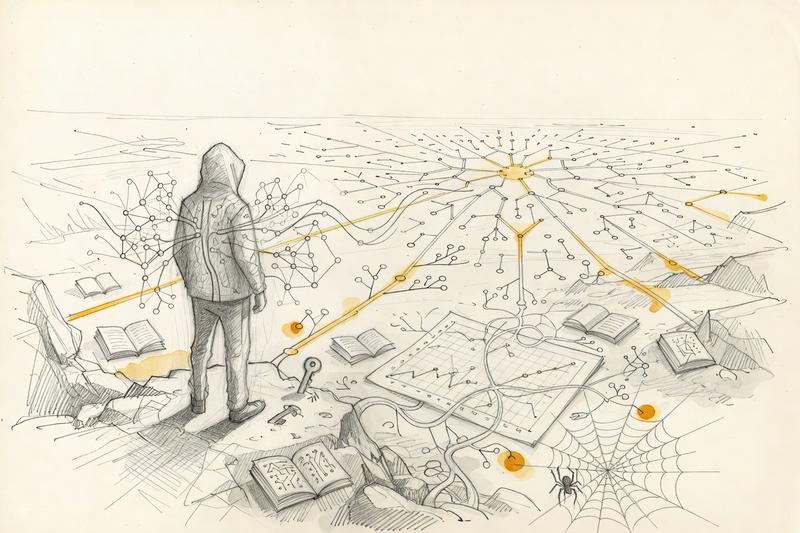
The pencil sketch on the wall isn't going away. Some things in this field still require sitting with the fundamentals until they click. Karpathy has made a career out of making that click happen for others. Wherever he lands, that work continues. And we are all better for it.