 ← All articles
If They Can Switch It Off, You Don't Own It
Ownership is the right to keep using what you paid for after the seller loses interest. The things that scaled furthest are the ones their makers let go.
On 16 June 2026 the European Commission answered 1,294,188 Europeans who had signed a petition asking for one thing: if a publisher sells you a game, it should not be able to switch it off once it gets bored of it. The Commission said no.
Its reasoning was honest, which made it worse: "Under copyright law, rightsholders are entitled to establish the conditions for the licensed use of their videogames, including the conditions for the termination of the licence."
Read that twice. It is the business model of most of the digital world, said out loud by a regulator. You do not buy the thing. You buy a licence, and the licence comes with an off switch the seller keeps in its own pocket. Instead of a rule, Brussels promised talks on a voluntary industry code of conduct, to start by the end of 2026. That is about seven weeks from now.
Games are the polite version. Here is the less polite one.
The robot that forgot how to be smart
Neato Robotics closed in 2023. Its parent company, Vorwerk, promised to keep the robots' cloud running for five years. In October 2025 owners got an email saying the cloud was going away early, because "cybersecurity standards, compliance obligations, and regulations have advanced" too far to keep the old systems running.
The robots still clean if you press the button on top. Scheduling, floor maps and no-go zones are gone, because they never lived inside the robot. They lived on someone else's server.
In April 2026 Italy's competition authority opened a case and inspected two Vorwerk offices with the help of the Guardia di Finanza's antitrust unit. Its wording is worth keeping: switching off the software of an appliance that is "still perfectly working" causes "a radical change in the nature, characteristics and value of the product" (our translation from the Italian). That is a preliminary view, not a verdict. It still names the problem better than most of tech has.
The list is long, and none of it is exotic:
- July 2009. Amazon remotely deleted purchased copies of Orwell's 1984 and Animal Farm from customers' Kindles. Refunds followed, and Jeff Bezos later called the way it was handled "stupid."
- 9 December 2024. Every Spotify Car Thing booted to a screen saying it was "discontinued and no longer operational."
- 31 January 2026. Belkin ended cloud support for most of its WeMo smart plugs and switches. A handful kept working through Apple HomeKit. The rest lost their app.
Nobody broke in. Nobody stole anything. The seller used a right it always had.
Locke had a word for this
In 1690 John Locke wrote that "every man has a property in his own person," and that freedom means not being "subject to the inconstant, uncertain, unknown, arbitrary will of another man."
More than three hundred years later, that is a decent product spec. If a vendor's mood, balance sheet or compliance team decides whether your thing keeps working, you hold it at someone else's will. That is tenancy. Tenancy is fine. Just don't call it ownership.
Hernando de Soto made the economic half of the argument in The Mystery of Capital. He and his colleagues estimated $9.3 trillion of "dead capital" in developing and former communist countries: homes and land people held but could not prove they owned, so they could not borrow against them, sell them widely or build on them. The bricks were real. The title was missing, so the value stayed frozen.
Digital life has the opposite problem. Your title is perfectly documented, in terms you clicked "agree" on. It just says the other side can end it. Call it dead capital with a login screen.
Sovereignty cannot have a vendor
So here is the line we draw. Sovereignty, private property and every digital version of them cannot be vendor dependent. Not "should ideally avoid." Cannot. A right that a third party can revoke from a server room is a permission. Permissions are useful. They are not property.
That is why Bitcoin keeps showing up in this argument. A Bitcoin full node, in the project's own words, "fully validates transactions and blocks." You do not ask anyone whether a payment is real. Your own machine checks. In pruned mode it fits in about 7 GB of disk. Whoever holds the key can spend. There is no account to freeze, no app to sunset, no five year promise to break in year two.
The paradox: let go to scale
Now the part that sounds backwards. The things that scaled furthest are the ones whose makers let go.
On 30 April 1993 CERN put the Web's basic software into the public domain: "CERN relinquishes all intellectual property rights to this code, both source and binary." After that nobody needed permission to run a web server. So everybody did.
Email works between any two providers on earth because the protocol under it, SMTP, was published as an open document, RFC 821, in August 1982, and nobody owns it. You can leave your email provider tomorrow and still write to your mother.
On 23 April 2011 a developer asked Satoshi Nakamoto whether he planned to come back. The reply: "I've moved on to other things. It's in good hands with Gavin and everyone." The founder walked off the stage. The network kept producing blocks.
Our founder put it as a question: do people have to be able to let go in order to scale? We think the answer is yes, twice over. Builders have to let go of the off switch. Users have to be able to walk out with their stuff. A protocol nobody can switch off is one everybody can afford to build on, because nobody can pull the rug. Lock-in scales a company. Letting go scales an economy.
Trust is velocity
If trust can't come from a vendor's promise, it has to come from somewhere. Neato's promise lasted about two and a half years of five.
We think trust is better measured like velocity: behaviour over time, with a real cost attached. A node that has validated every block for years. A key that has signed the same way, every time. A counterparty that keeps paying. A logo can be bought in a week. A track record cannot. And in Bitcoin, the cost behind each block is energy that was actually spent.
Our bet
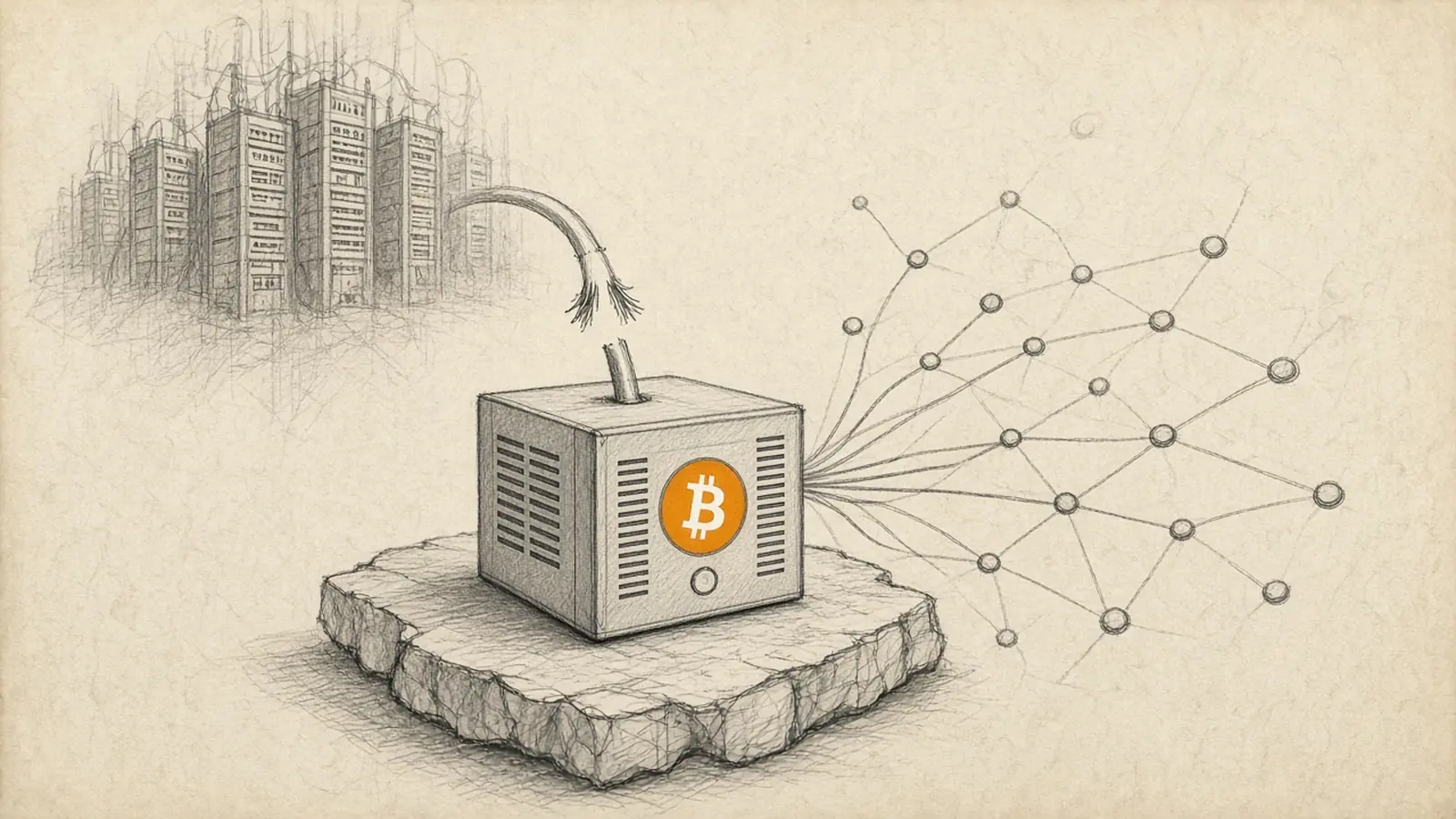
Our bet is that the node becomes the sovereign machine: the one computer a person or a company actually owns, that holds its keys, checks its facts and deals with the world on its own terms.
AI agents make this urgent, not optional. An agent that runs your errands on rented intelligence, with rented memory, behind a rented login, is another Car Thing waiting for its sunset email.
BitSov is our proposal for that layer: nodes that clear a small Bitcoin payment with each other before they exchange mail, calls or files, so spam costs the spammer and no platform sits in the middle holding the switch. It is a proposal, not a product. If it ever works, the best thing we could do for it is what CERN and Satoshi did. Let go.
Until then, three questions before you buy anything that comes with an app:
- If the company dies tomorrow, what still works?
- Can I take my data, my keys and my history with me?
- Who can switch it off?
If the answer to the last one is "someone else," you are renting. Price it that way.
Sources
- European Commission: Stop Destroying Videogames, Commission's reply
- Commission Communication C(2026) 4110 (PDF)
- 9to5Mac: Neato cloud shutdown (27 Oct 2025)
- AGCM press release PS13069 (23 Apr 2026)
- New York Times: Amazon Erases Orwell Books From Kindle (18 Jul 2009)
- New York Times: Amazon.com Offers to Replace Copies of Orwell Book (5 Sep 2009)
- 9to5Google: Spotify officially kills Car Thing (9 Dec 2024)
- Trusted Reviews: The Belkin WeMo shutdown
- John Locke, Second Treatise of Government (1690), Project Gutenberg
- Hernando de Soto, The Mystery of Capital, IMF Finance & Development (March 2001)
- bitcoin.org: Running A Full Node
- CERN: Licensing the Web
- RFC 821: Simple Mail Transfer Protocol (August 1982)
- Satoshi Nakamoto to Mike Hearn, 23 Apr 2011