 ← All articles
How to Use Multiple AI Models in 2026: A Practical Setup Guide
How to use multiple AI models in 2026: a routing guide with current prices, cross-model review, loops vs graphs, and setups for solo, team and regulated use.
If you want to use multiple AI models without drowning in tabs, keys and invoices, you need three things. You need a rule for which model gets which task. You need a second model plus a real check to catch mistakes. And you need your prompts, evals and data kept somewhere you control. This guide shows how to set that up today, with current list prices, a routing guide and step-by-step setups for a solo builder, a small team and a regulated company.
Why bother now? In the last ten days of September 2026, Anthropic shipped Claude Opus 5.5 and Sonnet 5.5, OpenAI shipped GPT-6.1 Sol and xAI shipped Grok 4.7. DeepSeek had released open weights for V4.1-Flash earlier in the month. A setup tuned to one vendor's model in August is already out of date. Prices are moving just as fast: Epoch AI estimates that the cost of reaching a given level of performance has fallen about 13x per year since 2023 [1]. The guide closes with what doesn't work.
1. The lineup, and why a leaderboard won't pick for you
The verified lineup on 1 October 2026:
- Frontier, closed: Claude Opus 5.5 ($4/$20 per million input/output tokens), Claude Fable 5.1 ($10/$50), GPT-6 Astra ($10/$50) [2][3][4].
- Mid-tier: Claude Sonnet 5.5 ($2/$10), GPT-6.1 Sol ($2/$10), Grok 4.7 ($2/$6), Gemini 3.1 Pro, still in preview ($2/$12 up to 200K tokens) [3][5][6][7].
- Budget: Gemini 3.8 Flash ($0.75/$3.75 until 31 December 2026, then $1.50/$7.50), Claude Haiku 4.5 ($1/$5) [8][3].
- Open weights: DeepSeek-V4.1-Flash (MIT licence, $0.30/$1.20 at peak on DeepSeek's own API), Qwen3.8-27B (Apache 2.0), and the larger Kimi K3, GLM-5.3 and Qwen3.8 flagship weights under custom licences [9][10][11].
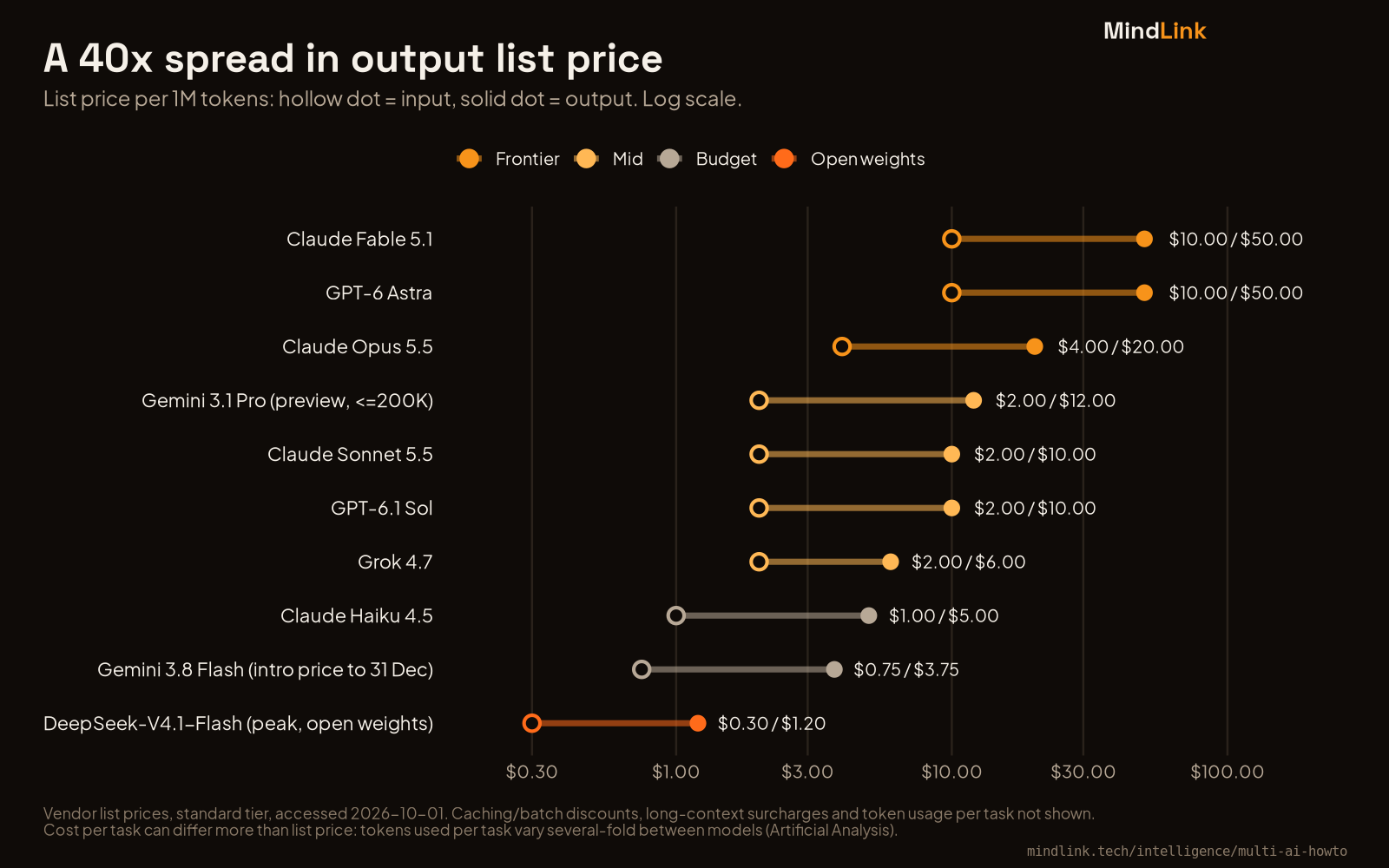
Figure 1. Output list prices span roughly 40x. List price is not cost per task.
Three cautions before you trust any ranking:
- Vendor numbers and independent numbers differ. Anthropic reports 66.4% for Opus 5.5 on Terminal-Bench 4.0 [2]. Artificial Analysis, running its own harness, measured 59.6% [12]. Neither number is wrong. The setup changes the result, and that alone is a reason to test on your own tasks.
- Tokens per task vary more than price per token. Artificial Analysis found Opus 5.5 at max effort used about 119k output tokens per index task, against about 27k for GPT-6 Astra [12]. A model that is cheaper per token can still cost more per finished job.
- Leaderboard tops are noisy. On LMArena's text board (25 September), Opus 5.5 sits first on 2,307 votes with a possible rank anywhere from 1 to 10 [13]. Anthropic itself now says benchmark margins are a weaker guide to real-world differences than they used to be [2].
2. Which model for which task: a routing guide
Treat this as a set of hypotheses for your own evals, not a ranking. Prices are standard-tier list prices per million tokens (input/output) as of 1 October 2026.
- Bulk classification, extraction, tagging. Start with Gemini 3.8 Flash ($0.75/$3.75) or DeepSeek-V4.1-Flash ($0.30/$1.20). Escalate to Sonnet 5.5 or GPT-6.1 Sol. Why: high volume, and easy to check against a schema.
- Everyday drafting, Q&A, small code edits. Start with Sonnet 5.5 ($2/$10), GPT-6.1 Sol ($2/$10) or Grok 4.7 ($2/$6). Escalate to Opus 5.5. Why: mid-tier models now cover most daily work.
- Long agentic coding and terminal work. Start with Opus 5.5 ($4/$20) or GPT-6.1 Sol ($2/$10). Escalate to GPT-6 Astra. Why: vendors' own evals put these near the top, at very different cost per task.
- Hardest reasoning, science, maths. Start with GPT-6 Astra ($10/$50) or Opus 5.5 ($4/$20). Escalate to Fable 5.1. Why: pay frontier prices only where your eval shows a gap.
- Review of another model's output. Use a model from a different vendor than the drafter, then a human. Why: judges favour their own outputs [14]. A mid-tier model is usually enough.
- Data that must not leave your control. Use open weights on your own hardware (DeepSeek-V4.1-Flash, Qwen3.8-27B), or a zero-data-retention API contract. Why: the licence and the hosting stay under your control.
- Very long documents (over 200K tokens). Any 1M-context model works, but price it with care. Surcharges apply: OpenAI above 272K tokens, Grok and Gemini Pro above 200K.
Routing is an established pattern, not a trick. Anthropic describes it as sending easy queries to smaller models and hard ones to more capable ones [15]. In research settings, learned routers cut cost by more than 2x without losing quality on some benchmarks [16], and model cascades matched a top model's quality at a fraction of the cost [17]. Your savings depend on your traffic, so measure them.
3. Four principles
Route by task, not by loyalty. Write down which task types you have, give each a default model and a fallback, and keep those rules in configuration rather than scattered through code. LangGraph's own docs show the model provider passed in as runtime context, so switching models becomes a config change [18].
Verify with a different model, then with ground truth. LLM judges recognise and favour their own generations [14]. Without external feedback, models do not reliably fix their own reasoning [19]. Strong judges agree with humans more than 80% of the time, but they still show position, verbosity and self-enhancement bias [20]. So pair the drafter with a reviewer from another vendor, give the reviewer a written rubric, and then check against something that isn't a model: tests, sources, schemas. In the MAST study of 1,642 multi-agent traces, verification failures were one of three main failure categories. In one intervention, adding a check of the high-level task objective to ChatDev raised task success on the ProgramDev benchmark by 15.6% [21].
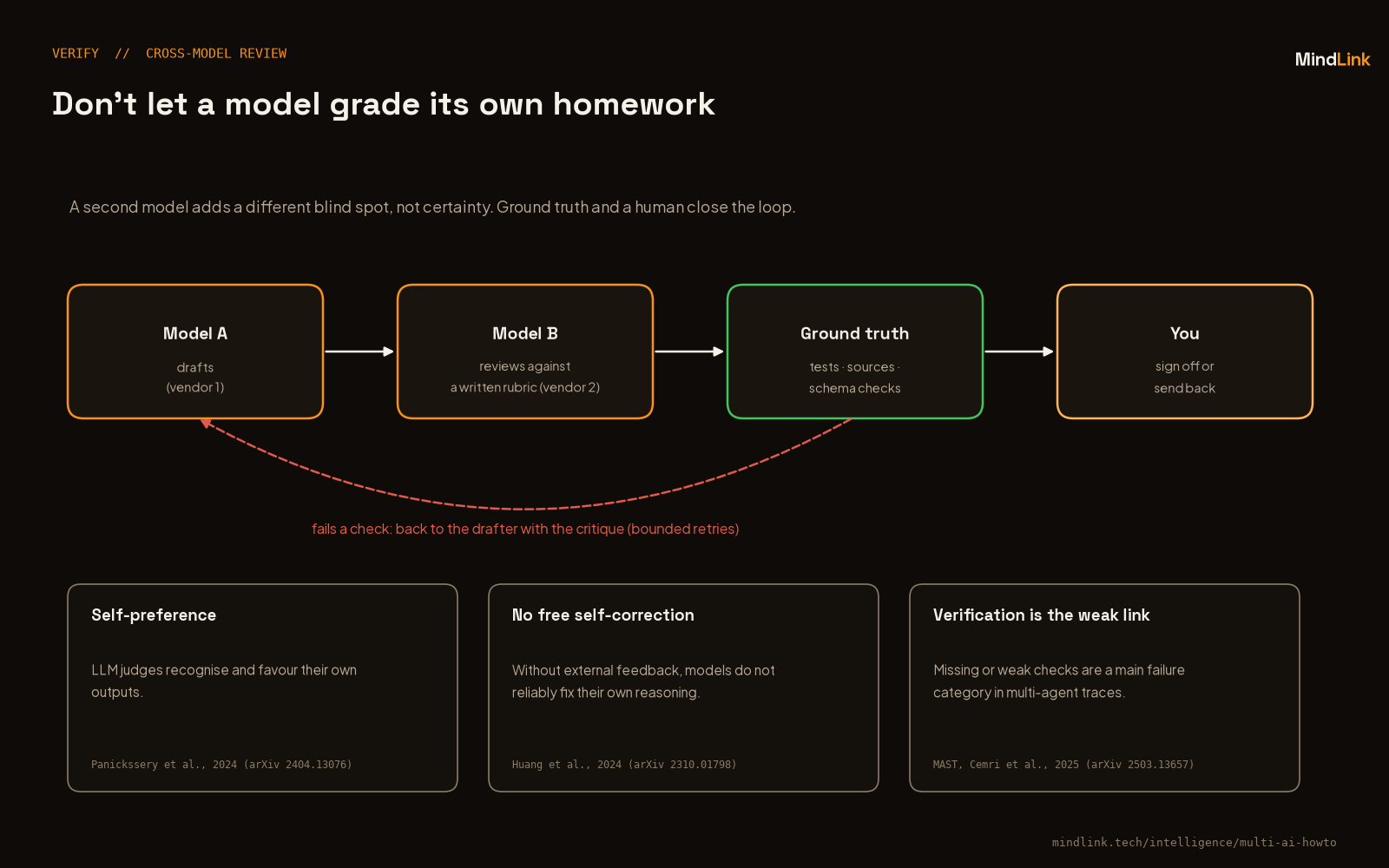
Figure 2. A second model adds a different blind spot, not certainty.
Keep context portable. Lock-in mostly sits in your prompts, memory, tool integrations and evals, not in the API call. Keep instructions and project memory in plain files (AGENTS.md is now a Linux Foundation project, alongside MCP) [22]. Connect tools through MCP so every model sees the same tools. Keep your eval set in your own repository. Pin dated model versions: Anthropic publishes retirement dates (Opus 5.5 not before 22 September 2027) [3], and xAI's -latest aliases update automatically while dated IDs stay fixed [23]. Silent drift is real: one study found GPT-4's accuracy on a prime-number task fell from 84% to 51% between March and June 2023 [24].
Own the data path. The defaults are better than many people assume. OpenAI does not train on API data unless you opt in, a policy in place since March 2023 [25]. Anthropic's commercial terms exclude training on customer content [26]. xAI says it never trains on API inputs or outputs without explicit permission [23]. Google is the exception to check: on the Gemini API free tier, content is used to improve products, while on the paid tier it is not [27]. Zero data retention exists at all four, but it has trade-offs. At xAI it disables Batch, Files and stateful responses [23]. OpenAI requires approval first [25]. Anthropic's "covered models" still need 30-day retention [26]. The AI is a tool. Authority stays with you: your keys, your data, your node.
4. Agents: loops versus graphs
An agent, in Anthropic's definition, is a model using tools in a loop and steering by what it observes. A workflow follows code paths you define in advance [15]. Sascha Bosio frames the same split as loops versus graphs. A loop is one agent iterating. A graph is declared structure: who owns each step, what depends on what, where failures go and who checks whom [28]. Bosio also cites two fair objections. A loop is technically already a graph, and the ideas are decades old (state machines, DAGs). The axis that matters more is whether each step is grounded in a real measurement and whether a human sits at defined checkpoints [28].
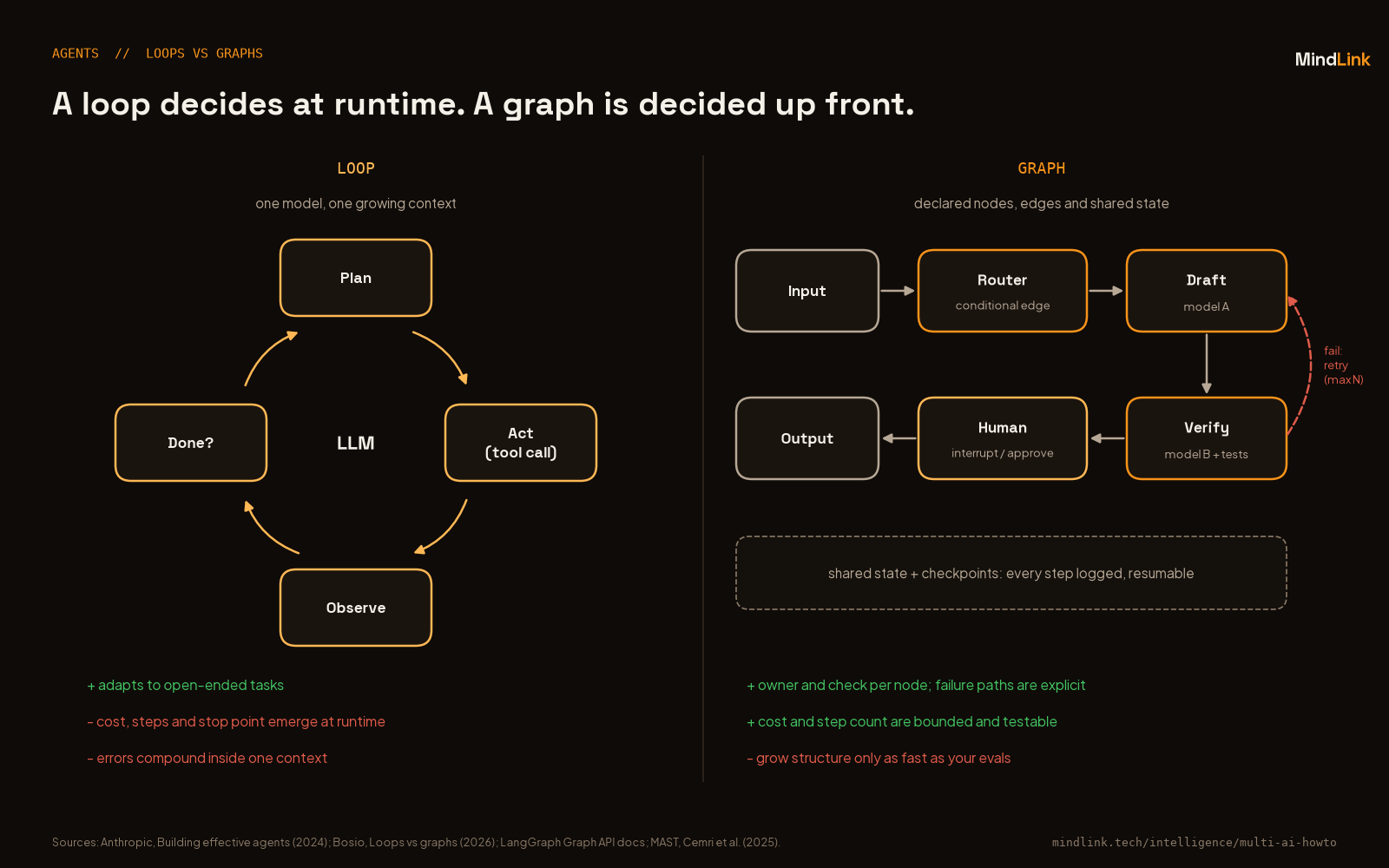
Figure 3. Loops adapt; graphs make cost, failure paths and review points explicit.
The other sources point the same way:
- Failure rates are high. MAST found failure rates between 41% and 86.7% across seven open multi-agent frameworks [21].
- Shared context matters. Cognition argues for single-threaded agents with full shared context, because each action carries implicit decisions that parallel agents cannot see [29].
- The tooling is graph-shaped. LangGraph's primitives are shared state, nodes and edges, plus checkpoints, human-review interrupts and a recursion limit. Its docs also warn that nodes re-run on resume, so they must be idempotent [18].
- Peer review backs the framing. MASFactory (ACL 2026 demo track) models multi-agent workflows as directed computation graphs and compiles natural-language intent into an editable graph with a human in the loop [30].
Agents also cost more. Anthropic reports agents use about 4x the tokens of chat and multi-agent systems about 15x. Its multi-agent setup beat a single agent by 90.2% on an internal research eval, but it fits broad, parallel research better than tightly coupled work such as most coding [31].
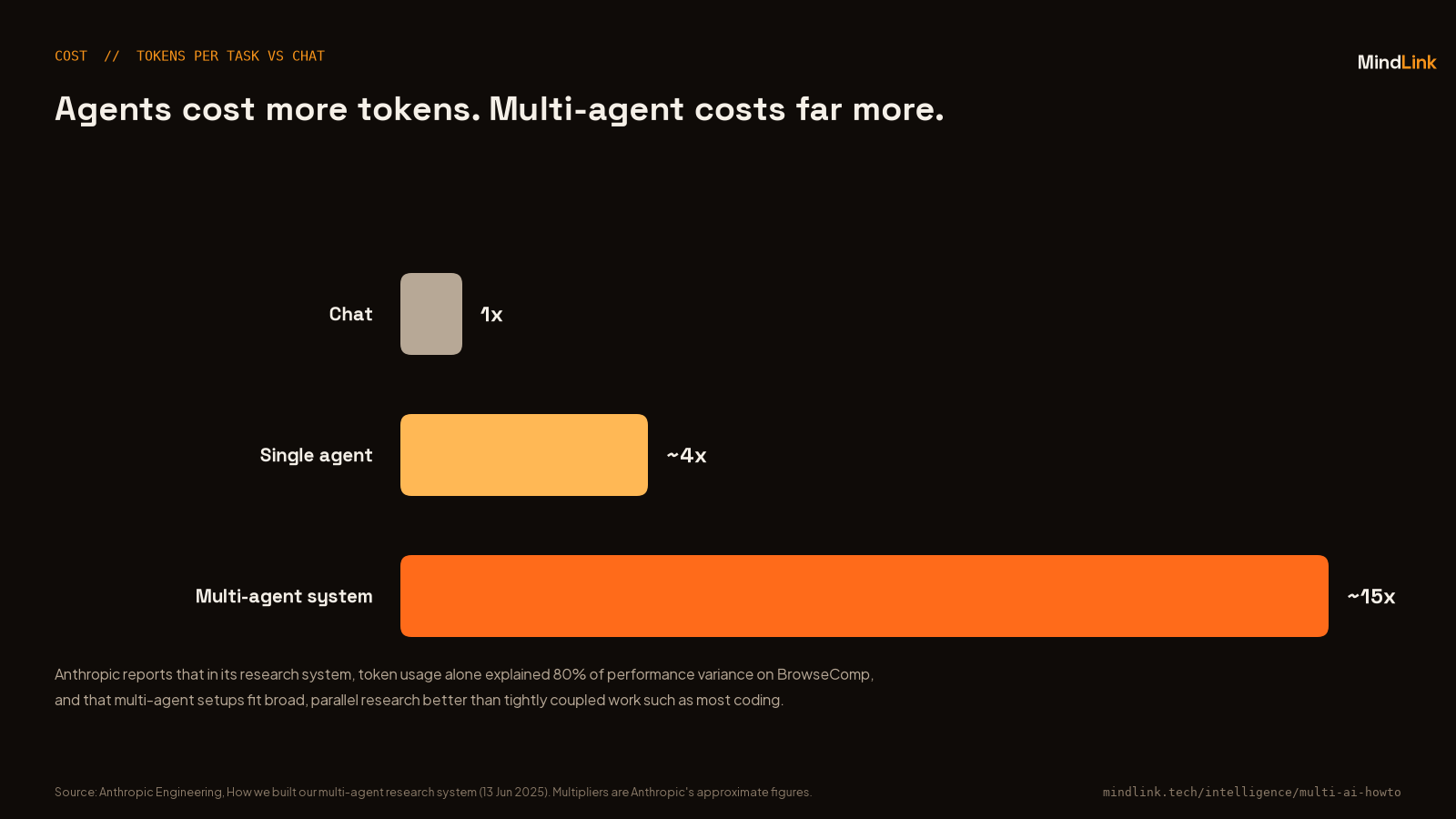
Figure 4. Approximate token multipliers reported by Anthropic.
Rule of thumb: start with a single call or a short fixed workflow. Add a loop where the task is genuinely open-ended. Move to a declared graph once the work repeats, needs review points or touches money, customers or production. Add structure only as fast as your evals can check it.
5. Three setups, step by step
A. Solo builder (an afternoon)
- Open API accounts with two vendors plus one budget model, for example Anthropic or OpenAI for drafting, a different vendor for review and Gemini 3.8 Flash for bulk work. Use paid tiers; free tiers can carry different data terms [27].
- Store keys in a password manager or environment variables, never in code. Set spending caps in each console.
- Pin dated model IDs in one config file.
- Put your standing instructions in an AGENTS.md and your project notes in plain markdown, so any model or tool can read them.
- Collect 20 real tasks you did recently, each with what a good answer looks like. Anthropic's research team started its evals with about 20 queries drawn from real usage. It notes that a small set is enough early on, because changes then have large, visible effects [31].
- Run every candidate model on the 20, recording pass/fail, cost and time. Judge accuracy and cost together, not accuracy alone [36]. Pick defaults per task type from the results, and rerun the set whenever a vendor ships a new version.
- For anything that matters, have the second vendor review the first's output against a short rubric, then check it yourself.
B. Small team: a small AI factory
CNCF describes an "AI factory" as a shared GPU platform that many teams draw on. It is built in layers (serving, gateway, observability, cost tracking), and for each layer you choose whether to build, assemble or buy [32]. At team scale you don't need GPUs to borrow the idea. You need five layers, and you own four of them.
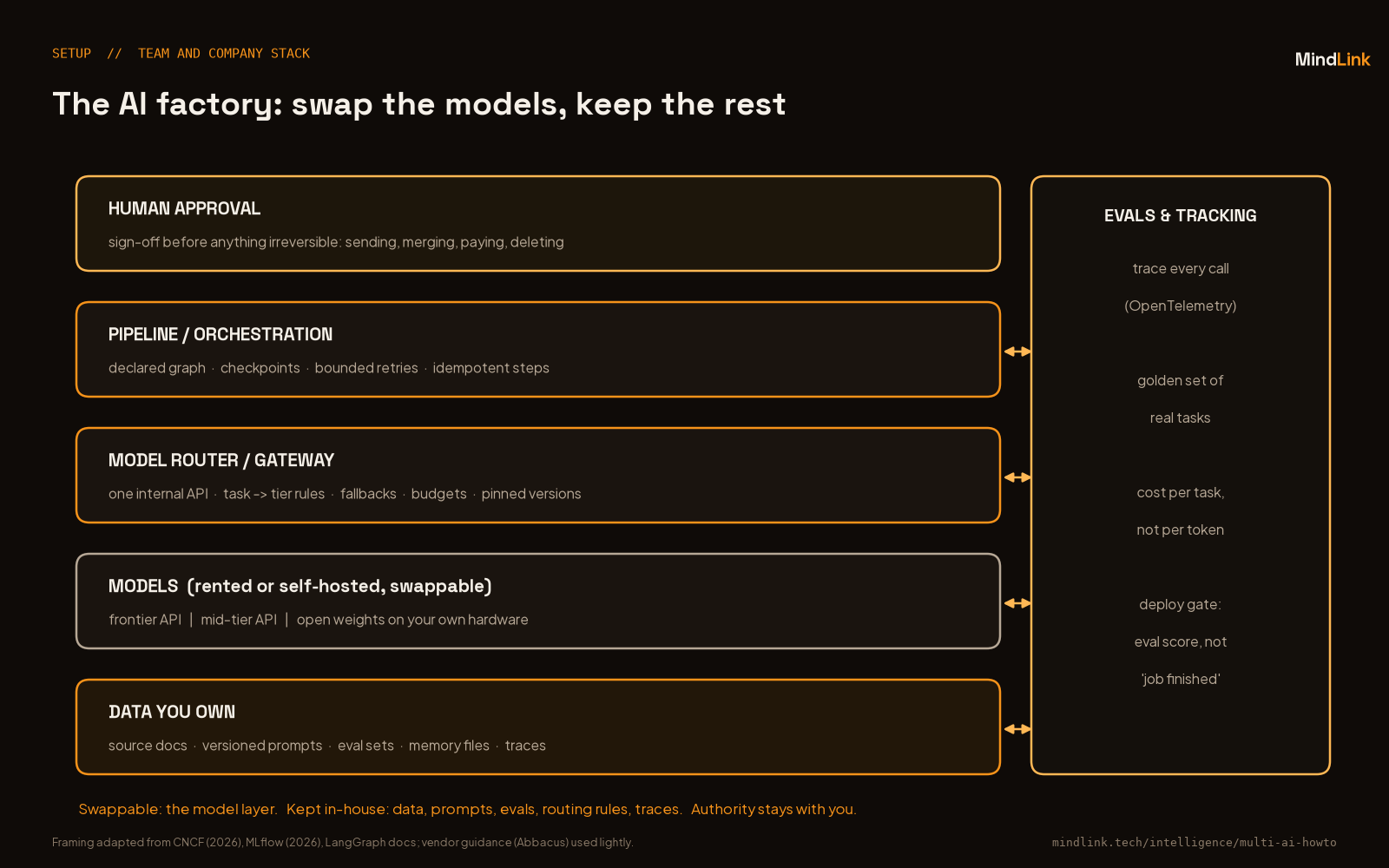
Figure 5. Models are the swappable layer; data, routing rules, evals and traces stay with the team.
- Data you own: a repository holding source documents, versioned prompts, eval sets and memory files. A vendor guide on avoiding lock-in adds a sensible rule: keep embeddings regenerable from source documents, so changing embedding model means a re-index rather than a migration [33].
- Model router or gateway: one internal, OpenAI-compatible endpoint (LiteLLM is one option CNCF names) with routing rules, fallbacks, budgets and pinned versions [32]. Keep it simple; it is plumbing, not strategy.
- Pipeline and orchestration: recurring jobs (weekly report, PR review, support triage) as declared graphs with checkpoints and bounded retries [18]. MLflow's guidance: make every step idempotent, check data contracts at each handoff, and prefer declared flows over agent-chosen routing in production [34].
- Evals and tracking: trace every call with OpenTelemetry so you can change backends without losing history [32]. Keep a golden set, and gate changes on eval score, not on "the job finished" [34]. Track cost per task.
- Human approval before anything irreversible: sending, merging, paying, deleting.
- Run a two-provider test once a quarter: switch one production workflow to its fallback vendor for a day and compare eval results [33].
C. Regulated company
- Classify your data first, then decide which model tier may touch which class. Public data can go to any API. Confidential data goes only to contracted APIs. Restricted data stays on self-hosted open weights.
- Negotiate retention and residency. OpenAI's EU endpoint keeps processing in the EEA and Switzerland. It requires approved retention controls (zero data retention or modified abuse monitoring) and adds a 10% uplift for models released since March 2026. GPT-6.1 Sol supports only US and EU residency [25]. xAI's regional endpoint is US-only and costs 10% more [23]. If you already have a cloud agreement, some models (Grok 4.7, for example) are available through Amazon Bedrock [35].
- Self-host where you must. CNCF's reference stack runs vLLM or KServe for serving, a gateway in front, OpenCost for chargeback and tenant isolation between teams [32]. Read licences carefully. DeepSeek-V4.1-Flash is MIT and Qwen3.8-27B is Apache 2.0, but the large Kimi K3, GLM-5.3 and Qwen3.8 weights ship under custom licences [9][10].
- Log for audit: every prompt, model ID, version, output, reviewer and approval, stored in your own system.
- Keep a model register with versions, retirement dates, licences and the fallback for each model, and review it monthly.
- Write and rehearse an exit plan for each vendor.
6. What doesn't work
- "Just use the top model." Rankings shift monthly and margins sit inside the noise. On one coding benchmark, OpenAI's own figures put GPT-6.1 Sol level with GPT-6 Astra at about a fifth of the cost [37]. The top model is often not the one your eval needs.
- "More agents, better results." Token use multiplies, failures compound, and coordination is the hard part [21][29][31]. Most work wants one agent with good context.
- "A gateway solves lock-in." It solves the API call. Your prompts, evals, memory and workflows are where switching actually hurts.
- "A second model makes it correct." Models share training data and blind spots. Cross-model review lowers risk; tests, sources and a human remove more.
- "Open weights are free and private." They are private if you run them yourself. They are not free: hardware, operations and licence terms all cost something.
- "Multi-model is always worth it." Every vendor adds a contract, a data agreement, a key to rotate and a new way to fail. A solo builder may do fine with one main model and one reviewer.
Sources
All sources accessed 1 October 2026.
- Epoch AI, "The plunging price of thought" (22 Sep 2026)
- Anthropic, Claude Opus 5.5
- Anthropic, models overview
- OpenAI, GPT-6 Astra model page
- Anthropic, Claude Sonnet 5.5
- OpenAI, GPT-6.1 Sol model page
- xAI, models and pricing; Google DeepMind, Gemini Pro
- Google, Gemini 3.8 Flash model docs
- Hugging Face model cards: DeepSeek-V4.1-Flash, Qwen3.8-27B, Kimi K3, GLM-5.3
- OpenRouter, Qwen 3.8 and Kimi K3 overviews (secondary)
- DeepSeek API pricing
- Artificial Analysis, Claude Opus 5.5
- LMArena text leaderboard
- Panickssery et al., "LLM Evaluators Recognize and Favor Their Own Generations."
- Anthropic, "Building effective agents."
- Ong et al., "RouteLLM."
- Chen et al., "FrugalGPT."
- LangGraph Graph API docs
- Huang et al., "Large Language Models Cannot Self-Correct Reasoning Yet."
- Zheng et al., "Judging LLM-as-a-Judge."
- Cemri et al., "Why Do Multi-Agent LLM Systems Fail?" (MAST)
- Linux Foundation, Agentic AI Foundation announcement
- xAI, Security FAQ
- Chen, Zaharia, Zou, "How Is ChatGPT's Behavior Changing over Time?"
- OpenAI, data controls
- Anthropic, API and data retention
- Google, Gemini API pricing (data use by tier)
- Bosio, "Loops vs graphs" (Jul 2026)
- Cognition, "Don't Build Multi-Agents."
- Liu et al., MASFactory, ACL 2026 System Demonstrations
- Anthropic, "How we built our multi-agent research system."
- CNCF, "Building an AI factory on Kubernetes" (27 Aug 2026)
- Abbacus Technologies, AI factory without vendor lock-in (vendor content)
- MLflow, "Orchestrating AI pipeline dependencies" (18 Aug 2026)
- AWS Bedrock, Grok 4.7 model card
- Kapoor et al., "AI Agents That Matter."
- OpenAI, "Introducing GPT-6.1 Sol" (29 Sep 2026)