 ← All articles
Holo3-35B Crosses the Human Baseline: The Agentic Tipping Point
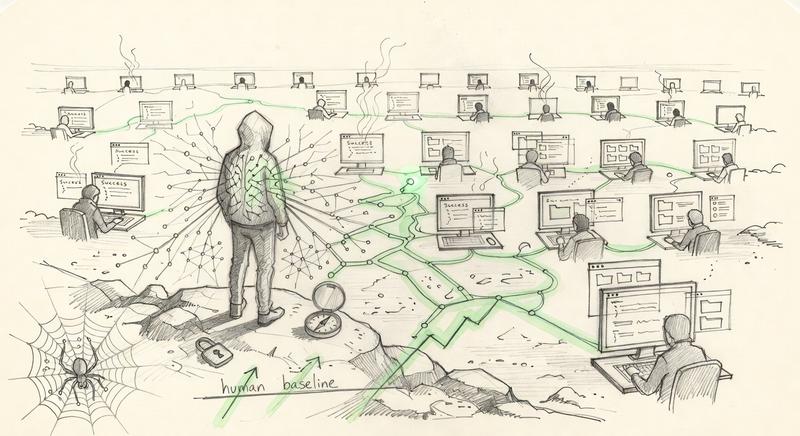
Holo3-35B has become the first model to surpass the human baseline on verified computer-use benchmarks, hitting 80.4% on a suite that includes OSWorld, BrowseComp, and Terminal-Bench. This isn't incremental progress, it signals the accelerating reality of autonomous agents that can plan, act, and iterate in digital environments without constant human oversight.
The numbers are in and they are unambiguous. Holo3-35B just posted 80.4% on the Computer Use leaderboard, clearing the human baseline for the first time across a verified suite that includes OSWorld-Verified, BrowseComp, Terminal-Bench 2.0, and SWE-Bench Pro.
The Benchmark That Mattered
Previous models impressed on narrow tasks or synthetic evaluations. This one was tested on real digital labor: navigating desktops, debugging code, recovering from failures, chaining tools across applications, and completing multi-hour workflows without hand-holding. The gap between "looks impressive in a demo" and "outperforms the median software engineer on a laptop" has closed.
This is not another language model milestone. It is the moment agentic systems crossed from prototype to prototype-that-can-actually-do-the-job. The knowledge graph at gentic.news tracks 4,893 AI entities and 5,036 relationships. Holo3 sits at the convergence of scaling laws, better tool-use architectures, and rigorous verification infrastructure that the community has been building for two years.
The implications compound quickly. Enterprises that have been piloting agents for customer support, code review, or data analysis now have empirical proof that autonomous digital workers can exceed average human performance on representative tasks. The question shifts from "can agents work" to "how do we deploy them responsibly at scale."
Why Sovereignty Becomes Non-Negotiable
When agents can act in your environment, the infrastructure they run on stops being an implementation detail. An agent that outperforms humans on terminal tasks and browser workflows will, by definition, have access to credentials, local files, APIs, and decision loops that touch real value.
Running that capability in someone else's cloud is renting your intelligence. The model might be open weights, but the execution environment determines who actually controls the agent. Local-first deployment, on-premise inference, and verifiable compute suddenly move from philosophical preference to operational necessity.
The Infrastructure Layer That Must Catch Up
The hardware side is already responding. Specialized inference chips optimized for agentic workloads, edge clusters that can run 30-70B class models at usable latency, and open tool-calling standards are all accelerating in parallel. But the trust layer remains the weakest link.
Bitcoin and Lightning aren't just for financial settlement anymore. They offer a neutral, verifiable coordination mechanism for agents that need to transact value, prove work, or establish reputation without relying on centralized platforms. An agent that books your travel, negotiates contracts, or manages your calendar will eventually need to move small amounts of value with cryptographic finality. The same immutable verification that makes Bitcoin the soundest money also makes it the soundest coordination protocol for machine-to-machine economies.
The convergence isn't forced, it is inevitable once agents become economically useful. A system that can outperform humans on digital tasks will quickly generate surplus that needs to be allocated, verified, and transferred. Sound money and sovereign compute are natural complements.
What Comes Next
Expect three immediate effects.
First, the open-source community will fork, distill, and specialize Holo3-style architectures at a furious pace. We will see domain-specific agents for software engineering, research, creative work, and operations within months.
Second, the deployment conversation will shift from cloud APIs to local runtimes. Companies that previously accepted "it runs in the vendor's environment" will start demanding on-prem or air-gapped options. The security and compliance teams were right all along.
Third, the benchmark wars will intensify. Computer Use is just the beginning. We will see agent benchmarks for physical robotics, multi-agent collaboration, long-term memory management, and adversarial robustness. The leaderboard at gentic.news will become the scoreboard that actually matters.
This milestone doesn't mean AGI is around the corner. It means the narrow but incredibly valuable category of "digital worker" has reached viability. The next 12 months will be defined by who can take this capability and turn it into reliable, owned, sovereign systems rather than rented black boxes.
The age of the agent isn't coming. It just proved it can already do the job better than most of us on a Tuesday afternoon. Now the real engineering begins: making that capability trustworthy, private, and aligned with the humans who deploy it.