 ← All articles
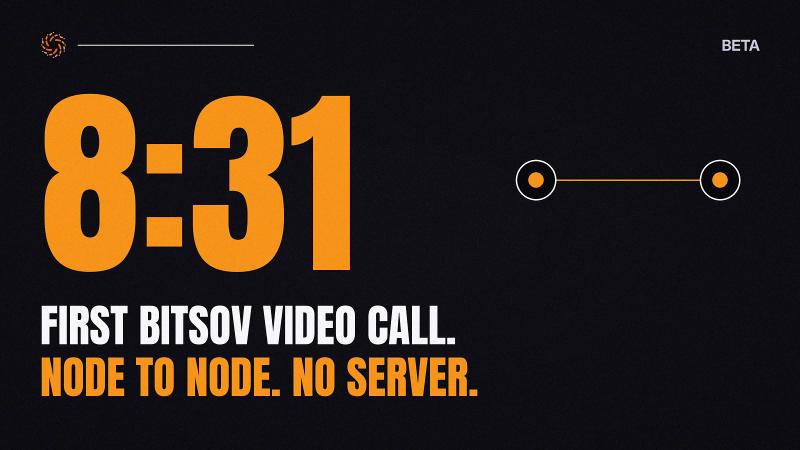
Two homes, two nodes, 8 minutes 31 seconds: the first BitSov video call ran with no server in the middle
Last night a BitSov video call ran between two homes, each on its own node. It is a beta milestone, not a launch. Here is what worked, what did not, and the idea in the whitepaper behind it.
What happened
On the evening of 18 November 2026 we made the first live BitSov video call. One end was our founder Rasmus in Odense, on the BitSov Mac app running against his own Raspberry Pi node. The other end was a family tester in his own home, on his own Mac app running against his own Umbrel node.
The call ran 8 minutes 31 seconds on the new build. No crackle.
The order of events matters. An audio test call came first. Once that held, we built video and shipped it to both Macs within the hour. Then we called again, this time with video.
Each side runs its own node. No central server carries the call. The media goes box to box.
The call was metered in sats from each node's own budget. No account was charged and no platform sent an invoice.
Why it matters
Almost every call you make today passes through somebody's server. Video apps, chat apps, and now AI assistants work the same way: you talk, a company in the middle carries it, and that company decides what is kept, for how long, and who else gets to look.
You can toggle settings. You cannot toggle where the server is.
BitSov flips the order. Authority sits with the node, and the node sits in your home. The call goes from one box to the other. The budget for the call lives on each person's own node, not in an account on someone else's server.
This is the lesson Bitcoin taught about money, applied to conversation. If it runs on someone else's machine, it is their machine.
What the whitepaper says
Last night's call is a small, concrete instance of an idea we wrote down in full in the BitSov whitepaper: mindlink.tech/bitsov/whitepaper. Three of its ideas carry this milestone.
The node holds the relationship. The whitepaper describes BitSov as a communication substrate in which the node, not a platform, holds every relationship. Last night there was no platform to hold anything. Two nodes held one call.
Your identity is your own key. In the whitepaper, each node's identity is its own cryptographic key, derived from a seed the person holds. There is no account, no registration, and no platform that hands out names. That is why the other end of last night's call needed his own node, not a login.
No service without settlement. The whitepaper's core rule is that a node does no meaningful work for a counterpart without a settled Bitcoin payment. It argues that "free" communication was never free: when sending costs nothing, the network gets paid by selling the receiver's attention and data. Its answer is that the sender carries a small, settled cost, with the value going to the recipient or the network, not to an advertiser. Last night's call was metered in sats from each node's own budget, which is that rule running in a beta.
The whitepaper also separates what is built from what is still a target. We recommend reading it with that line in mind, and with this post as a single data point, not a proof of the whole design.
The protocol is public. Privacy is the aim.
What is honestly not done yet
We would rather say this ourselves than have someone else find it.
- Beta, not a launch. This ran in our beta, not in a product you can download today.
- Beta, with family testers. Last night's call was between two homes in one family. That is a real test, but it is a small one.
- Spend approvals still needed a manual step. Last night a person still had to approve the spend. Automating that step away is our next job.
- Mac only, for now. Both ends were Macs.
BitSov is a proposal running in beta. It is not a finished product, and we are not making claims beyond what ran last night.
What is next
Windows and Linux are next, with two testers on those platforms. Then we keep doing the boring part: remove the manual approval step, run longer calls, and write down what breaks.
If you build on Bitcoin and want to see how this works, read the whitepaper and the public protocol. Issues and patches are welcome.
Two homes. Two nodes. 8 minutes 31 seconds. Nobody in the middle.