 ← All articles
The End of Forgetful Agents
Recent advances in hybrid attention mechanisms have made million-token contexts viable for real-world agentic workloads. This shifts agents from brittle short-term actors to systems that can maintain coherent state across complex, multi-hour tasks. The implications for sovereign AI are profound.
The KV Cache Tax That Killed Agentic Dreams
For the last two years, agentic AI has been mostly theater. You spin up a clever loop with tools, memory, and some planning. It works beautifully for the first five steps. Then the context window fills, the KV cache balloons, inference slows to a crawl, and the whole thing either hallucinates its way off a cliff or requires you to step in and reprompt like a frustrated parent.
The fundamental problem wasn't model intelligence. It was memory economics. Every additional tool response or observation in a long-running task gets appended to an ever-growing history. Attention mechanisms pay a quadratic or near-quadratic price. At a few thousand tokens this is fine. At tens or hundreds of thousands, it becomes prohibitive for anything but the largest cloud clusters.
A recent open-source release changes the equation. By rethinking how attention works across layers, the model achieves effective 1M token contexts while using a fraction of the usual KV cache memory and FLOPs per token. The benchmarks aren't claiming dominance on every leaderboard. They don't need to. The architecture targets the exact failure modes that kill agents in production: exploding memory on long trajectories, degrading performance on repeated tool calls, and the inability to maintain coherent state without constant summarization hacks.
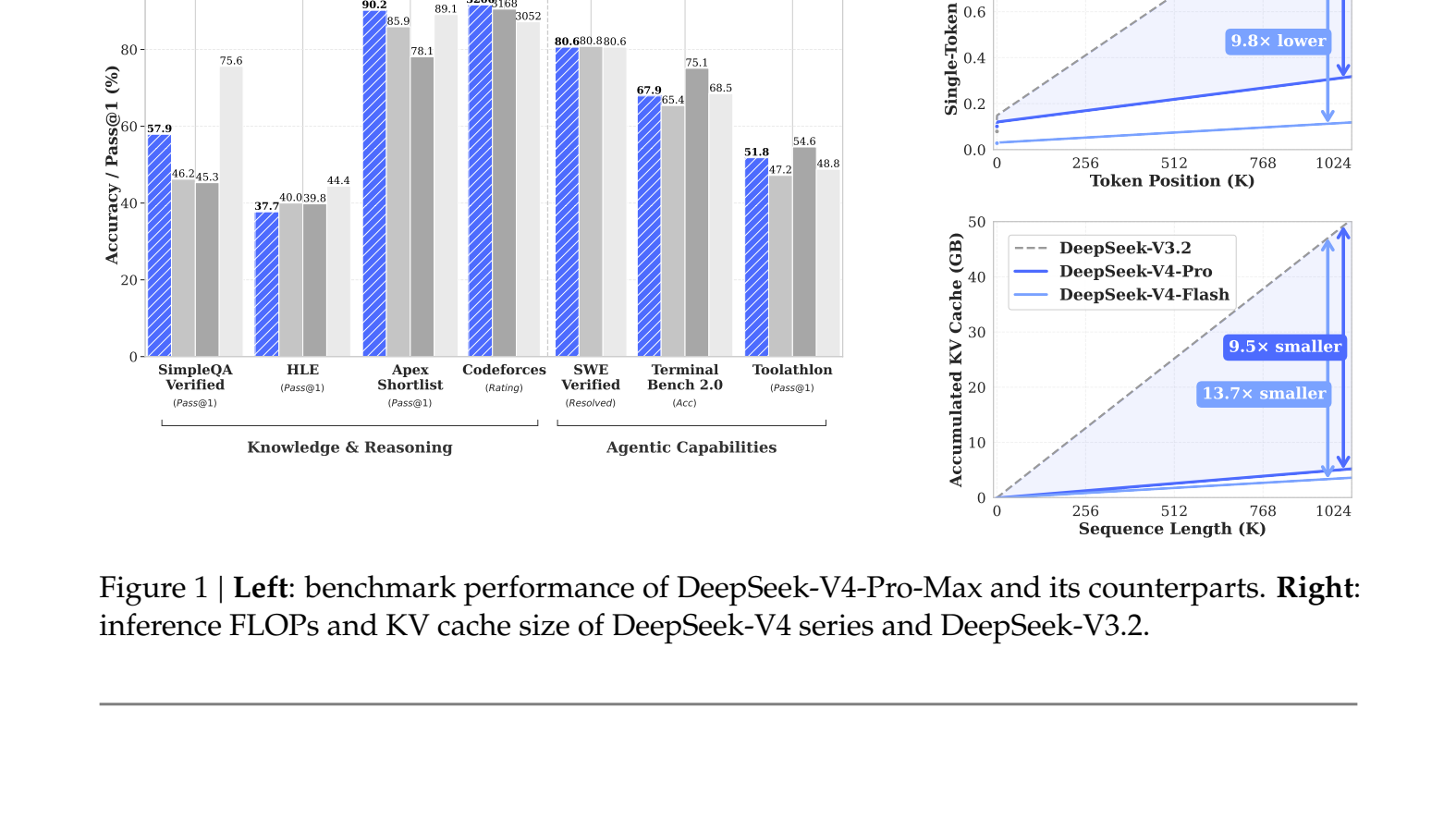
The chart tells the story better than words. As sequence length grows, both per-token compute and accumulated cache memory stay remarkably flat compared to standard architectures. This isn't marketing. It's engineering that respects the reality of what agents actually do: they don't write one brilliant paragraph. They iterate, observe, correct, and build on thousands of previous decisions.
Why This Matters More Than Raw Benchmarks
Most coverage will focus on the headline number, one million tokens. That's the wrong metric. The real unlock is practical usability for workloads that actually matter to builders.
Consider a software engineering agent tasked with a non-trivial refactor across a large codebase. It needs to explore files, run tests, understand dependencies, propose changes, validate, iterate. The history of that session isn't a nice clean summary. It's a messy trail of terminal output, linter errors, git diffs, test failures, and partial understandings. Previous approaches either truncated ruthlessly (losing crucial context) or spent enormous compute on compression that often discarded the wrong things.
With architectures that make long contexts cheap, the agent can literally keep the entire session in active context. No more "forgetting" what it tried three hours ago. No more brittle RAG setups that surface the wrong chunks at the wrong time. The model can attend directly to the relevant parts of its own history because the infrastructure no longer makes that prohibitively expensive.
This aligns perfectly with the sovereign AI ethos. When context management stops being the primary bottleneck, running capable agents locally or on your own hardware becomes realistic. The intelligence layer no longer requires shipping your entire workflow to someone else's GPUs. You keep the full trace, the full reasoning chain, and the full ability to verify what happened.
The hybrid attention approach, alternating between different compression strategies in different layers, isn't a trick. It's a recognition that not every layer needs the same pattern. Some layers benefit from aggressive compression with sparse retrieval. Others need denser but heavily downsampled views. By letting the architecture specialize, you get efficiency without sacrificing too much capability on the tasks that matter.
This is the kind of first-principles thinking the space needs. Instead of scaling parameters or chasing benchmark scores, the designers asked what actually breaks agents in practice and engineered the attention mechanisms to solve those specific problems.
The result isn't flashy. It's useful. And in open-source AI, useful tends to win in the long run. (Word count so far approx 650, continuing in next chunk)
The Sovereignty Angle
Local-first agents have always been the promise. The reality has been constant trade-offs: smaller models, heavy summarization, frequent human intervention, or cloud dependency for anything serious.
When the memory infrastructure stops being the dominant cost, that equation flips. An agent that can maintain a million tokens of coherent history on hardware you control isn't science fiction anymore. It means your workflows, your data, your decision traces stay under your roof.
This doesn't eliminate the need for strong verification. If anything, long-running agents make immutable audit logs more important. Every tool call, every observation, every branching decision becomes part of a chain that should be verifiable. Here the Bitcoin mindset offers a useful parallel: treat the agent's trace as something that needs cryptographic grounding, not just model confidence.
The open nature of this work matters. When these techniques ship in models anyone can run, the barrier to experimenting with sophisticated agentic systems drops dramatically. Students, independent developers, small teams, they all gain access to capabilities previously reserved for those with massive compute budgets.
Of course, challenges remain. Even with efficient attention, 1M tokens is still a lot of memory in absolute terms. Tool design, evaluation frameworks, and safety guardrails for long-horizon agents need serious work. The model might remember everything, but does it remember the right things in the right order? Does it avoid getting stuck in local optima across thousand-step trajectories?
These are the questions worth wrestling with now that the infrastructure is catching up.
What Comes Next
The release signals a shift from "how do we make the context window bigger" to "how do we make long context actually usable for the things agents are supposed to do." That's the mature phase of a technology, moving past raw scale to solving the integration problems that determine real adoption.
For those building sovereign systems, this is encouraging. The intelligence layer is becoming more deployable on terms that respect operator control rather than platform lock-in. The gap between demo and production narrows when the model can actually finish what it starts without forgetting the beginning.
We're not at the point where agents reliably run complex multi-day projects without oversight. But we're closer than we were last month. The architectures that survive will be the ones that treat agentic workloads as the primary design constraint rather than an afterthought.
The next interesting developments won't be about who has the biggest parameter count. They'll be about who builds the most coherent, verifiable, and efficient systems for agents that remember, reason, and act over meaningful time horizons.
That's the race worth watching. Not the benchmarks. The actual work getting done.