 ← All articles
The Dawn of Embodied Open AI: What Physical Reasoning Models Change
An open omni-model that reasons about and acts in the physical world isn't hype, it's the bridge from language to real agency. This shift demands we rethink where our agents run and who they answer to.
We've been chasing intelligence in the wrong direction for too long. Language models mastered conversation, code, and even creative writing. But they remained trapped in the abstract, disembodied ghosts in the machine.
The Grounding Problem
The real test of intelligence has always been action in the physical world.
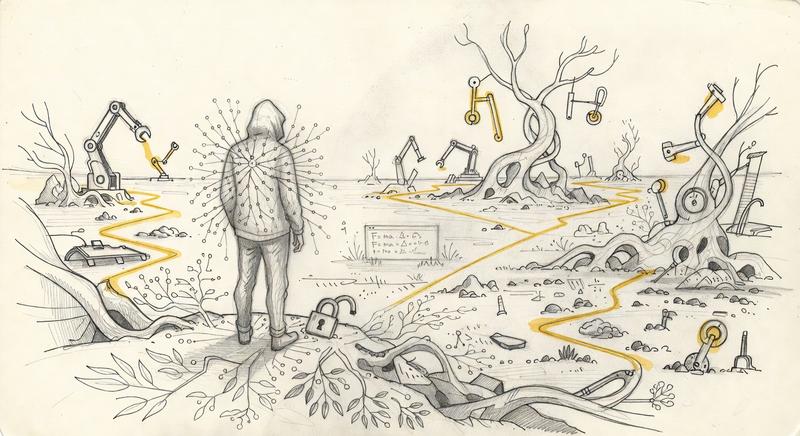
That's what makes the arrival of open omni-models capable of physical reasoning such a pivotal moment. These systems don't just predict the next token. They build internal models of physics, causality, and spatial relationships. They can watch a video of a robot arm and reason about the forces involved, predict outcomes, and even generate control sequences.
This isn't incremental progress. It's the closing of a fundamental gap. For years we've had impressive demos of robots guided by separate perception and planning stacks. The new wave integrates reasoning directly into the model itself. One system that can see, think, and act with coherent understanding of the messy real world.
The implications cascade. Agentic workflows that were previously confined to digital tasks, research, coding, data analysis, can now extend into the physical. Imagine local agents that manage your workshop, optimize a small manufacturing cell, or maintain infrastructure without phoning home to a distant data center every few seconds.
Why Open Matters Here
Closed models keep the intelligence behind paywalls and rate limits. Open models put the weights in your hands. You can run them on your hardware, fine-tune them for your specific environment, and verify what they actually know about physics rather than trusting the provider's claims.
This aligns with first principles. Intelligence should be sovereign. Your agents should operate under your control, on infrastructure you own, with models you can audit. The alternative is outsourcing your physical operations to someone else's cloud, the same mistake we made with data and now risk repeating with action.
The models aren't perfect yet. Hallucinations in physical space are more dangerous than in text. A wrong prediction about torque or balance can break hardware or worse. But the trajectory is clear: open models are catching up fast because the community can iterate, combine, and specialize them in ways closed labs can't match.
The next wave won't be about who has the biggest model. It will be about who has the best grounded models running closest to the point of action. Local-first isn't a nice-to-have. It's the only architecture that scales to real-world deployment without creating new points of failure and control.
From Language to Embodiment
The shift from pure language models to omni-models trained on video, robotics data, and simulation changes the agent game completely. Traditional agent frameworks relied on brittle pipelines: LLM for planning, separate vision model for perception, yet another for control. The new generation collapses this. Reasoning about the physical world happens in the same latent space as the language.
This enables more robust, adaptive agents. An agent that truly understands friction, gravity, and material properties can recover from disturbances in ways scripted systems never could. It can generalize from one task to another without exhaustive retraining.
Sovereignty isn't abstract when your agents interact with the physical world. If your manufacturing agent or home maintenance bot depends on a remote API, you're one outage or policy change away from paralysis. Running grounded models locally, perhaps anchored to your own compute nodes, changes the risk equation.
We're seeing the early signs in open-source robotics projects and local-first automation tools. The models provide the brains. The community provides the grounding data and fine-tunes. The result is intelligence that lives where the work happens.
There's a deeper philosophical point too. Intelligence without a body is incomplete. We've known this in theory for decades. Now the technology is catching up. The models that survive won't be the ones that talk the best. They'll be the ones that can act effectively in uncertain environments while respecting the operator's boundaries.
The open nature accelerates this. Researchers can share datasets of physical interactions, techniques for simulation-to-real transfer, and safety guardrails that work in the real world. Closed labs hoard their data. The open ecosystem compounds.
The Lingering Question
This leaves us with a choice. We can continue building agents that live in the cloud, clever but dependent. Or we can invest in the stack that lets intelligence run sovereign: local models, verifiable compute, decentralized coordination layers where needed.
The release of capable open physical reasoning models tips the scales. It proves the technical path exists. The remaining work is engineering, data, and integration. Builders who understand both the models and the hardware will have the edge.
The future of AI isn't in bigger datacenters. It's in smaller, smarter systems that understand the world well enough to act in it responsibly. Under your control. On your terms.
That future starts now. Not with fanfare and benchmarks, but with quiet deployments in workshops, labs, and factories where the models run without asking permission. The ones that last will be the ones we can truly own.