 ← All articles
The Claude Code Reckoning: Why Uber’s AI Budget Implosion Proves Sovereign AI Is the Only Sane Path
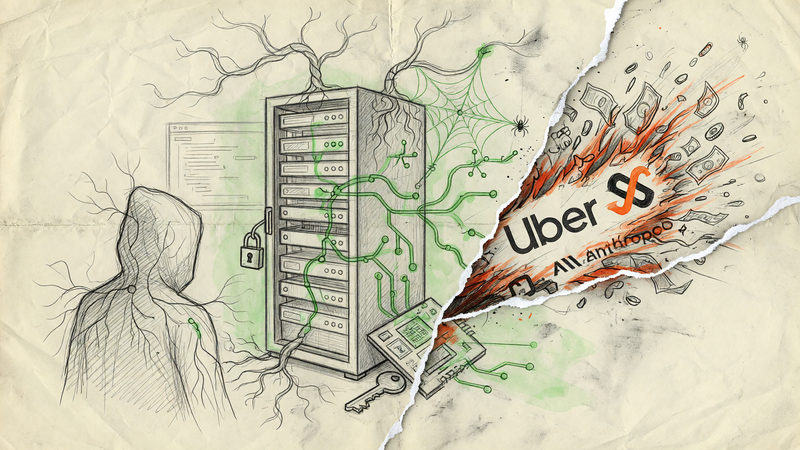
Uber torched its entire 2026 AI budget in four months after giving Claude Code to 5,000 engineers. Adoption hit 84%. Per-engineer spend hit $500-$2,000/month. They capped it at $1,500. This isn’t an anomaly, it’s what happens when agentic coding meets usage-based token pricing. The sovereign alternative just became table stakes.
The numbers coming out of Uber aren't an anomaly. They're the canary.
After rolling Claude Code (and tools like Cursor) out to roughly 5,000 engineers, adoption of agentic workflows went from 32% to 84%. Seventy percent of the code being written is now AI-originated. Eleven percent of backend updates run fully agent-driven. Individual engineers were racking up $500-$2,000 per month in token spend. The entire 2026 AI budget was exhausted by April.
Their response was predictable: implement $1,500 monthly caps per employee on these tools while they review spend and test alternatives. Microsoft saw the same pattern internally.
Productivity gains were real. That's not in dispute. The speed at which good engineers can now explore, prototype, debug, and ship is genuinely different. But the economic model underneath it is broken.
Usage-based token pricing works fine for occasional queries or simple autocomplete. It collapses when you hand an agent a complex, multi-step coding task that spawns sub-agents, runs debugging loops, explores alternative implementations, writes tests, refactors, and iterates until it ships. The better the agent gets, the more tokens it consumes. Success becomes the budget killer.
This is non-linear cost scaling disguised as linear pricing. Fixed budgets and forecasting become impossible. Every time an engineer has a productive day, finance gets a surprise.
The fundamental problem isn't Claude specifically. It's that the intelligence layer is rented by the token from a centralized provider whose incentives are not aligned with yours. When your agents start doing real work at scale, the bill becomes unpredictable and massive.
This pattern is repeating across the industry. The dream of "just use the API" hits the wall of real usage. What looked like a simple opex line item becomes a variable cost center that scales with your success.
The honest read is that cloud AI providers have built an incredible capability layer. The models are powerful. The agent frameworks are getting shockingly good. But they've coupled that capability to a pricing model that makes high-volume, high-agency usage economically unstable for the customer.
Enterprise buyers are waking up to the fact that "AI budget" isn't a fixed thing you can plan. It's a function of how much your agents think. And agents that think productively think a lot.
This is where sovereign AI stops being a philosophical preference and becomes basic risk management.
When you run models locally or on infrastructure you control, your costs become predictable capex or reserved compute. You decide the hardware once. You choose which open models to run or fine-tune. You own the inference. The bill doesn't change because your agent got clever at 2am and decided to spin up three parallel research branches.
You also get the privacy and compliance properties that enterprises actually care about when the agents start touching real code, real data, real customer systems. No more wondering what leaves the perimeter in the context window.
And here's the part that ties it together: that local intelligence layer can sit on top of sovereign infrastructure. Agents that communicate node-to-node, verify via Lightning, anchor their state and coordination on Bitcoin rails. No platform can deplatform you. No surprise invoice can kneecap your velocity. The trust layer and the intelligence layer converge on infrastructure you control.
At MindLink we're building the other side of this equation. Local-first AI agents that run where you need them to run. Enterprise implementations that don't come with a usage roulette wheel attached. The stack that treats sovereignty as a non-negotiable property, not a nice-to-have.
The Uber story isn't a failure of AI. It's a feature of the current deployment model becoming obvious at scale. The productivity is real. The dependency and cost unpredictability are also real.
Builders who want to capture the upside without the downside are moving to sovereign infrastructure: models you host, agents you own, communication and verification layers that don't require trusting a vendor's billing system or data policies.
Token math broke the naive "everything in the cloud" dream. The next wave understands that intelligence without sovereignty is just rented capability with a very expensive meter running.
The question isn't whether agentic coding is coming. It's whether your organization will control the agents doing the coding, or whether you'll just be writing ever-larger checks to whoever does.
We're choosing the former. The numbers from Uber suggest more teams will be joining us.