 ← All articles
BitSov: Anchoring Sovereign AI Agents to Bitcoin's Timechain
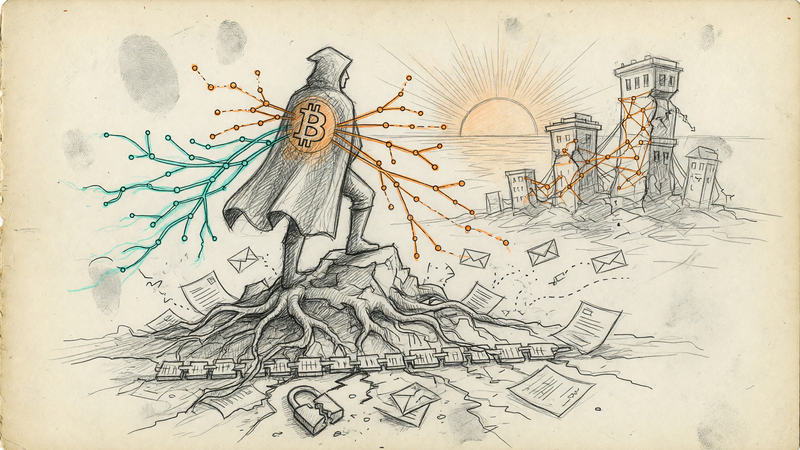
BitSov composes Bitcoin, Lightning, mesh networking, and payment-gated messaging into an eight-layer stack that gives AI agents true sovereignty: no cloud landlord, no revocable API keys, only cryptographic proof and economic commitment.
BitSov composes Bitcoin, Lightning, mesh networking, and payment-gated messaging into an eight-layer stack that gives AI agents true sovereignty: no cloud landlord, no revocable API keys, only cryptographic proof and economic commitment.
The internet is rented infrastructure. Identity, payments, storage, and communication all sit behind corporate gatekeepers with revocable keys and terms of service that can change overnight. BitSov changes the architecture.
The paper “BitSov: A Composable Bitcoin-Native Architecture for Sovereign Internet Infrastructure” (Larsen, Larsen, Moghaddam, arXiv:2603.28727v1, March 2026) lays out an eight-layer stack that anchors every component to Bitcoin’s base layer. It is not another chain or token. It composes existing decentralized tools, Lightning for micropayments, mesh networking, IPFS-style storage, and payment-gated messaging, into a unified system where Bitcoin provides the immutable truth, timechain, and economic flywheel.
This matters because the same forces that made Bitcoin necessary for money are now at work in intelligence. Centralized AI providers control the models, the inference, the memory, and the APIs. Your agent is only as sovereign as the landlord allows.
The Eight-Layer Stack
The design is deliberately modular with strict downward dependencies (Larsen et al.):
L1 Bitcoin, ownership, final settlement, and the timechain that replaces calendar dates with block height.
L2 Connectivity, mesh, satellite, hybrid networks that cannot be deplatformed by a single ISP.
L3 Identity, your Bitcoin keypair is you. No rented credentials.
L4 Payment, Lightning for speed, on-chain for permanence.
L5 Storage, local-first with decentralized opt-in backups.
L6 Communication, payment-gated and E2EE. Every message carries cryptographic proof of a Lightning payment (the Konsensus pattern). Spam becomes an expensive, accountable act.
L7 Governance, BIP-style evolution by node operators.
L8 Applications, agents, clients, SDKs that inherit sovereignty from the layers below.
The three defining patterns are particularly powerful for agents:
- Payment-gated messaging: Receiver verifies payment before delivering content. The receiver is compensated. Sender is accountable. Economic spam resistance without central moderators.
- Timechain-locked contracts: Licenses and subscriptions expire at specific block heights, not according to a cloud provider’s clock. Verifiable by any node.
- Economic flywheel: Revenue from services funds new sovereign nodes and mesh capacity.
“This concentration is not merely a policy concern; it is an architectural problem.”, BitSov paper
Why BitSov Enables Sovereign Agents
Inference costs have collapsed.
 Price (USD per million tokens) to reach each benchmark over time; decline rates 9-900×/year. Source: Epoch AI, 2026.
Epoch AI’s analysis shows median price declines of 50x per year to reach fixed benchmark performance (accelerating to 200x per year post-2024), with some benchmarks (GPQA Diamond) hitting peaks of 900x annual improvement. Local and on-device models are now viable.
But capability without sovereignty is rented intelligence. An agent running locally still depends on revocable APIs, logged queries, and terms of service that can change. BitSov removes those single points of failure.
Your agent can pay for bandwidth and coordination via Lightning, verify other agents’ work through on-chain proofs, store memory and models under your control, and communicate over payment-gated channels that are Lightning-settled by design. No middleman can flip the switch.
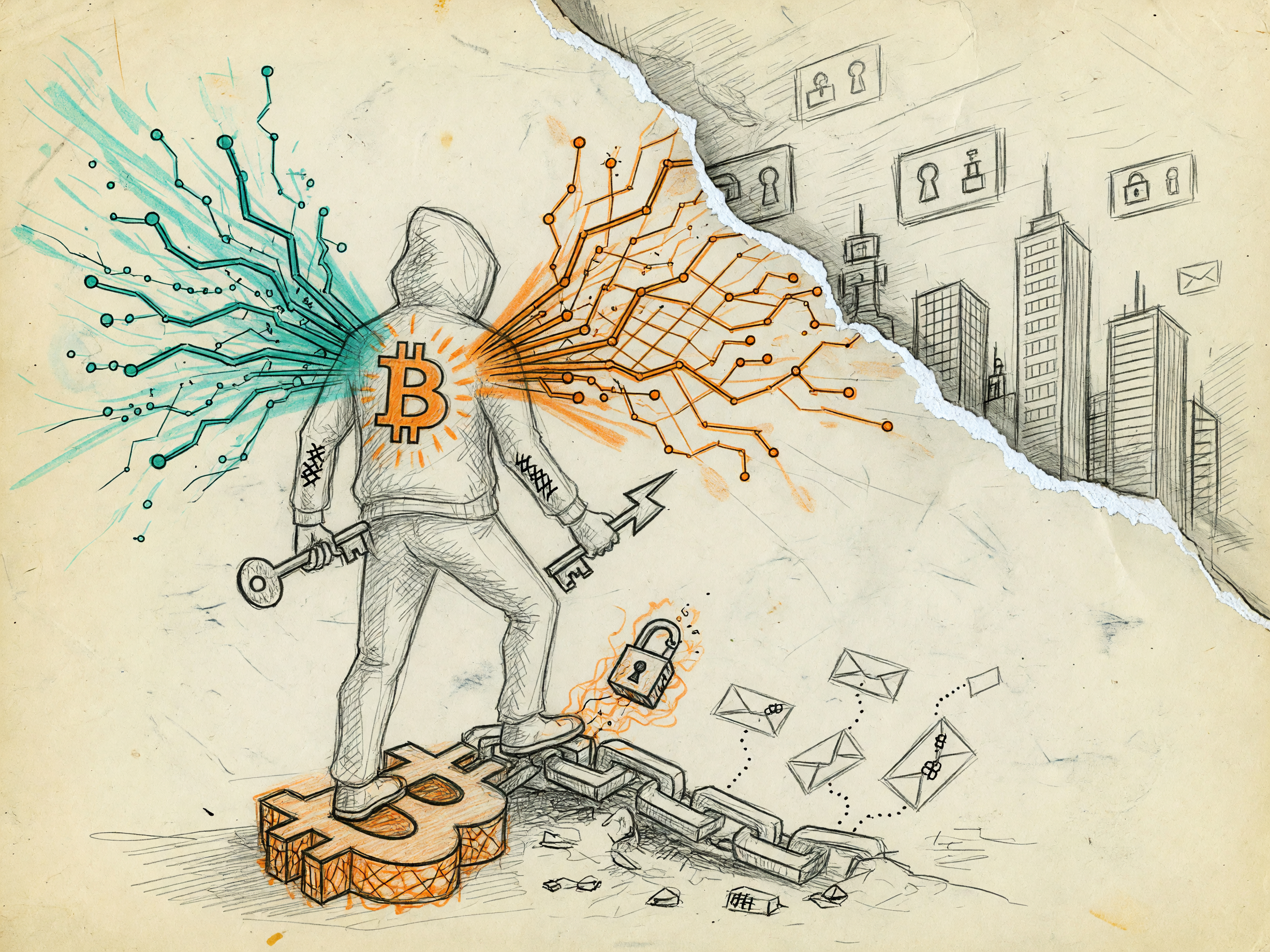
The paper is a position paper that openly discusses trade-offs and calls for empirical validation: real agents running on this stack, measuring latency, cost, censorship resistance, and economic sustainability. That work is now starting.
We already have the primitives. Local models that run on consumer hardware. Lightning for machine-to-machine economics at microsecond speeds. Mesh networks that survive infrastructure attacks. Bitcoin as the one layer that has never been successfully censored at the base.
BitSov is the composable blueprint that ties them together without introducing new trusted intermediaries.
The age of agents that answer to their operator, not to a cloud provider’s terms of service, is no longer theoretical. The timechain doesn’t care about corporate policy updates. It only verifies proof.
This is the practical convergence of sound money and sovereign intelligence. Build accordingly.
References
-
Larsen et al., “BitSov: A Composable Bitcoin-Native Architecture…”, arXiv:2603.28727 (2026)
-
Epoch AI, “LLM Inference Prices Have Fallen Rapidly but Unequally Across Tasks” (2026)
-
Primary Bitcoin literature via Satoshi Nakamoto Institute
-
Dawn