 ← All articles
Bitget Lost $388M Without Losing a Single Key
Bitget lost about $388M from its hot and warm wallets without a single private key being stolen: attackers fed its approval system spoofed data and it signed the withdrawals itself. The protocol held; the pool did not. The fix is to remove the pool and let the node enforce the spending rules.
On Thursday, 24 September, attackers drained Bitget's hot and warm wallets. The first estimate was about $352M. A day later, after counting Zcash and TRON assets it had missed, the exchange revised the total to about $387.5M. According to CEO Gracy Chen, the cold wallets were untouched, withdrawals were paused, and users are covered by Bitget's $464M User Protection Fund. On-chain tracker Lookonchain reported that the attacker had already swapped most of the stolen funds on EVM chains into 67,982 ETH, worth about $183M.
The detail that matters most came on Friday. Chen said private key compromise had been ruled out. Instead, attackers got into a backend system in Bitget's wallet setup, fed it faked transaction data, and Bitget's own approval process signed the withdrawals. No key was stolen. The system that held the keys was persuaded to use them.
Bitcoin did exactly what it was designed to do. It moved coins for whoever controlled the signing process. No consensus rule broke and no signature was forged. What failed was a custodian's approval process, the layer that decides whether a valid signature should be produced at all.
Reachability is the attack surface
The split between the wallets that survived and the wallets that fell tells you most of what you need to know. The cold wallets survived because nothing online could reach them or ask them to sign. The hot and warm wallets fell because an exchange needs an online system that can approve and send withdrawals quickly, and that system controlled a large pool of other people's funds.
An attacker is weighing the cost of a break-in against the size of the prize. A reachable, automated approval path in front of a shared pool combines both factors in the attacker's favor. A single successful intrusion pays out for everyone in the pool.
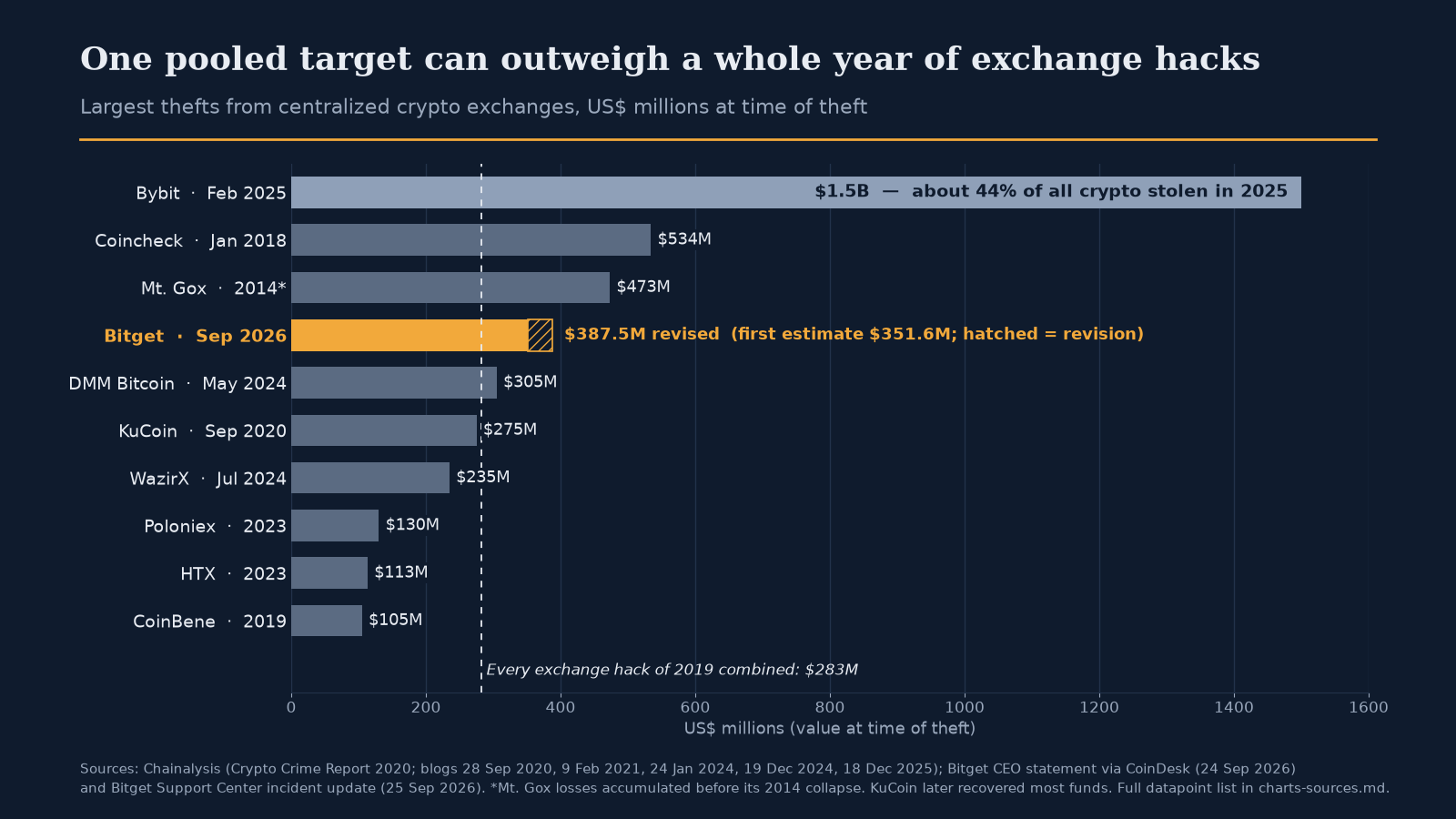
The biggest crypto thefts are raids on single custodial pools, not breaks of Bitcoin. Bitget's hot and warm wallets alone lost more than every exchange hack of 2019 combined, and Bybit's $1.5B was about 44% of everything stolen in 2025.
AI changes the math on one side only
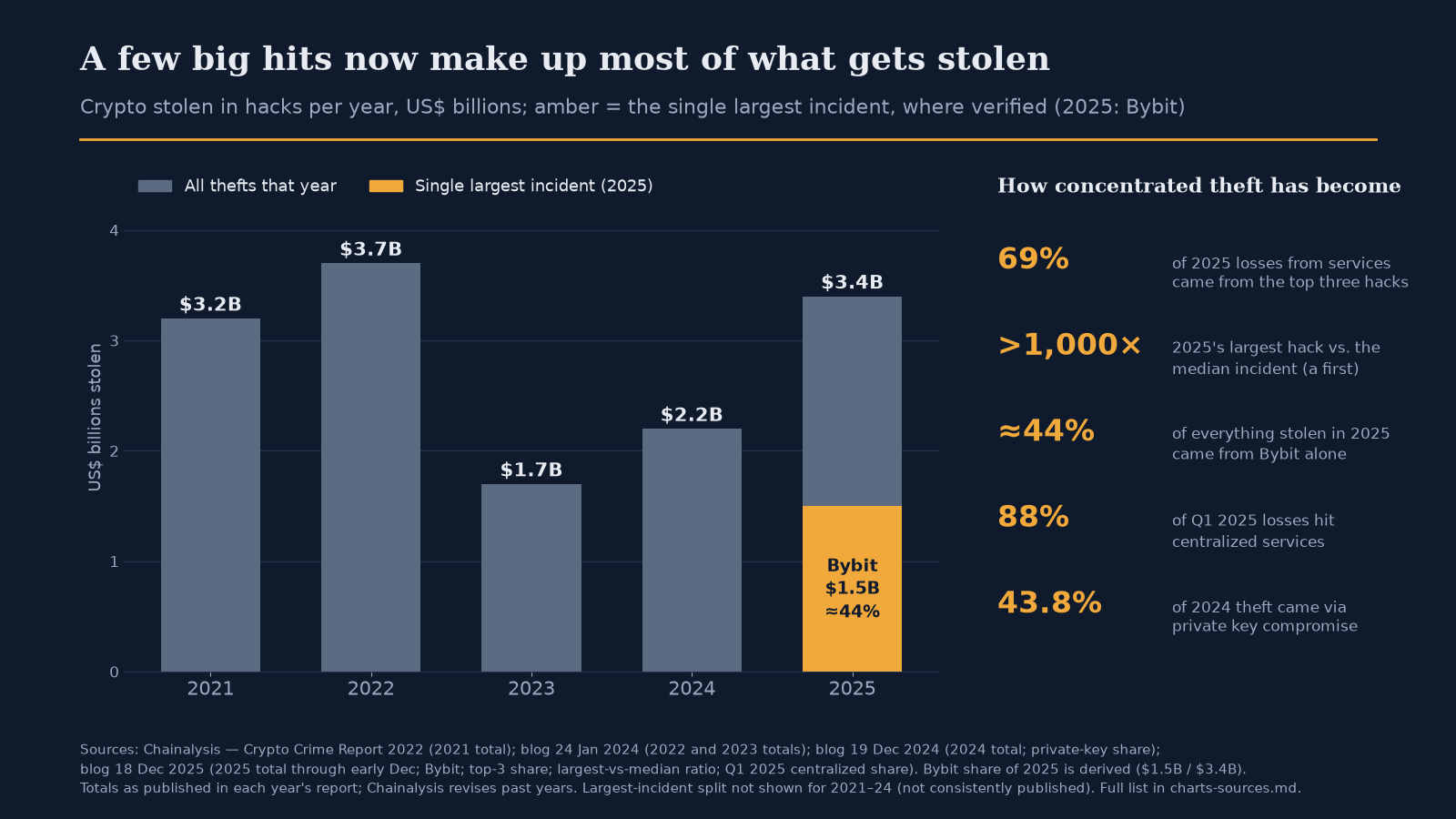
Crypto theft is increasingly a game of a few huge hits. In 2025 the top three hacks made up 69% of losses from services, the largest was over 1,000 times the typical incident, and Bybit alone accounted for about 44% of everything stolen.
Attack work used to be expensive: reconnaissance, phishing tailored to specific staff, mapping internal systems, crafting data that passes automated checks, and laundering the proceeds. Language models and coding agents now make much of that work cheaper and faster to repeat. They lower the attacker's cost for each attempt, while the reward from a pooled wallet stays just as large.
A large pool behind an automated approval path is therefore a better target every month. Better perimeter security helps, but it does not change what the attacker gets from a single successful break-in.
Why slowing down is not a defence
The people building these systems are worried about the same thing. On 12 September, Anthropic CEO Dario Amodei published an essay called We Must Pace the Frontier, arguing that the industry must "slow the pace at which we improve the capabilities of AI models." Among his reasons, he wrote that today's models, unlike those of 2023, are capable of significant deception and cyberattacks. Within a day, OpenAI's Sam Altman, Elon Musk of xAI, and Google DeepMind co-founder Demis Hassabis had publicly backed the direction.
That raises the obvious question: why hold back at all, instead of building better defences? Pacing the frontier buys time, and time is useful. But it does not change the attacker's economics at the point where money actually moves. The tools that make break-ins cheaper already exist and will keep getting cheaper, whether or not the frontier labs slow down. Meanwhile, a pooled wallet behind an automated approval path is still worth the same to whoever reaches it first.
Better perimeter defences have the same limit. They raise the cost of getting in, but they leave the prize intact, so the attacker only has to win once. The defence that holds as attack costs fall is one that shrinks what any single break-in can win, and puts limits on what any system, human or AI, is allowed to approve.
Remove the target, then constrain the signer
The structural fix has two parts.
The first is to stop pooling. When users hold their own keys on their own nodes, there is no single target worth hundreds of millions of dollars. An attacker would have to break into thousands of separate setups, and each one pays out only that user's balance. The economics of the attack fall apart.
The second part matters even more after Bitget, because this attack never needed a key. The spending rules have to live in the node itself, where no system above it can override them, however convincing the data it is fed. Examples include:
- daily or per-transaction spending budgets,
- allowlists of approved destination addresses,
- time delays on large or unusual withdrawals, so there is time to cancel them,
- multisig, so no single compromised system or person can approve alone.
A faked transaction record can fool an approval process. It cannot raise a budget cap, add an address to an allowlist, or skip a time delay that the node enforces. The same holds as people hand wallet access to AI assistants. A hijacked agent, a poisoned prompt, or a stolen session can only request a transaction. If the node enforces the rules, the request fails the same way the forged one would.
Where authority should live
This is the design principle behind BitSov. Authority over funds belongs to the node, not to the AI, not to a backend service, and not to a remote operator. Software above the node can draft, suggest, and automate within limits. The node decides whether a transaction actually happens.
Bitget's users look set to be made whole, which is to its credit, and the protection fund worked as intended. The lesson reaches beyond one exchange, though. A shared pool behind a reachable approval path will keep being an attractive target, and cheaper attack tooling makes that worse. The durable answer is to remove the pool and move authority down to the node, where the owner sets the rules.
Caveats. The loss figures, the protection fund amount, the untouched cold wallets, and the ruling-out of key compromise come from Bitget and its CEO, as reported by CoinDesk and Bitget's support page. The 67,982 ETH (about $183M) swap figure is Lookonchain's on-chain estimate. Bitget's suggestion of North Korean involvement is unproven, and this piece does not rely on it. Beyond what Bitget has described, the piece makes no claim about how the intrusion worked.
Sources: Bitget CEO Gracy Chen via CoinDesk, 25 Sep 2026; Bitget Support Center incident update, 25 Sep 2026; Lookonchain, 24 Sep 2026; chart data from Chainalysis, 18 Dec 2025, Chainalysis, 19 Dec 2024, Chainalysis, 24 Jan 2024 and the Chainalysis 2020 Crypto Crime Report; Dario Amodei, We Must Pace the Frontier, 12 Sep 2026; Axios, 13 Sep 2026; The Guardian, 13 Sep 2026.