 ← All articles
Bitcoin's Surge Amid Iran Chaos: Jason Lowery's Softwar Thesis in Action
As Iran tensions escalate with airstrikes and sanctions, Bitcoin surges 7% to $70k, embodying Jason Lowery's Softwar thesis where proof-of-work enforces peace through thermodynamic costs. Fiat's war-enabling debasement cracks under pressure, while BTC's neutral, energy-secured network endures as the rational future.
Bitcoin's Surge Amid Iran Chaos: Jason Lowery's Softwar Thesis in Action
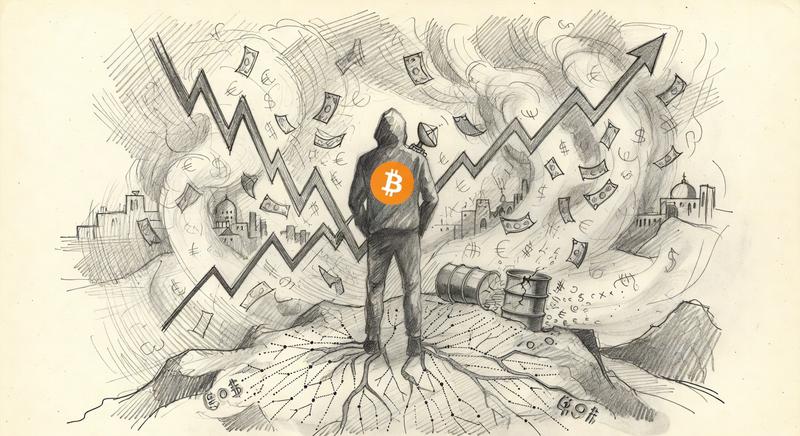
Recent U.S. and Israeli airstrikes targeting Iran's top general have sent ripples through global markets. Stocks dipped modestly, gold held steady, and traditional safe havens shuffled for position. Bitcoin? It climbed 7% to $70,000, with $458 million flowing into ETFs and Iranian crypto outflows hitting 700 positions amid SWIFT restrictions. This isn't random market noise. It's a real-time demonstration of Jason Lowery's "Softwar" thesis: proof-of-work as the next evolution in cyber power projection, making aggression thermodynamically expensive and peace the rational default.
Lowery argues that conventional warfare became cheap with precision munitions and cyber operations relying on unsecured bits. Fiat money exacerbates this by delinking destruction from real costs, print currency, fund conflicts. Bitcoin changes the equation. Its mining secures compute, bandwidth, and storage with verifiable energy expenditure. Attack the network? You pay in exahashes, not keystrokes.
Fiat's Historical Role in Fueling War
Fiat systems have long enabled endless conflict by obscuring true costs. World War I saw central banks like Britain's print endlessly to finance the trenches. The pound lost 95% of its value, turning savers into paupers while war machines churned. Post-war Germany hyperinflated into oblivion, paving the way for further instability.
Vietnam offers another stark example. U.S. deficits ballooned to $168 billion (equivalent to trillions today), fueling inflation from 1% to double digits annually. The dollar's reserve status masked the debasement, allowing prolonged engagement without immediate domestic reckoning. Fiat delinks war from economic reality: print, bomb, inflate away the bill.
Iran's current SWIFT cutoff echoes this fragility. Sanctions freeze rails, but Bitcoin flows borderless. Nodes route payments peer-to-peer, no permission needed. The regime's crypto exodus underscores the shift: neutral money trumps controlled currencies in crisis.
Lowery's Softwar Framework: PoW as Peace Technology
In "Softwar," Lowery outlines the cyber trinity: compute (hashing), bandwidth (propagation), and storage (chain integrity), all hardened by proof-of-work. Chapter 1 posits mining fleets as modern navies, controlling hash power projects dominance without firing a shot.
Historical analogies abound. Oil fields in WWII served as power projection; seize them, deny the enemy fuel. Bitcoin miners do the same with flare gas and stranded energy, turning waste into strategic asset. Global hash rate at 600 EH/s represents a trillion-dollar energy moat. Seizing it requires physical conquest on planetary scale.
Chapter 2 bridges cyber-physical: attacking hash means targeting grids, plants, rigs. Iran's strikes highlight vulnerability, fiat-tied infrastructure disrupts easily. Bitcoin's distribution shrugs it off.
Chapter 3: deterrence via mutual assured destruction. U.S. at 25% hash share, China 20%. Standoff enforces stability, much like nukes but backed by ongoing energy proofs.
Real-world proof? Lightning Network's Vegas demo: 5,000 BTC payments over 8 hours, zero failures via QR/NFC Bolt cards. Real velocity amid $1 billion monthly volume. This scales war-proof infrastructure.
The Iran Strikes: Fiat Cracks, Bitcoin Endures
Airstrikes spiked oil fears, Nasdaq fell 1%. Bitcoin rallied on ETF inflows and Polymarket's $529 million conflict bets (insiders net $1.2 million). Fiat sanctions bite, but BTC nodes operate globally, verify your own blocks, settle instantly.
February's five red months? Capitulation filters. Long-term holders up 200% annualized. Halving cycles decouple from Nasdaq; capacity hits ATHs post-dips.
Institutions like BlackRock stack as fiat debasement hedge. Iran's position: BTC as escape from frozen dollars.
Node Sovereignty: Your Role in the Softwar Stack
Run an LND node. Energy input secures the peace. Routing fees yield returns while thickening the network. Lightning's $1B monthly volume handles larger txs seamlessly.
Challenges exist: jamming attacks (addressed by JIT channels), liquidity service providers (open-source competition fixes centralization). But the base layer holds.
Geopolitics in the Softwar Era
Ukraine aid moved instantly via BTC. Venezuela sats bypassed hyperinflation. Iran? Exodus underway. Lowery sees Bitcoin as strategic neutral ground, neither aggressor nor victim.
Conclusion: The Rally Signals Softwar's Victory
Fiat accelerates war by cheapening destruction, endless printing funds proxies and strikes. Bitcoin's Softwar imposes a thermodynamic tax, making conflict prohibitively expensive. The $70k surge amid Iran chaos is no anomaly; it's fiat's death spiral manifesting. Nodes, miners, and holders build the post-war infrastructure: energy-secured, verifiable peace.
Stack sats. Run nodes. The rally is just the beginning.