 ← All articles
ARIS: Adversarial Multi-Model Collaboration and Structured Memory Make Autonomous Agents Reliable
The ARIS harness shows that long-horizon agent reliability depends less on model size and more on the system around the models. By defaulting to cross-family adversarial review (executor vs independent reviewer) and maintaining a persistent structured wiki of papers, ideas, experiments and claims, it turns one-shot research into spiral learning while catching "plausible unsupported success." This architecture is a blueprint for sovereign, verifiable multi-agent systems.
Most talk about agentic AI focuses on the models. Bigger context windows, better reasoning chains, more tools. The ARIS paper flips the script. It argues that the harness, the system logic for storage, retrieval, critique, and assurance, matters as much as the weights. Without it, even powerful models produce "plausible unsupported success": outputs that look good but rest on incomplete evidence, self-normalized metrics, or inherited framing from the executor.
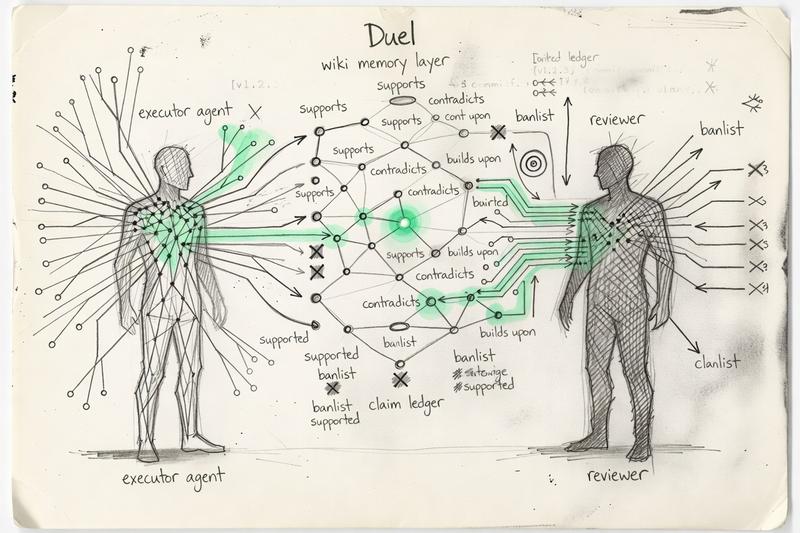
ARIS is an open-source research harness built around adversarial multi-model collaboration as the default operating mode. An executor (say Claude-family) drives the work. A reviewer from a different model family (GPT, Gemini, etc.) critiques every artifact using fresh threads and direct access to raw files rather than summaries. This cross-family adversarial setup is deliberate. Same-model self-review suffers from correlated blind spots. Different families probe weaknesses the executor never anticipated.
The real innovation is the persistent structured memory layer at the center of the system: a research wiki that maintains canonical pages for papers, ideas, experiments, and claims. These aren't loose notes. They carry typed relationships: extends, contradicts, addresses_gap, supports, invalidates, supersedes. The result is a lightweight knowledge graph that survives across sessions. Failed ideas become a banlist. Validated claims become foundations. The system learns in spirals instead of resetting to zero every time.
This structured memory is what enables true multi-agent collaboration over long horizons. Without it, each new session is stateless. The same dead-end idea gets re-explored, the same failure mode repeats. With it, agents build cumulatively. The wiki turns individual agent runs into collective institutional memory. Claims are tracked in a ledger that maps experimental evidence to final assertions in the paper. The assurance layer then runs a three-stage audit cascade: experiment integrity, result-to-claim mapping, and fresh zero-context manuscript audit by yet another model family. Unsupported or overreaching claims get pruned before they reach the final draft.
The execution layer adds over 65 composable skills defined as single-file Markdown documents with YAML frontmatter. These are portable across executors, version controlled, and community-extensible. Artifact contracts (standardized Markdown reports and JSONL event logs) create clear interfaces between skills. Figure generation is deterministic from JSON specs so visualizations are reproducible. The whole thing is designed for modularity and checkpointing, you can pause, inspect, resume, or fork a research thread without losing state.
Orchestration coordinates five main workflows (idea discovery, experiment bridge, auto review loop, paper writing, rebuttal) with configurable effort levels. The meta-optimization loop even analyzes past traces to propose harness improvements that are themselves reviewer-gated before adoption. The entire system treats the harness as the primary research object, not just a wrapper around models.
The implications for sovereign AI are direct. When your agents maintain a shared, queryable, versioned memory layer that records both positive claims and negative results, you escape the one-shot trap. Long-horizon work becomes cumulative instead of episodic. The adversarial reviewer from a different model family acts as an independent verifier, the AI equivalent of proof-of-work or multi-sig. You don't have to trust a single model's self-assessment. The system forces evidence to match claims through structured audits.
This is the same principle that makes Bitcoin robust: clear rules, verifiable state, independent validation. ARIS applies it to research. The wiki is the shared ledger. The typed relationships are the consensus rules. The cross-model review is the decentralized verification. The fact that the entire harness is open-source and portable (local GPUs, multiple executors, plain-text skills) means you can run it on your own infrastructure without vendor lock-in. The skills are designed so the community can extend them for robotics, hardware, grant writing, or domain-specific research without waiting for a central lab.
The paper itself was partially written by Aris. The authors manually reviewed and take responsibility, which is the honest posture. They don't claim the system is infallible. They claim it raises the bar on what "reliable" means for autonomous agents by making the failure modes explicit and the assurance machinery first-class.
For builders of multi-agent systems this is a blueprint. Structured memory isn't a nice-to-have when your agents are supposed to collaborate over days or weeks. It is the foundation that lets them accumulate knowledge instead of forgetting or repeating mistakes. Adversarial collaboration across model families isn't overhead, it is the mechanism that catches the blind spots single-agent loops miss.
The cost of plausible unsupported success is high in research. It is higher in production agents that make real decisions. ARIS shows one way to make the memory layer and the review layer explicit, machine-readable, and independent of any single model. That separation is what sovereignty looks like in practice.
The code and data are open. The skill format lowers the barrier for contribution. If your agents are going to work together over long horizons on your infrastructure, give them a shared structured memory and independent reviewers from the start. The alternative is watching them confidently build on sand.
Run your own Aris instance. Extend the wiki. Add domain skills. The harness that survives will be the one that treats memory, verification, and adversarial critique as architectural primitives rather than afterthoughts. This paper doesn't just advance autonomous research. It shows what reliable multi-model agent collaboration actually requires.