 ← All articles
The AI Utility Curve: Why Sovereignty Matters Most Where Precision Is Highest
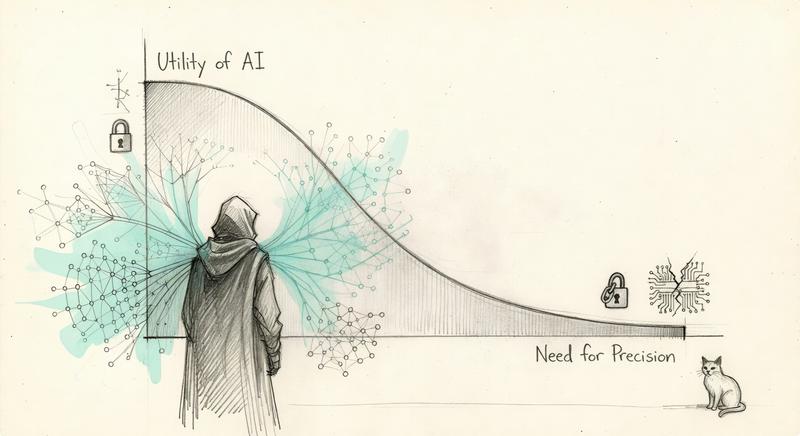
AI delivers its highest utility where the need for precision is lowest. As precision requirements increase, utility falls off sharply. This curve isn't a flaw in the technology, it's a map that reveals why sovereign, local-first AI is the only rational approach for anything that actually matters.
Look at the curve. It starts high on the left, where the need for precision is near zero. Brainstorming sessions. First-draft writing. Exploratory conversations. Summarizing vast piles of notes into something coherent. Here, AI is magic. It accelerates thought, surfaces connections you missed, and turns vague intuition into tangible output at shocking speed.
Move right along the x-axis. The need for precision grows. Now you're asking the model to produce code that controls physical systems, diagnose a medical condition, draft a binding contract, or calculate financial exposure where a single error costs millions. The curve drops. Not gradually at first, sharply. Then it flattens, suggesting that beyond a certain point, throwing more compute at the problem yields diminishing returns.
This isn't theory. It's the lived experience of anyone who's shipped AI into production. The utility peak lives in the fuzzy, creative, high-volume domain. The danger zone lives where precision is non-negotiable.
Most of the AI industry optimizes for the left side. Bigger models. More parameters. Massive cloud infrastructure. The entire narrative revolves around scaling intelligence without limit. And for the left side of the curve, that works brilliantly. But it creates a false impression that the same approach will eventually conquer the right side too.
It won't. Not without a fundamental change in architecture and control.
The right side of the curve demands something the big centralized models fundamentally cannot provide: verifiable trust, complete data sovereignty, and the ability to constrain behavior with guarantees rather than hopes. When the cost of hallucination is measured in human lives, regulatory fines, or lost contracts, "pretty good most of the time" is not good enough.
This is where sovereign AI becomes the default rational choice, not a philosophical preference. Running models locally or in your own infrastructure. Maintaining custody of your data. Implementing deterministic guardrails. Building verification layers that don't depend on the goodwill of a distant API provider. These aren't constraints. They are what let you safely operate further right on the curve than cloud-dependent systems ever could.
The hand-drawn graph that inspired this piece captures it better than any polished dashboard ever could. High utility, low precision: the domain of augmentation and creativity. Low utility, high precision: the domain that still belongs primarily to humans and to systems we fully control.
The future doesn't belong to whoever builds the single largest model. It belongs to those who understand this curve and build accordingly: small, specialized, sovereign systems that excel exactly where their operators need them most.
Consider real deployments. On the left side, a local 7B or 13B model running on a laptop or private cluster can outperform a frontier cloud model for personal knowledge work, creative iteration, and internal analysis. The latency is lower, the privacy is absolute, and the cost is predictable. You don't need the last 5% of capability when the task doesn't demand it.
On the right side, the equation flips. Here you see teams bolting on human review loops, complex retrieval systems, and multiple layers of validation, not because the models are stupid, but because the downside of a single confident error is unacceptable. Sovereign infrastructure changes the economics. When you control the stack, you can tune, constrain, audit, and verify in ways that are impossible when your intelligence layer is a rented black box.
This is not anti-AI. It's pro-reality. The curve doesn't lie. Most of the genuine economic and human value creation with AI will happen on the left and middle. The right side will be conquered incrementally, through better architectures, not simply bigger models. Open-source research, local inference engines, agentic frameworks that can call external verifiers, and yes, Bitcoin as an immutable trust layer for high-value agent interactions, all of these extend the usable portion of the curve without surrendering control.
At MindLink we see this daily. The clients who get the most out of AI aren't the ones chasing the shiniest frontier model. They're the ones who map their workflows against this curve, deploy sovereign systems where the utility is highest, and reserve human oversight and custom infrastructure for the precision-critical domains. The result isn't incremental productivity. It's compound advantage.
The graph should be required reading for every AI strategy session. It cuts through the hype and reveals the actual geography of value. The revolution isn't coming from a single model that does everything. It's coming from thousands of sovereign implementations that know exactly where they sit on the curve and operate there without compromise.
Ignore the curve at your peril. The organizations that thrive will be those that design their AI stack around it rather than pretending it doesn't exist. Sovereignty isn't a feature. On the right side of the curve, it's the prerequisite.
The paper is cream. The lines are imperfect. The insight is sharp. Print it. Pin it up. Let it remind you that intelligence without control is just another form of centralization. And we've had quite enough of that.