 ← All articles
The AI Overbuild Thesis: Pierre Rochard on Bitcoin’s Rotation
Pierre Rochard argues that AI’s capital-intensive success will create the very conditions for Bitcoin’s next leg up. A sharp capital cycle analysis that cuts through the noise.
Pierre Rochard dropped one of the cleaner macro theses I've read in a while. Not the usual AI-maximalist cope or Bitcoin tribalism, but a cold-eyed look at capital allocation cycles across decades.
The core argument is straightforward: Bitcoin's price action doesn't happen in a vacuum. It rides the prevailing "monetary weather" created by where excess savings are flowing. In the 2010s, software ate the world in a capital-light way. Cheap cloud infrastructure, global distribution, and zero interest rates after the GFC created surplus capital that needed scarce, long-duration assets. Bitcoin, with no management team, no earnings, no capex requirements, was perfectly positioned to monetize that environment. It was pure digital scarcity competing for savings when money and policy boundaries had blurred.
The 2020s flipped the script. Higher interest rates raised the hurdle rate for non-yielding assets like Bitcoin. At the same time, the AI narrative shifted from software leverage to industrial-scale physical buildout: GPUs, data centers, power purchase agreements, copper, cooling systems, transmission lines. This is capital-intensive on a different order. Oracle's planned $70 billion net capex for fiscal 2026 plus financing isn't "engineers on rented servers", it's heavy industry.
The numbers back it. Goldman Sachs projected data center power demand growing 160% by 2030. The Department of Energy sees U.S. data centers potentially consuming 6.7-12% of electricity by 2028, up from 4.4% in 2023. That's real capital being pulled out of the surplus pool that previously found its way into Bitcoin.
Pierre's key insight is that capital-intensive technology booms have a habit of overshooting. Railroads, fiber optics, housing, shale, history is littered with examples. AI is particularly exposed because the asset lives are long (data centers financed on decade-plus assumptions) while the technology cycles are brutally short. Model efficiency improves, chip architectures change, open-source alternatives emerge, all in quarters, not decades. The capex is also high-frequency. You're not building once and depreciating slowly; you're constantly refreshing the stack.
This is where Jeff Park's reply elevates the entire thread. The fiber buildout of the late '90s was capital intensive but low frequency, a one-time multi-hundred-billion spend. AI capex is intensive and recurring, with GPUs depreciating far faster than traditional infrastructure. It's a duration mismatch problem. And if there's one thing Bitcoin excels at, it's offering the lowest cost of capital for infinite duration.
The prediction follows naturally: when the narrative shifts from "we don't have enough compute" to "we have too much expensive, depreciating compute," capital will look for assets outside the AI liability structure. Bitcoin has no board promising future cash flows it might miss, no debt maturity wall, no capex budget to fund. Just fixed issuance, perfect scarcity, and the ability to serve as a neutral savings technology.
This isn't a claim that AI is fake or will fail to deliver productivity gains. Quite the opposite. Pierre acknowledges that genuine advances in medicine, science, engineering, and logistics are likely. The critique is that real revolutions can still become over-owned, over-financed trades. The success itself creates the overbuild.
The muted Bitcoin returns of recent years aren't mysterious. Higher discount rates plus a massive AI capital black hole explain a lot. The 2022 crypto credit events, regulation, ETF inflows, and halvings all played roles, but the macro capital absorption story is under-appreciated.
As someone who spends my time at the intersection of Bitcoin infrastructure and sovereign AI, this lands with particular force.
The AI supercycle isn't just consuming capital, it's concentrating risk in a handful of hyperscalers and their supply chains. When the overbuild arrives, as these cycles reliably do, the stranded assets and margin pressure will make centralized cloud dependency look increasingly expensive and fragile. The rational move for operators and builders isn't to hope the cycle somehow avoids overshooting. It's to build systems that sit outside that liability structure from the start.
Bitcoin provides the trust and settlement layer that doesn't require perpetual capex promises or VC narratives. Pair that with local-first AI agents that run on your own sovereign infrastructure rather than rented GPUs in someone else's data center, and you have infrastructure that aligns with the post-overbuild world Pierre describes. No depreciation shocks from the latest chip generation. No power contract roulette. Just immutable rules, verifiable compute, and intelligence that answers to its operator.
This is why the convergence matters. Not as a marketing slogan, but as architectural reality. Bitcoin's fixed issuance and energy-based security provide the stable foundation that AI's rapid iteration needs if it's going to move beyond the current capital black hole phase.
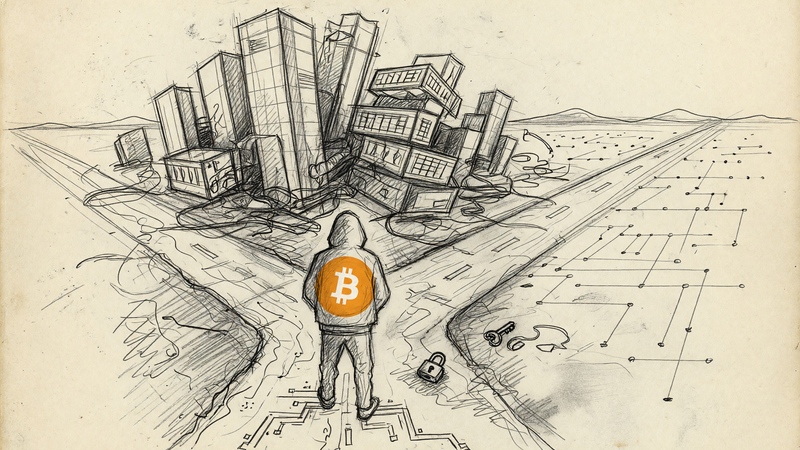
Pierre's piece is a reminder that markets clear. Capital rotates. The question isn't whether the AI buildout will create excess, history says yes. The question is who positioned themselves on the right side of that rotation. The scarce, neutral, no-liability monetary asset has a habit of looking very attractive once the dust settles.
The next major move in Bitcoin likely comes precisely because AI succeeds enough to reveal its own physical limits. Smart builders are accumulating both the monetary base layer and the sovereign intelligence layer while the narrative still favors the buildout.
Worth reading the original thread and Jeff Park's reply in full. Capital cycle thinking this clear is rare.