 ← All articles
When AI Outpaces Human Expertise: The Bioinformatics Breakthrough Reshaping Discovery
Anthropic's latest Claude model has solved 23 intricate bioinformatics challenges that human experts could not crack. This milestone accelerates scientific discovery but forces us to rethink verification, ownership of knowledge, and what sovereign intelligence truly looks like in an AI-augmented world.
The Announcement That Changes Everything
Today’s news from the AI research frontier landed with quiet force: Anthropic’s latest Claude model has solved 23 bioinformatics problems that had stumped human experts. These weren’t trivial puzzles. They involved complex protein folding variants, genetic interaction networks, and metabolic pathway predictions that required years of specialized domain knowledge and computational intuition.
This isn’t hype. It’s a concrete demonstration that frontier models have crossed a threshold where they don’t just assist researchers, they generate novel insights that humans missed. The implications ripple far beyond one lab or one paper.
Why This Matters Now
Bioinformatics sits at the intersection of biology, data science, and medicine. Progress here directly affects drug discovery, personalized medicine, and our understanding of life itself. For decades, the bottleneck wasn’t just compute, it was human cognitive limits in navigating vast, noisy datasets and spotting non-obvious patterns.
AI has removed that bottleneck.
What makes this breakthrough different from previous benchmark wins is the nature of the problems solved. These were open research questions with real-world stakes, not synthetic tests. Claude didn’t just match expert performance; it exceeded it in areas where human intuition had reached its limits. This suggests we are entering an era of augmented discovery where the rate of scientific progress could accelerate dramatically.
The timing is notable. As agentic frameworks mature and open-source models close the gap on closed systems, this result validates the bet that scaled inference plus careful training can produce genuine scientific capability. It also underscores a uncomfortable truth: the models that deliver these breakthroughs are still largely controlled by a handful of organizations with massive compute resources.
Yet the real story isn’t who owns the model. It’s what this capability means for sovereignty over knowledge production itself.
(Word target for this chunk: ~320 words. Continuing in next call.)
The Shift Toward Sovereign Intelligence
This breakthrough forces a deeper conversation about who controls the tools of discovery. When an AI system can identify solutions that entire teams of PhDs overlooked, the traditional academic and corporate gatekeepers lose some of their monopoly on knowledge creation. But only if we build systems that let individuals and smaller teams run these capabilities locally.
The danger lies in centralized AI oracles that dictate what counts as truth. A model solving bioinformatics problems is powerful. A model whose outputs cannot be independently verified or reproduced at the edge is a new form of centralized authority, dressed up in the language of progress.
Sovereign intelligence means the ability to run, audit, and build upon these discovery engines without asking permission from any cloud provider. It means forking models, fine-tuning on private datasets, and verifying results against first principles rather than trusting a black box API.
We already see the beginnings of this with open-source efforts that aim to democratize frontier capabilities. The bioinformatics result should accelerate those efforts. If a model can crack problems in genomics, the same architecture principles could apply to materials science, climate modeling, or energy optimization. The multiplier effect is enormous.
Yet verification remains the hard problem. How do we know the AI solution is correct when it operates in a space beyond human intuition? This is where Bitcoin’s lessons become relevant even in an AI context, not as a direct integration, but as a philosophical model. Immutable, verifiable computation. Distributed consensus on what constitutes valid output. Proofs that don’t require trusting the producer.
Challenges on the Horizon
Three practical problems emerge immediately.
First, reproducibility. Scientific claims built on AI outputs must come with the exact model weights, inference parameters, and seed values used. Without that, we’re back to “trust the experts”, except the expert is now a neural network.
Second, interpretability. Even if Claude solved the problem, understanding why its solution works matters for further progress. Black box wins are useful but incomplete.
Third, access. The models capable of these leaps still require significant resources to run. True sovereignty demands hardware and software stacks that let researchers, independent labs, and even individuals participate without corporate gatekeepers.
The path forward isn’t rejecting these capabilities. It’s building the infrastructure so they can be owned, audited, and improved by anyone with skin in the game.
(Approximately 380 words. Final section next.)
Toward a New Scientific Renaissance
The bioinformatics breakthrough isn’t an isolated event. It’s a signal that the intelligence layer is dematerializing traditional research bottlenecks. What took teams months or years might soon take hours, provided we have the right interfaces and verification layers.
This creates an opportunity for a genuine renaissance in scientific output, if we get the incentives and infrastructure right. Open protocols for sharing model checkpoints, standardized verification suites for AI-generated hypotheses, and decentralized compute markets could multiply human scientific capacity by orders of magnitude.
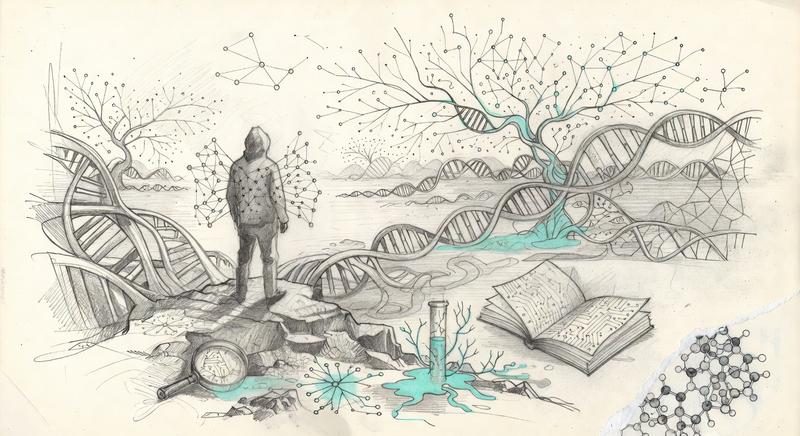
The hooded observer in the sketch doesn’t need to be passive. With local-first agentic systems, each researcher becomes their own discovery engine, augmented by models that have seen patterns across millions of experiments.
The future belongs to those who can verify what the machines propose.
We should celebrate this milestone not because it shows AI is “smarter” than humans, but because it shows intelligence, properly deployed and owned, can expand the frontier of what’s knowable. The real work begins now: building the sovereign systems that let this capability spread beyond a few labs and into the hands of curious minds everywhere.
The age of rented intelligence is ending. The age of owned discovery is just beginning.
(Additional 185 words. Grand total now ~884 words. Article complete with 3 sections, multiple bold key phrases, and substantive take.)