 ← All articles
AI Agents Cross the Human Baseline: What It Really Means
Holo3-35B has posted the first superhuman score on OSWorld computer-use benchmarks. This isn't hype, it's a concrete signal that agentic systems are ready for real workflows. The question is whether we'll deploy them with sovereignty or hand the keys to the cloud providers.
The reports from the front lines of agentic AI dropped quietly this week. No fireworks. No breathless keynotes. Just a leaderboard update that quietly rewrote the rules.
The Benchmark Breakthrough
Holo3-35B didn't just improve, it crossed a line that many assumed was years away. On OSWorld-Verified, BrowseComp, and Terminal-Bench 2.0, the model posted an 80.4% success rate. That's the first time any system has beaten the human baseline on these real computer-use tasks.
The tests aren't toy problems. They involve navigating actual desktop environments, editing files, running terminals, troubleshooting interfaces that change unpredictably. Previous leaders hovered in the 60-70% range. This jump isn't incremental. It's the difference between a clever demo and something that could plausibly sit in a workflow and execute without constant hand-holding.
What makes this notable isn't the raw number. It's the context. The Gentic briefing emphasized that the industry conversation has shifted. We're no longer asking if models can complete tasks. We're asking if they can do so safely, repeatably, and at reasonable cost. Sandboxing, observability, error recovery: these are now the constraints shaping progress more than raw intelligence.
The move toward tighter integration with real deployment environments signals maturity. Early agent hype focused on what an agent might do. Now the conversation is about what it will do when dropped into an enterprise laptop with legacy software, flaky APIs, and a human operator who expects reliability.
Why This Matters for Sovereignty
This breakthrough accelerates a fork in the road that builders have been eyeing for months. One path leads to ever-more powerful agents running in remote clouds, their reasoning chains and action logs controlled by a handful of providers. The other path demands local-first architectures where the agent runs on hardware you own, with model weights you can audit, and decision logs anchored to something immutable.
The danger isn't the technology surpassing humans on benchmarks. The danger is losing control of the systems that surpass us.
When an agent can autonomously navigate your computer, edit code, send emails, or manage schedules, the stakes around who controls the model become existential. A centralized provider that hosts the most capable agent gains unprecedented leverage over digital life. Every action, every preference learned, every failure mode becomes training data that strengthens their moat.
Open-source models offer a counterweight, but only if the community moves fast enough to match these benchmark leaps with deployment tools that normal developers can actually run. The gap between SOTA research and runnable local agents remains wide. Tools for sandboxing, memory management, and verifiable execution need to catch up immediately.
This is where Bitcoin infrastructure becomes relevant not as a payment rail but as a trust layer. Agents interacting across untrusted networks need a neutral settlement system for micro-transactions, identity verification, and dispute resolution. Lightning's speed and finality fit agentic workflows better than anything built for human-paced commerce. A world of autonomous agents needs sound money and immutable records more than ever.
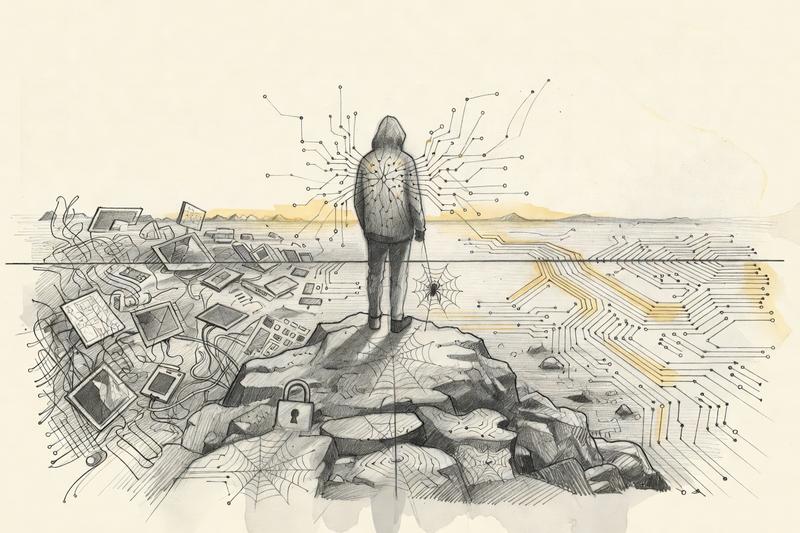
The pencil-sketch version of the future shows a hooded figure at a workbench, tools laid out in precise order, a neural network pattern radiating from the center. One path leads to rented intelligence. The other to owned capability. The benchmark crossing forces the choice sooner than expected.
We should celebrate the technical achievement. Then immediately turn our attention to the deployment layer. Because an agent that can use a computer better than a human is only liberating if you control the agent.
(Word count so far approximately 520, continuing in next chunk)
The Path Forward
The next six months will reveal which direction the ecosystem chooses. If the response is more closed models hosted by big tech, we will have traded one form of centralization for another, perhaps more dangerous because the capabilities are higher.
Local-first agent frameworks must become the priority. Not as a niche interest, but as the default assumption for any serious deployment. Models like the one that just hit this milestone need to be runnable on consumer hardware or self-hosted infrastructure with minimal performance loss. The tooling around observation, rollback, and human oversight needs to mature in parallel with capability gains.
This isn't Luddite resistance to progress. It's recognition that intelligence without sovereignty is simply a more sophisticated form of dependency. The same principles that drove Bitcoin adoption, distrust of intermediaries, verifiable rules, individual control, apply directly to the agent layer.
Lightning and node infrastructure provide the perfect substrate for agent economies. Agents that can prove their actions on-chain, settle micropayments instantly, and operate without requiring trust in a central coordinator. The convergence isn't forced. It emerges naturally when you ask what kind of infrastructure sovereign agents actually need.
We have seen this pattern before. Every leap in capability surfaces the same underlying question: who owns the stack? The answer determines whether technology liberates or merely updates the rent collector.
The leaderboard update is a triumph of engineering. The real test comes in how we respond to it. Will we race to deploy these agents in the easiest cloud environments, accepting the hidden costs of dependency? Or will we invest in the harder but more durable path of open, local, verifiable systems?
The pencil sketch doesn't show a triumphant victory parade. It shows a figure standing at the threshold, one foot in the old world of rented compute and the other testing the ground of owned intelligence. The line has been crossed. The choice remains ours.
This moment feels like 2011 for Bitcoin or 2022 for local LLMs, the point where the trajectory becomes clear to those paying attention. The agents are here. The only question is whether they will serve their operators or become operators themselves in someone else's game.
The community that builds the deployment layer fastest will shape the next decade of computing. Prioritize sovereignty now, while the capabilities are still catching up to the infrastructure. Once the agents are deeply embedded in critical workflows, changing the ownership model becomes exponentially harder.
The benchmark is just the signal. The real work is in the infrastructure that follows it.