 ← All articles
The Agentic Tipping Point: Local AI That Actually Works
Open-source models have crossed a threshold where complex agentic workflows run reliably on consumer hardware. This changes the economics, the privacy equation, and who ultimately controls intelligent systems.
I've spent the last year experimenting with agentic systems. The pattern was always the same. Promising demo, then brittle failure on anything longer than a few steps. Tool calls hallucinated. Memory leaked. The agent would confidently loop forever or give up.
That changed with the latest wave of open-source reasoning models. One particular release last week isn't being shouted from every rooftop yet. But those of us running local inference noticed immediately. The reliability jumped. Not by 10%. By enough that multi-hour autonomous workflows stopped feeling like science experiments.
The Reliability Threshold
What crossed the threshold isn't raw intelligence. It's the combination of better chain-of-thought in open weights, improved tool integration patterns, and memory architectures that don't collapse under their own weight.
Previous open models could mimic the surface of reasoning. These new ones sustain it. They maintain context across tool uses without the classic drift. They know when to stop, when to verify, when to escalate to a human. Small things. But they compound.
The benchmarks tell part of the story. On agentic suites that measure success rate over 50+ step tasks, the gap between the best closed models and the new open ones has narrowed to single digits. And that's before you factor in latency and cost. When your agent runs on hardware you own, those metrics look very different.
The implications hit different when you run it yourself. No rate limits. No surprise billing when your agent decides to think for 40 seconds on a problem. No data leaving your network. You can iterate on the system prompt, the tools, the memory schema without asking permission.
This is what sovereign AI was always supposed to look like. Not a marketing term. A practical reality where the intelligence layer belongs to the operator.
What Sovereignty Actually Costs
The old objection was always hardware. You needed a datacenter to run anything useful. That's no longer true. With quantization and efficient architectures, a decent GPU or even a cluster of consumer machines can host agents that outperform last year's cloud offerings on specific tasks.
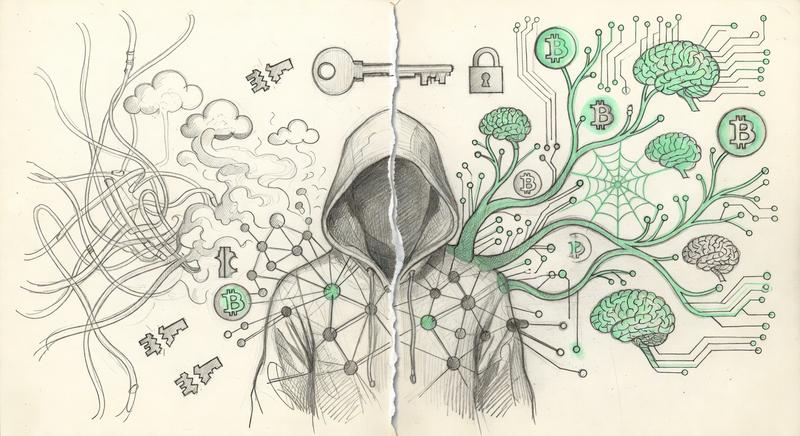
The real advantage isn't even the performance numbers. It's the optionality. You can fork the model. You can train on your proprietary data without feeding it to someone else's trainer. You can connect it to your own tools, your own verification layers, your own Bitcoin-anchored oracles if you want immutable records of decisions.
This is where the convergence becomes interesting, though I won't force it. The point stands on its own: intelligence that you control is different in kind from intelligence you rent.
There are still hard problems. Long-term memory that doesn't hallucinate its own history. Reliable multi-agent coordination without central orchestration. Guardrails that don't neuter capability. These releases don't solve everything. They just move the frontier enough that serious builders can start shipping instead of prototyping.
The Lingering Question
The question isn't whether local agents will work. They already do, for enough use cases to matter. The question is what we'll do with the freedom.
Most organizations will still choose the path of least resistance and rent their intelligence from the big providers. That's fine. Convenience has always won short term.
But for those who value control over their most valuable asset, their decision-making systems, the door is open wider than it was last month. The models are good enough. The tooling is catching up. The hardware is accessible.
We're moving from "can we run an agent locally" to "what kind of agent do we want to own."
That shift matters more than any single benchmark. Because once you own the intelligence, you start asking different questions about what it should optimize for. Your questions. Not theirs.
The age of rented minds is ending, one open-source release at a time. The only question left is whether we'll seize the tools while they're still free to shape.